To tell someone your travel plans for safety, send one trusted person a short written plan: where you are staying, how you are getting there and getting around, what you plan to be doing, and the exact time you will check in next. Then send a brief check-in at that time, and agree in advance what they do if one goes missing.
That is the whole system. It takes about ten minutes to set up before you leave, and about fifteen seconds a day to keep it running.
I have sent versions of this message more times than I can count, and the version that works is boringly short. The long versions, with day-by-day listings and a map link for every hike, are the ones nobody reads. A contact who has not looked at your plan since you landed cannot tell whether something changed or whether you simply fell asleep on a bus.
One thing to clear up first: sharing plans does not invite trouble. It is the absence of a plan that leaves a search starting from scratch. Knowing where you were supposed to be, and when, turns an unexplained disappearance into a time-stamped lead that police, a hostel manager, or a missing-person service can actually work with.
Table of Contents
- What You Need
- Step-by-Step
- Frequently Asked Questions
- How often should I check in while traveling?
- What should I include in a travel itinerary I send home?
- Is it safe to post my travel plans on social media?
- What happens if I miss a check-in while traveling?
- What if I have no one at home to tell?
- Do I need a location tracking app, or is a text message enough?
- Conclusion
What You Need
You need five things, and four of them take under a minute.
- One trusted person. Ideally two, but one who answers is worth more than five who do not. Pick someone calm, reachable across time zones, and willing to act rather than panic.
- Your accommodation details. Property name, address, and the phone number of the front desk or host. A photo of the booking confirmation works well.
- Your transport details. Flight or train number, arrival time, and how you are getting from the airport or station to the door.
- The local emergency number and your embassy or consulate contact. Write these into the message, not into your phone only.
- A check-in time, and a channel that works without data. SMS to a phone number beats an app your contact has never installed.
Keep a digital copy of your passport, insurance details, and prescriptions somewhere reachable from another device, and tell your contact where to find it. That single line does more for an emergency than any app.
Step-by-Step
How to Tell Someone Your Travel Plans for Safety: Choose the Right Person
Choose for response, not for closeness. The right contact is someone who will answer an unknown number, will not post your details in a group chat, and can act on bad news without messaging you first.
Set the expectation in the same conversation where you ask. A good frame: here is my plan, here is when I will check in, and if you have not heard from me by 10am my time, this is what I want you to do. That last sentence is the part most people skip, and it is the part that stops a delayed bus from turning into a police call.
Tell them plainly that you are not tracking your location and will not be reporting every hour. Saying it up front removes the awkwardness of a two-week silence that was never a plan in the first place.
Share the Essential Travel Details
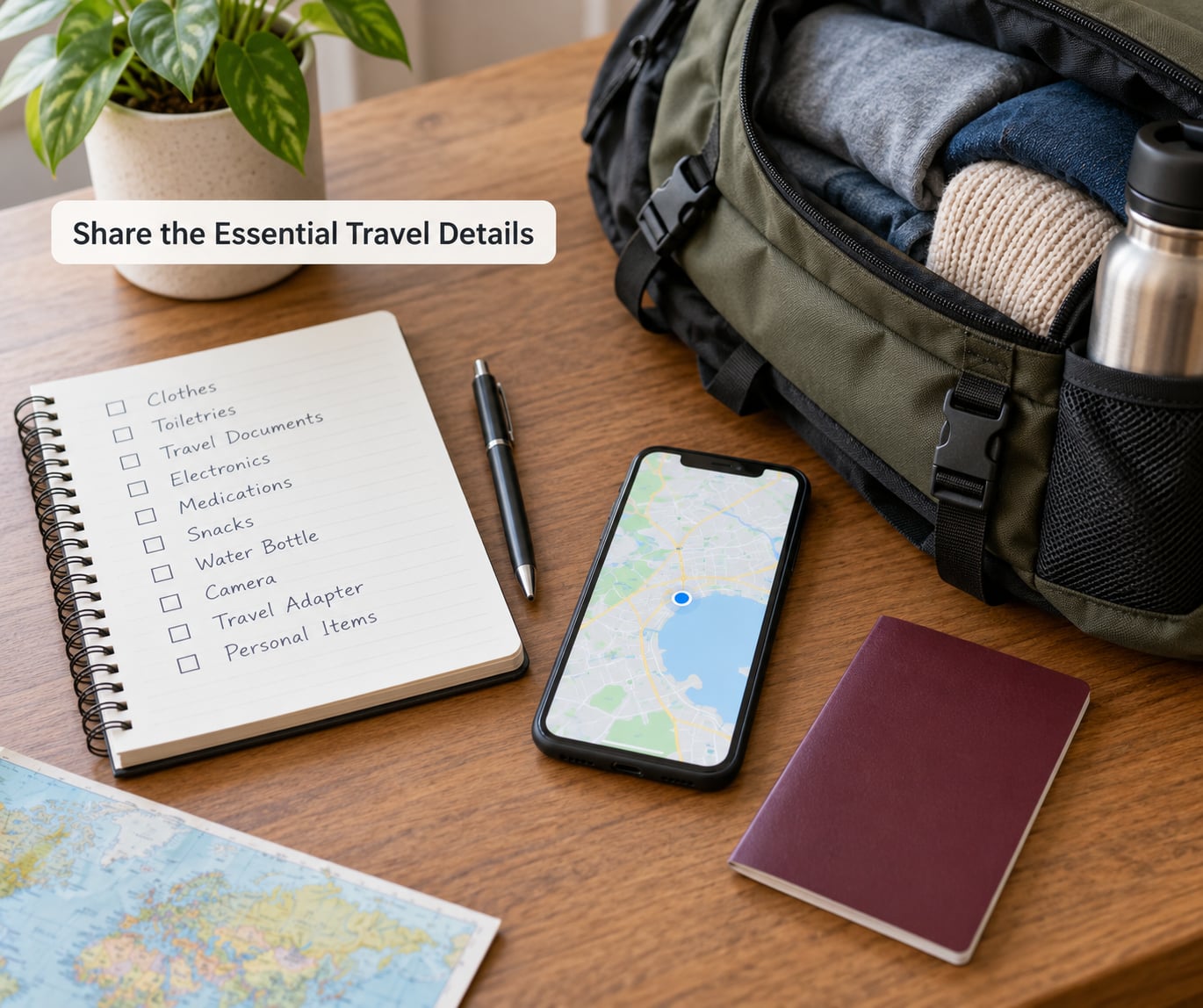
Six items, and you can type them in under a minute. Everything else is optional.
- Where you are going and until when. Country, cities, and return date. If the return is open-ended, give a date you plan to be home by.
- Where you are staying. Name, address, check-in date, and the direct phone number.
- How you are getting there and around. Flight or train number, arrival time, onward transport.
- What you are doing. One line. A week of hiking, a few cities, some work. Enough for a stranger to place you.
- When you will check in next. A specific time, not “tomorrow”.
- What to do if you miss one. The escalation instruction from the step above.
Here is the template I keep in my notes app, with the placeholders filled in at the airport:
Hi — travelling to [city/country] from [date] to [date]. Staying at [property name, address], phone [number]. Arriving on [flight/train] at [time], then getting to the accommodation by [transport]. Plan is [one line about what you are doing]. I’ll message you a check-in every evening by [time, time zone]. If you haven’t heard from me by [time] the next day, please call the property first, then [host’s name, relationship]. Emergency services in [country] is [number]. My passport and insurance copies are in [where].
Send it by text or message, not email, if you can. Email sits unread in an inbox for days, and a text thread also gives you somewhere to send the daily check-ins.
Set Check-In Times and Backup Methods
One fixed time a day, in the evening, in your local time zone, works better than a promise to check in “when I can”. Evening messages get answered; 6am ones do not.
Build in a grace period. If your check-in time is 8pm, tell your contact to do nothing until 10pm, then call the property, then try your backup channel. Most missed check-ins are a dead phone or a bus with no signal, and a two-hour buffer absorbs almost all of them.
Pick a backup channel before you need one, and choose it for the worst part of your trip rather than the best.
| Method | What your contact sees | Effort for you | Privacy | Works without data |
|---|---|---|---|---|
| Text message | Everything, only when you send it | 15 seconds | High | Yes, over SMS |
| Email or shared note | Everything, including a file they can forward | Two minutes | Medium | Only on Wi-Fi |
| One-off live location link | A point on a map, expiring on a set date | 30 seconds | Medium | Needs data |
| Check-in app | A daily tap, alert if you miss it | One tap a day | Medium | Usually, via SMS |
| Continuous GPS sharing | Your route, live | Battery and privacy | Low | Varies |
| Timed email that sends unless cancelled | A warning, and then your plan | Set up once per trip | High | Yes |
Most solo travelers land somewhere in the middle: a text thread for the routine check-ins, plus a timed email that goes out with your plan attached if you go quiet. The timed email is the only method that works when your phone is broken, out of battery, or at the bottom of a bag you cannot reach.
Decide in advance what a missed check-in actually triggers, in this order: call the property, then your second contact, then local emergency services or your embassy, then a formal missing-person report with the details you already sent. Write the order down in the original message so nobody has to improvise at 3am.
Update Your Contact When Plans Change
Send a one-line update whenever a material change happens: a different city, a different property, a delayed flight that moves your arrival, a gap in coverage, or a day of deliberate silence.
The format is simple and does not need explaining: Update — moving to [place] tonight, staying at [property], back on the [date] plan. Twenty words, and your contact now holds a current plan instead of a stale one.
You do not need to share live location to do this well. A one-off link that expires in 24 hours covers the “get me a taxi” or “which train are you on” moments without handing over a permanent map of your life. Forum threads on r/solotravel and r/travel treat always-on tracking as a last resort, and the objection there is rarely about safety — it is about autonomy, battery, and not being watched.
Wait until you are home before posting photos of the route, the accommodation, or the gear that made the trip easy. Several travelers describe losing items from rentals after a detailed public post. Safety information and holiday content can travel on different timelines.
Common Mistakes
Sending the plan too late. People send it the night before, forget half the details, and update it again from an airport. Send it when the bookings are made.
Vague details. “Staying in the centre of town” is useless at 2am. An address plus a phone number finds a door; a neighbourhood description does not.
No missed-check-in instruction. This is the most common failure. Your contact has no idea whether to call you, wait, or start phoning hotels, and they will default to the most anxious option.
Relying on one channel in a place with no signal. Mountain passes, ferries, and cheap roaming plans break apps. SMS survives more of the trip than anything else.
Making the recipient install something. The most common answer in the travel forums is some version of “my mum will not download an app”. Pick a method that works on a phone she already owns.
Treating it as surveillance. Frame the check-in as a safety net for the one bad day, not as monitoring. Contacts who expect a report every hour will start expecting an explanation every hour.
Frequently Asked Questions
How often should I check in while traveling?
Once a day at a fixed time, usually in the evening where you are, plus an extra message whenever the plan changes materially. Twice a day is reasonable for hiking, remote areas, or long solo drives. More than that adds little unless the route is genuinely remote, because frequency matters less than having a pre-agreed consequence attached to a missed check-in.
What should I include in a travel itinerary I send home?
Six things: where you are going and until when, where you are staying with its address and phone number, your arrival and onward transport, one line on what you are doing, the time of your next check-in, and what your contact should do if you miss one. Add the local emergency number and where your passport and insurance copies are stored.
Is it safe to post my travel plans on social media?
It is safer not to, while you are still on the road. Posts with real-time locations, accommodation names, and dates tell a stranger which properties you have chosen and when you will be alone there. Forum travelers report items going missing after detailed public posts. Save the trip photos until you are home and share plans privately instead.
What happens if I miss a check-in while traveling?
Nothing should happen until the deadline you both agreed on. After that, your contact calls the property, tries your backup channel, then contacts a second person, then local emergency services or your embassy. Formal missing-person reporting comes last and needs the itinerary you already sent, which is why the message before departure matters more than any app.
What if I have no one at home to tell?
Many solo travelers do not, and it is more common than the forums suggest. Options include a close friend who is not family, a scheduled check-in with a travel buddy on a fixed app, your work or a club or study group, and the staff at a hostel you are returning to for several nights. A recurring booking is a useful safety net because someone expects you back.
Do I need a location tracking app, or is a text message enough?
A text message is enough for most trips, and it is the option that survives poor signal and recipients who will not install anything. Tracking apps help when you are moving through unfamiliar places at odd hours or need a ride traced. Solo travelers on forums treat always-on sharing as a last resort rather than a default, largely for battery and privacy reasons.
Conclusion
Three things, in order. Pick one person who will act rather than panic, and tell them what to do if you go quiet. Send them the six details, including an exact address and a specific check-in time, before you book anything else. Then send one short message a day and one more whenever the plan moves.
That is how to tell someone your travel plans for safety without turning your trip into a surveillance exercise. Ten minutes of setup buys someone at home the one thing they would otherwise never have: a place to start.