Plan on 1 gallon of water per person per day for a normal road trip, and 2 gallons per person per day when you are in the desert, far from towns, or spending long days hiking. That single gallon has to cover drinking, cooking, washing dishes and basic hygiene, not just sips from a bottle.
The reason the numbers look thin is weight. A gallon of water weighs 8.3 pounds, so 20 gallons for a family of four on a five-day trip is 166 pounds sitting in your vehicle. That is why the answer is not simply “pack more.” It is pack enough, then pick a base rate that matches your route.
I have planned and driven enough long routes to know where most trips go wrong: people count drinking water only, then discover on day three that a stuck traffic jam, a 100-degree stretch, or a campsite with no water hookup wiped out the margin. Here is the math, adjusted for the situations that actually come up.
Table of Contents
- How Much Water to Pack Per Person for a Road Trip: Quick Guide
- How to Calculate Your Road Trip Water Needs
- Recommended Water Amounts by Trip Length
- How Much Extra Water to Pack in Hot Weather
- Water Packing Tips for Families and Groups
- How to Store Water Safely in Your Car
- Frequently Asked Questions
- How much water should I pack for a one-week road trip?
- Is one gallon of water per person per day enough for a road trip?
- How much extra water should I carry in a desert or during hot weather?
- Can I refill water bottles at gas stations along the way?
- How should I store water in a car during a road trip?
- How can I reduce the amount of water I need to pack?
- Start With One Gallon, Then Adjust
How Much Water to Pack Per Person for a Road Trip: Quick Guide
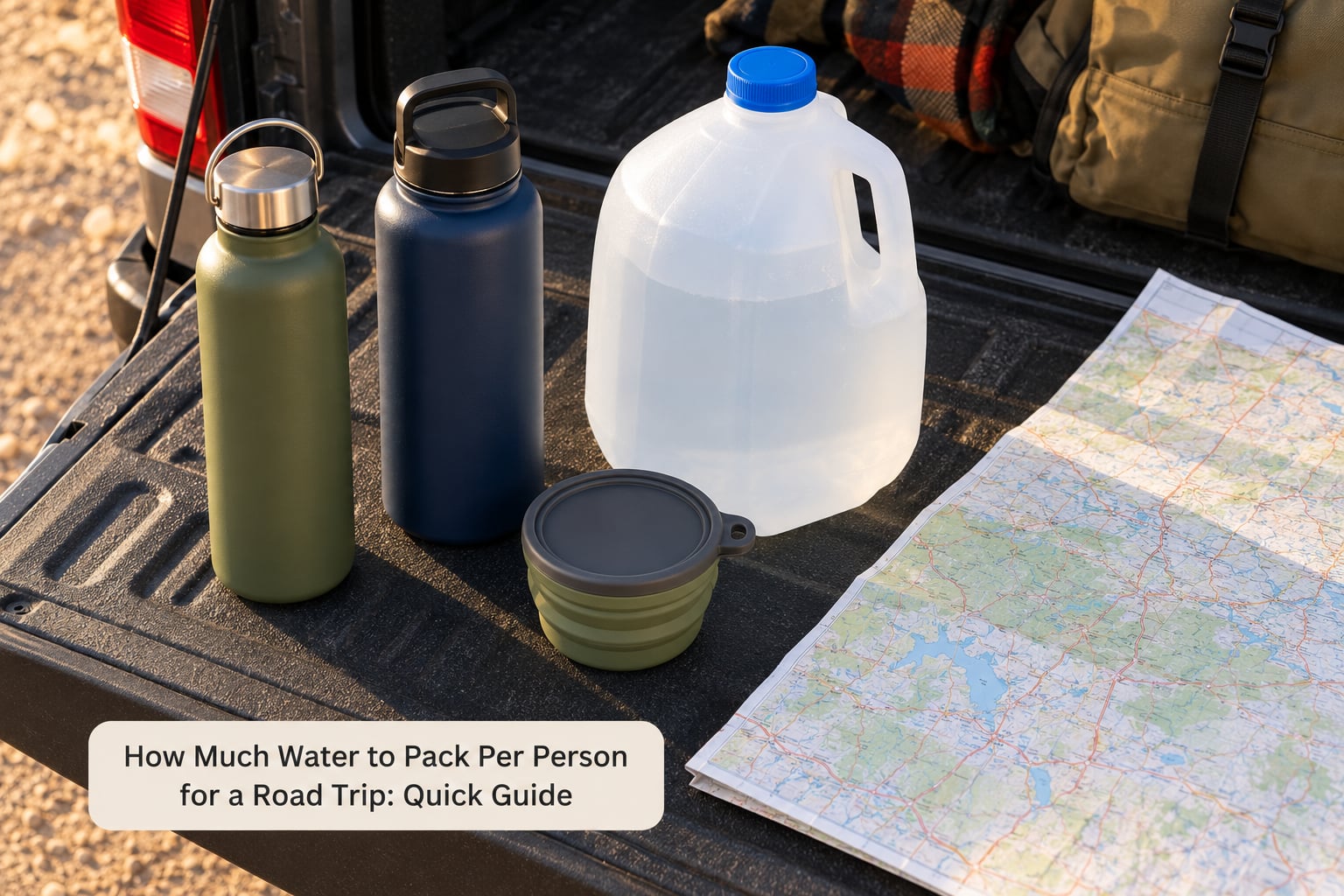
The short version of how much water to pack per person for a road trip comes down to trip length. Use the table below as your starting point, then adjust for heat and remoteness.
| Trip length | Gallons per person | What that assumes |
|---|---|---|
| Same-day drive, under 4 hours | 0.5 gallon | Restaurants, service stations and water coolers along the way |
| Overnight, 1 to 2 days | 1 to 1.5 gallons | A couple of refills on a normal highway route |
| Weekend, 2 to 3 days | 2 to 3 gallons | One reliable refill point at the destination |
| One week, 7 days | 4 to 5 gallons | Car camping or motels with a tap in the room |
| Two weeks or longer | 8 to 10 gallons | Long stretches between towns, or boondocking |
The formula behind those numbers is simple enough to do in your head: people multiplied by days multiplied by your base rate. Two people, five days, one gallon each is 10 gallons. Add roughly 20 percent for a reserve, and you are at 12.
The CDC and the National Park Service both publish one gallon per person per day as the emergency preparedness figure. Camping and overlanding guides usually quote two gallons, because they assume you are cooking over a fire and washing up at a campsite. Both numbers are right for their own situation, which is why the base rate depends more on your route than on the length of your trip.
How to Calculate Your Road Trip Water Needs
Start with the base rate and then walk through the factors one at a time. Most adjustments you make will be small, a quarter gallon here and half gallon there, and they add up faster than you would expect.
Daily drinking baseline
Most adults land somewhere around half a gallon of fluid a day under normal conditions, and more when they are generating heat. Mainstream guidance puts total water needs for a sedentary adult near 2 to 3 liters, roughly 0.5 to 0.8 gallons, before you count cooking and cleanup water at all.
That is why the drinking-only number is a trap on a road trip. A gallon per person is roughly double what a person drinks sitting still, and the difference is where cooking, dishes and washing go.
Driving days vs activity days
This is the adjustment most road trip articles skip. A day spent in the car is a low-water day even in summer, because you are seated, shaded and moving through air conditioning. A day where you hike four miles, paddle a kayak or spend an hour at a hot spring is a completely different drink.
Count driving days at 0.75 gallon per person and activity days at 1.5 to 2 gallons per person. On a two-week trip with three real activity days, that spread of rates is often more accurate than picking one number and hoping.
Temperature, sun and altitude
Heat raises fluid needs because you lose more through sweat, and the effect shows up fast once the thermometer passes 90 degrees. High altitude is its own adjustment, since thin air makes deep breathing and increased fluid loss common in the first few days at elevation. Anyone coming from sea level to a mountain pass in summer should treat the first two days as activity days.
Access to refill points
This is the factor that moves the answer the most. Water you can buy or borrow along the way does not need to ride in the car from your front door. Count the reliable stops on your actual route, not the ones that exist in theory.
National park developed areas, highway rest areas with potable fountains, most chain gas stations and practically every campground with a water hookup count as reliable. A creek is not a refill point until you have a way to make it safe, and a small town gas station with a single pump and a slow well is a risk, not a plan.
Non-drinking water uses
Budget a few gallons across the trip for everything that is not a drink. Camp coffee and tea, instant noodles, rinsing pots, washing hands before eating, brushing teeth and a sponge bath all draw from the same supply.
Dehydrated meals cut this line item more than anything else. A pouch of freeze-dried food needs about half a cup of hot water, while a canned stew needs close to a cup and a half, and the difference adds up when you are eating one of each every night.
Pets
A dog or cat needs roughly half a gallon to a gallon per day depending on size and heat, and a large dog in the desert can drink more than a person. For a family of four with a large dog on a five-day trip, add 3 to 5 gallons and put a bowl in the vehicle rather than only at the campsite.
Weight and space
Every gallon adds 8.3 pounds, and every rigid jug takes up the same trunk space whether it is full or empty. That is why overpacking feels expensive long before it feels dangerous. Ten extra gallons you never touch is 83 pounds of dead weight in the back of the vehicle.
Recommended Water Amounts by Trip Length
Here is the calculation table most road trippers actually want: total gallons for a given number of travelers and a given number of days, at the one gallon per person per day base rate.
| Travelers | 3 days | 5 days | 7 days | 10 days |
|---|---|---|---|---|
| 1 person | 3 gallons | 5 gallons | 7 gallons | 10 gallons |
| 2 people | 6 gallons | 10 gallons | 14 gallons | 20 gallons |
| 3 people | 9 gallons | 15 gallons | 21 gallons | 30 gallons |
| 4 people | 12 gallons | 20 gallons | 28 gallons | 40 gallons |
Read that table as the amount you consume, then add a reserve on top. Twenty percent is a good rule for routes with frequent towns, and 50 percent is closer to right for anything crossing a desert or high desert stretch. An overlanding couple I followed planned 20 gallons for a five-day Baja run, two people at two gallons a day, and treated the extra half as a margin they hoped never to spend.
One expedition forum regular did the same math a different way: a gallon a day for drinking plus a gallon a day for washing, which came to 56 gallons for two people over 14 days. That figure is honest about how quickly dishes and cleanup accumulate, and it is why an empty gallon jug is a genuinely useful packing item.
Now subtract for refills. A five-day trip through towns every day might only need four gallons riding along if you are disciplined about topping up. The trick is deciding in advance which stops are refills, because a half-full jug discovered on day four tells you nothing useful.
How Much Extra Water to Pack in Hot Weather
Add half a gallon per person per day once daytime highs reach the low 90s, and add a full gallon per person per day above 100 degrees, especially on desert routes with no shade and no services for stretches of 100 miles or more. Summer traffic stops are part of the same problem, since a car sitting in the sun with the windows up generates heat quickly.
Several things drive water use up at once on a hot road trip. Running the air conditioning hard, sitting in traffic for hours, and a day that includes a hike or a swim all stack on the same day. If two or three of those land together, treat that day as a 2 gallon day for that person, no matter what the route average says.
Keep the planning water and the emergency reserve separate, because they solve different problems. Planning water is what you drink and cook with. The reserve is a sealed container nobody touches, and it exists for a breakdown, a detour, a closed road, or a campsite that turns out not to have a working tap.
Overlanding forums commonly report 3 gallons per person per day in the desert, and that is not crazy talk when the nearest reliable source is a day away. It is also 25 pounds per person per day, so it belongs in a trip with a real reason for going remote. For a family trip through the Southwest where you are never more than 90 minutes from a town, one gallon plus a reserve is usually plenty.
Water Packing Tips for Families and Groups
Children and older travelers need more attention than the average adult figure suggests. Kids drink less than adults overall but lose water faster in the sun, and a bottle they can actually reach matters more than a jug they cannot. Refillable bottles in the back seat, not one jug everyone shares, cut down on the number of times the car has to stop.
Groups sharing a vehicle should split the water rather than pool it. Two people in a car with 12 gallons can carry six each in their own space. It is easier to load at the trailhead, and if one jug gets contaminated the rest of the supply is still fine.
Watch for anyone with a medical condition that restricts fluid intake, and anyone taking medication that increases sun sensitivity. For the second group, water and sun protection are a safety issue, not a comfort one, and the amount they carry should be based on what they can drink, not on the group average.
Food counts more than most people give it credit for. Watermelon, oranges, cucumbers, grapes and tomatoes carry a large share of their weight in water, and eating them on a hot driving day genuinely reduces how much you drink. This is a small effect, but on a trip where every pound matters, it is a free one.
Freezer jugs are worth using if you have a freezer the night before you leave. They freeze solid, do not slosh around, and act as their own cold pack for the first few hours of the drive. They also stop people from making a habit of hitting the vending machine every hour.
How to Store Water Safely in Your Car
Keep water out of direct sun and out of a closed vehicle in hot weather for long stretches when you can avoid it. A parked car in summer can climb well past the temperature outside, and that heat plus plastic is what makes travelers uneasy about the supply, sometimes justifiably and sometimes not.
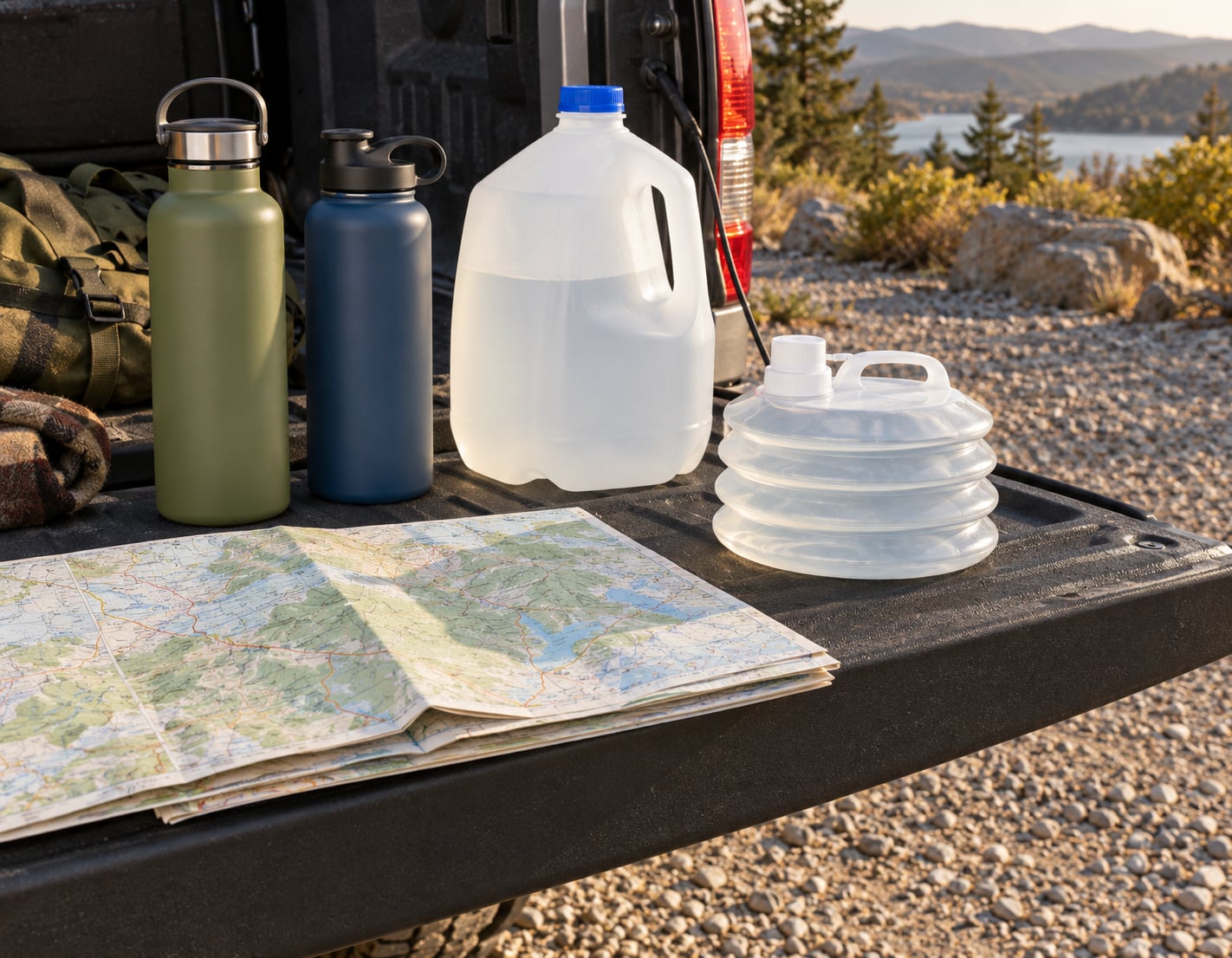
Use containers intended for food and drinking water, and replace any that have been in a hot trunk for years or have a container that is not rated for what you are putting in it. If you are filling jugs at home, a clean five-gallon jug you have used for water and kept for that purpose is the standard, boring, correct choice.
Leave headroom in every container. Water expands when it freezes, and a completely full jug left overnight in a mountain campsite can split. If you keep anything in a vehicle overnight in freezing conditions, fill containers about three quarters full and keep the lid loose until the ice has settled.
Stop the jugs from moving around. A gallon bouncing behind the passenger seat in a panic stop is a shattered container and a soaked interior. A rubber mat, a plastic crate, or a five-gallon container with a molded base that sits flat is worth the extra minute of loading.
Your cooler melt water counts. People treat cooler water as a bonus, and it is, but the cleaner version of that thinking is to run the melt through a filter and count it toward your reserve. It is unaccounted-for water in most plans, and a spare collapsible container catches it for hand washing at the campsite.
Carrying a filter changes the whole calculation. A backpacking microfilter or a small pump filter lets you turn clean-looking water from a stream, a campground spigot or a roadside spring into drinking water, which means you can carry noticeably less and stop treating every refilling stop as a risk. A backup iodine or chlorine treatment covers you when the filter fails.
For anything beyond basic planning, follow the guidance in the CDC and Wilderness Medical Society advice on water treatment, and check current rules for the parks and border areas you drive through. Some land requires you to carry your water in, and local rules beat any article, including this one.
Frequently Asked Questions
How much water should I pack for a one-week road trip?
At one gallon per person per day, a one-week trip is 7 gallons per person, plus about 20 percent for a reserve. A family of four would load roughly 34 gallons, or about 282 pounds. If you will pass through towns daily and can refill at service stations or campground taps, you can often cut the carried amount to 4 gallons per person and top up as you go.
Is one gallon of water per person per day enough for a road trip?
One gallon per person per day is the baseline that covers drinking, cooking and basic hygiene on a route with regular refills, and it matches the CDC and National Park Service emergency preparedness figure. On desert routes, in summer heat, or on days with heavy activity, plan 2 gallons per person per day and hold an extra reserve for breakdowns.
How much extra water should I carry in a desert or during hot weather?
Add half a gallon per person per day when daytime highs sit in the low 90s, and a full gallon per person per day above 100 degrees, particularly on routes with long gaps between services. Forum travelers report carrying 3 gallons per person per day in true desert, but at 25 pounds per gallon per day, that amount only makes sense when the nearest reliable water source is more than a day away.
Can I refill water bottles at gas stations along the way?
Usually yes. Most chain gas stations, many rest areas and nearly every developed campground have potable water, though independent stations can be slow or have a weak well. Restroom sinks and drinking fountains are not treated as a supply in an emergency. Fill up every time you are under two gallons per person, and never count on a single stop per day in a remote area.
How should I store water in a car during a road trip?
Keep containers shaded, use food-grade water jugs you have used for water, and leave about a quarter of each container empty so freezing water cannot split it. Stop jugs from sliding with a crate or rubber mat. In hot weather, park in the shade when you can, and do not keep a supply in a sealed vehicle for days on a cross-country leg.
How can I reduce the amount of water I need to pack?
Carry a microfilter or pump filter so you can treat water from streams, campground spigots and roadside springs, and choose a route with frequent towns. Dehydrated meals need about half a cup of water each, much less than canned food. Eating water-rich produce, using freezer jugs, and washing dishes with a low-flow rinse all cut the total meaningfully.
Start With One Gallon, Then Adjust
Multiply your traveler count by your days and the base rate, add your reserve, and then walk the route and subtract the refills you can genuinely count on. Write that number down before you pack, because it is the number that keeps a normal road trip from turning into a logistics project.
If your trip crosses a desert, climbs into the mountains, or includes more than two full days of hiking, start from 2 gallons per person per day instead. The extra weight is the point, not a mistake.