Staying warm sleeping in a van comes down to four things: cut heat loss, add a controlled heat source, trap your own body heat in layers, and keep moisture out of the air. Get those right and a 30°F night is genuinely manageable, even in an uninsulated van.
The reason vans get cold so fast is boring physics. A metal shell with single-pane glass has almost no resistance, so interior temperature falls toward outdoor temperature within a few hours, and the floor is the coldest surface in the vehicle. Insulation slows that loss, a heater replaces what leaks out, and bedding traps the pocket of warm air around you — most of the warmth you actually feel comes from that trapped air, not from the temperature of the air moving through the van.
This guide is written around one night, not around a whole build. You can work through the six steps below with almost no gear on a first cold night, then add the expensive pieces as the nights get colder.
Table of Contents
- What You Need
- Step-by-Step: How to Stay Warm Sleeping in a Van
- Common Mistakes
- Frequently Asked Questions
- What sleeping bag temperature rating is appropriate for sleeping in a van?
- Is it safe to use a heater while sleeping in a van?
- How do I stop condensation from making my van feel cold?
- Do I need extra insulation if my van already has a thick mattress?
- How can I stay warm in a van if I am sleeping in freezing temperatures?
- Conclusion
What You Need
Most gear lists bury you in options. Skip that. Buy in this order, because each item only works if the step before it works.
- Floor insulation under the sleeping area. A closed-cell foam pad is the single highest-impact item on this list. Conductive loss through the floor is relentless.
- A sleeping mat above it. Comfort, not warmth. You cannot sleep well on bare foam, so this is not optional in practice.
- Insulated window covers for every pane. Glass is the weakest part of the shell, and covers are cheap, removable and endlessly reused.
- A draft strip for the sliding door and any window gaps. Cheap, small, and it makes the other insulation work.
- A sleeping bag or quilt rated below your expected overnight low, plus a base layer. Rating is a temperature number, not a comfort vibe.
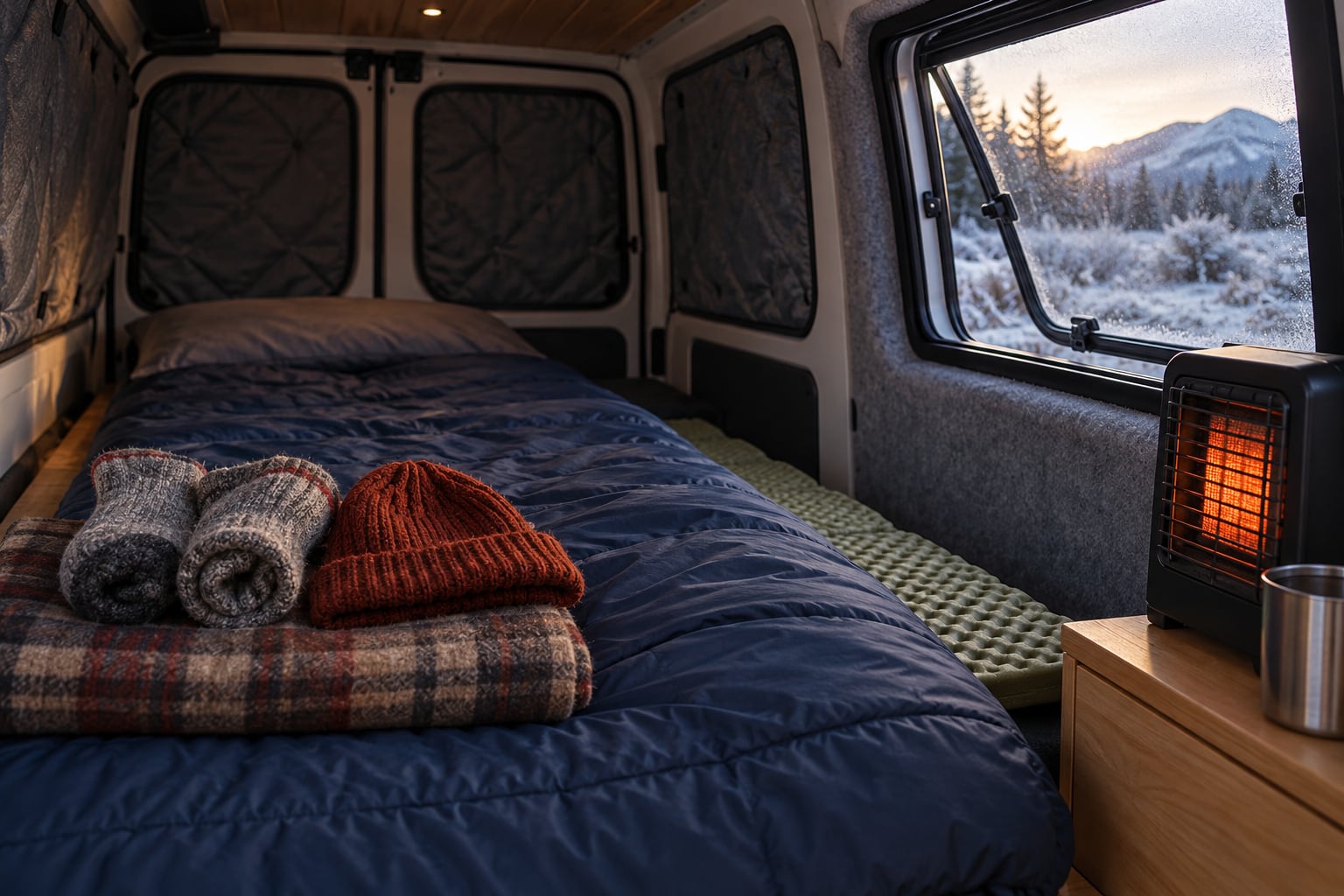
- Wool socks, a warm hat and spare dry layers. Feet and head are where sleepers lose heat first.
- A towel or microfiber cloth for condensation. Wipe surfaces before sleeping, not in the morning.
- A working carbon monoxide detector if you will run any combustion heater. Non-negotiable, and cheap.
Optional until you know your van: a diesel heater, a propane heater, an electric blanket, a hot water bottle, heat tape on plumbing lines, and wool or synthetic insulation in the walls and ceiling. You can sleep comfortably for many freezing nights with the first eight items alone. You add a heater when the outdoor low drops below what your bedding and clothing can hold.
That threshold depends on how well the van is insulated and how cold you personally run, so use this as a starting map rather than a rule:
| Outdoor low | What gets you through |
|---|---|
| Above 50°F (10°C) | Window covers, floor pad, liner, hat and wool socks. No heat source needed. |
| 32-50°F (0-10°C) | Add wall or ceiling insulation, a mid-weight bag or quilt plus a blanket layer, and a hot water bottle. |
| 10-32°F (-12-0°C) | Heating source strongly recommended. Down bag rated to single digits plus a pad with real R-value. |
| Below 10°F (-12°C) | Treat it as survival, not camping. Approved heater, carbon monoxide detector, two layers of insulation, and a partner or pet if you have one. |
Step-by-Step: How to Stay Warm Sleeping in a Van
1. Choose a Sheltered, Dry Sleeping Location
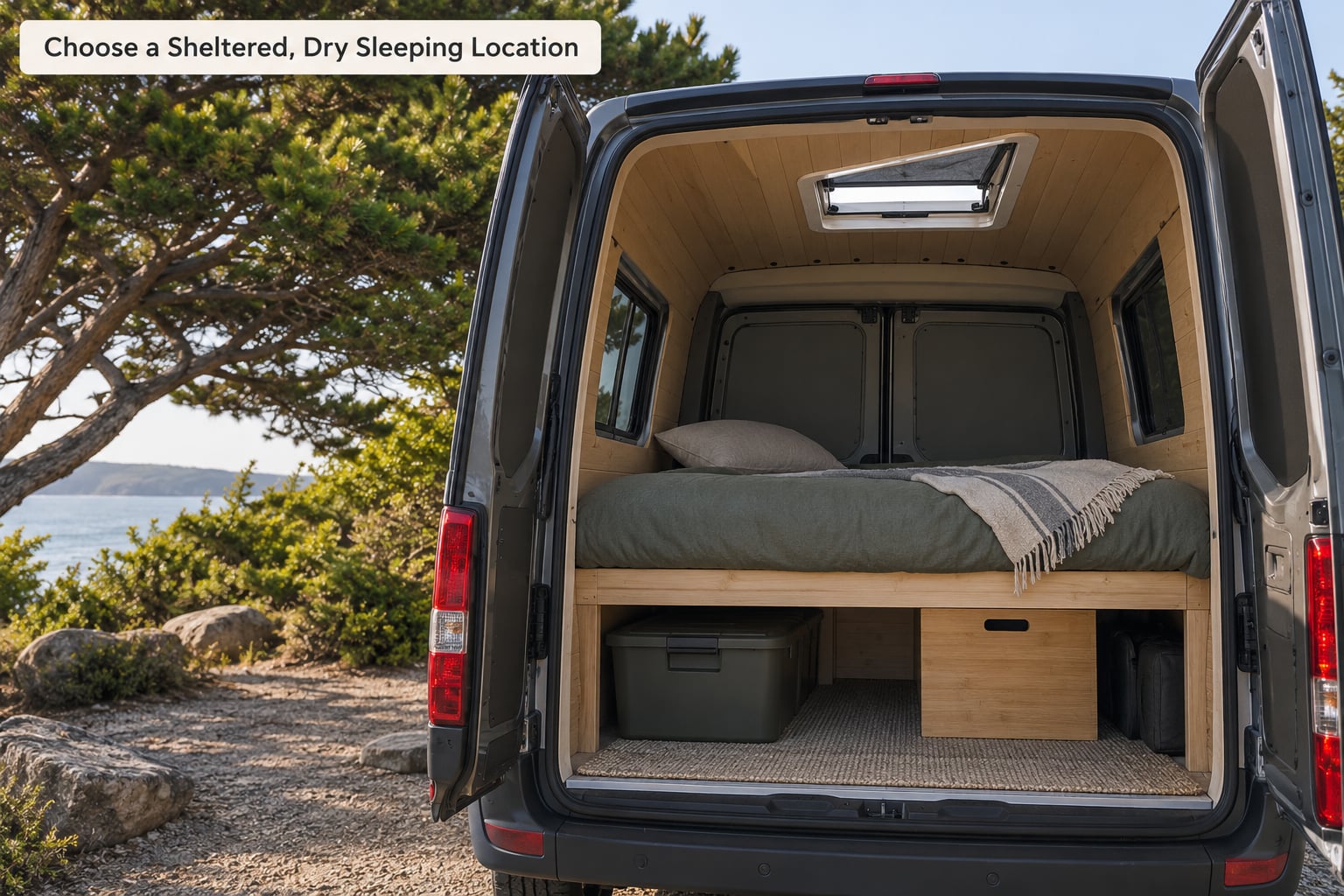
Park position does more for your warmth than most gear does. Wind direction, ground slope and drainage decide whether you wake up to a dry, still van or a damp, wind-tunneled one.
Point the van’s broad side into the wind where you can, and choose a spot shielded by trees, a rock wall or a bank. Watch the ground: low spots, hollows and anywhere water has run are wet before you arrive and stay wet all night.
Two things are non-negotiable at the sleep spot. The van must not be parked under anything that could fall on it or where exhaust could collect, and the roof vent must be openable if you plan to run any heater. If you cannot satisfy both, move the van rather than work around them.
How do you know the spot is right? Stand outside for two minutes and check the doors. If air is moving noticeably past a gap, you have found a draft path and you should look for a different position.
2. Insulate the Van Floor First
Insulate with a high-performance closed-cell foam pad laid edge to edge under the whole sleeping area, with no gaps at the seams. Over that goes your mat or mattress, which handles comfort and stops you shifting off the foam in the night.
These two layers do different jobs and it is worth keeping them straight. Foam stops heat conducting up out of the ground and out through the shell. The mat only makes the surface something you can actually relax on, and a soft mattress alone does very little about conductive loss.
Check that any product you buy is rated for the load it carries — a full adult plus bedding — and measure your space before cutting. A pad that leaves a two-inch gap at the door is a heat leak you paid for and cannot use.
You will know it works within ten minutes of lying down. If you can feel the cold coming up through the mat, the pad is too thin, has a gap under it, or is too small.
3. Block Drafts and Protect the Bedding
Still air holds heat far better than moving air, so every window gets a cover and every gap gets a strip. Insulated window covers or thermal blackout curtains on the windshield and side glass do more than any single heater upgrade.
Door seals, brush strips and a fitted sheet tucked tight at the edges stop the sleeper’s own warm air from leaking out and drawing cold air in. Pull bedding up over the shoulders and tuck it along the wall side rather than letting it hang.
Be careful about the trade here. If you run any combustion heater, you need a ventilation gap — a window cracked an inch, ideally the one furthest from your face — and window covers must be vented rather than sealed shut, or you are trapping combustion gases. Never cover a heater’s intake or outlet, and never seal a van airtight while a heater runs.
The test is simple: run the heater for ten minutes, then check that the crack is still drawing air and that no alarm sounds. If you cannot keep the vent open, do not sleep with the heater running.
4. Build Layered Bedding Around Your Body
How to stay warm sleeping in a van comes down to building layers that trap air against you, not piling on weight. A thin base layer, an insulating middle layer and a breathable outer layer outperforms one enormous bag almost every time.
Start with a merino or synthetic base layer that moves sweat away from your skin. Add a wool, fleece or down layer in the middle. Finish with something breathable — a quilt or comforter works well, and a thin sheet under it keeps the whole stack from sliding.
Pick the bag or quilt using the comfort rating, not the limit or the extreme rating. Marketing likes to quote the lowest number on the label, and comfort is the one that describes sleeping temperature. Sleeping in a bag rated well below your actual temperature is the standard way people end up shivering at 3 a.m.
Three details matter more than people expect. Wear a dry base layer to bed and change it if you sweated earlier, because damp insulation conducts heat away from you roughly five times faster than dry. Cover your head with a beanie, because a large share of your heat loss leaves there. And protect your feet — wool socks, plus a hot water bottle filled with hot, not boiling, water tucked near your feet at the bottom of the bag.
A commonly repeated setup that works well in practice is a sheet on the mattress, an electric blanket or heated pad on top of that, then the bag or quilts layered over it so nothing is trapped bare against your body.
Keep spare dry clothing within arm’s reach of the sleeping area. Most cold nights are not about one cold night, they are about the temperature dropping after you fell asleep and you had no way to change what you are wearing.
How to tell the sleep system is working: your shoulders and the inside of your feet stay warm through the first hour, and you stop shifting to find a comfortable position. Cold hands, cold nose and a damp sleeping bag at dawn all mean the layering order is wrong, not that the gear is too light.
5. Manage Condensation and Moisture
Humidity, not temperature, is what makes a warm setup feel cold. Warm air holds water vapour, and in a sealed van that moisture condenses on the coldest surfaces — usually the inside of the windows and roof — then makes your bedding damp and your surfaces cold to the touch.
A short morning reset prevents most of it. Wipe condensation off the ceiling and glass before sleeping, not after waking. Open a roof vent or window slightly while you cook or run a heater so vapour leaves instead of condensing. And keep wet gear — jackets, boots, damp towels — outside the sleeping area on a hook or line, because wet wool beside your pillow ruins a warm night faster than any cold snap.
Ventilation is the balancing act: enough to control moisture, not so much that you lose all the heat you just stored. A cracked window a few inches at the top, or a vented window cover, is the usual compromise, and dwelling advice repeats the same point — crack one window, and make it the one furthest from your face.
Diesel heaters give off dry heat, so they make condensation less of an issue inside the van, though they still pull in fresh air. Propane and other combustion heaters add water vapour to the cabin, which is part of why people running them overnight report morning headaches and damp bedding.
The tell that moisture is winning: droplets or a solid freeze-over on the inside of the glass at dawn. Fix it by wiping before sleep, cutting back on indoor cooking, and keeping your dry layer and dry socks in a sealed bag away from the damp stuff.
6. Use Supplemental Heat Safely
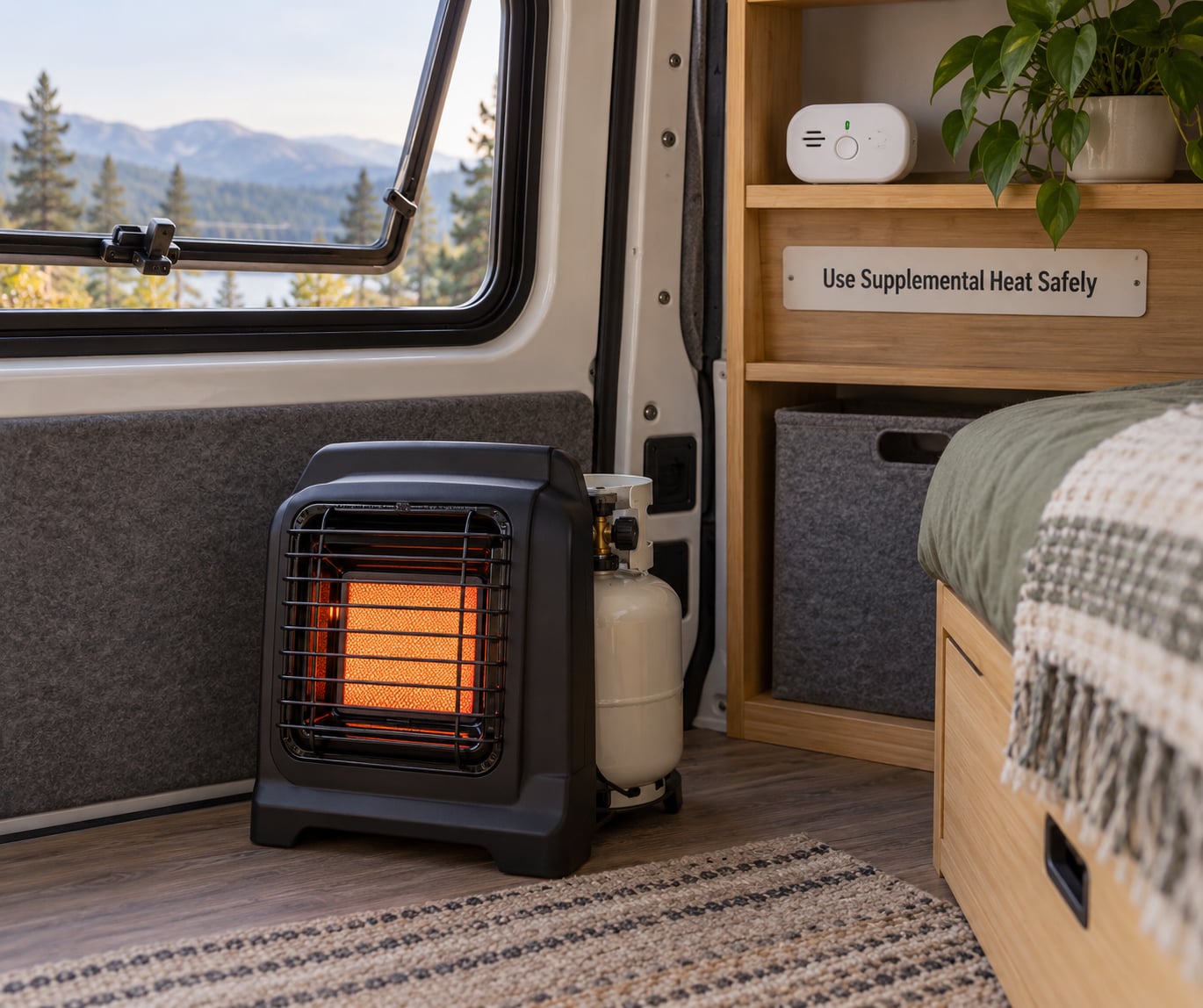
Supplemental heat replaces the heat leaking out, but it is the only step here with a real safety cost. Comparing options honestly saves you from choosing on price alone.
| Option | Electrical draw | Moisture | Notes |
|---|---|---|---|
| Diesel heater (2kW class) | About 20-40W while running | Dry heat | Quiet, efficient, needs a fuel line to a tank and a vented mounting. Most common permanent install. |
| Propane heater (Mr Buddy type) | None, but consumes fuel | Adds water vapour | Cheap, portable, no install. Requires the ventilation gap and a working carbon monoxide detector. |
| Ceramic electric heater on shore power | 1500W, about 12.5A on 120V | None | Only sensible where you have plugged-in power. Drains a small battery bank overnight. |
| Electric blanket or heated pad | 60-100W typical | None | Cheap, warms you rather than the air. Follow the manufacturer instructions exactly. |
On battery math, a 100Ah lithium bank holds roughly 1280Wh before you touch it, and staying above about 50% leaves you around 640Wh. A diesel heater drawing 30W for eight hours uses about 240Wh, which fits comfortably. A 1500W electric heater running four hours uses 6000Wh — several times your usable battery, which is why shore power or a separate heater bank matters for electric heat off-grid.
Safety rules I would not bend on: follow the heater’s own instructions, keep a working carbon monoxide detector near but not directly above the unit, keep the prescribed ventilation gap open, clear flammable bedding and curtains away from the output, and never leave a heater running unattended or while you are outside the van.
Carbon monoxide is colourless and odourless, and early symptoms are easy to mistake for a bad night: headache, dizziness, nausea, unusual fatigue, chest tightness, confusion. If a person sleeping near a running heater wakes with a headache or feels groggy, treat it as a ventilation failure, not as the bedding.
Know that a carbon monoxide detector and a carbon dioxide detector are not the same device. A CO detector looks for carbon monoxide specifically, which is what a combustion heater produces. A CO2 detector reports elevated carbon dioxide as a proxy for stale, unventilated air, and will not reliably catch carbon monoxide. Most people running any combustion heat inside a vehicle want both.
If you cannot meet the ventilation rule, the answer is not to squeeze the window shut. Turn the heater off, add layers, and revisit the setup when you can install it properly.
Common Mistakes
Sleeping directly on the van floor. The floor is the coldest surface in the vehicle and it conducts constantly. Fix: foam pad plus mat under the whole sleeping area, edge to edge, every night.
Relying on one very thick sleeping bag. A bag rated for far colder than your actual night keeps you slightly too warm at best, and you fight it by throwing things off. Fix: match the comfort rating to the real temperature, then add layers.
Blocking all airflow for the sake of warmth. A sealed van traps vapour, condensation and, with a combustion heater running, exhaust. Fix: a cracked window and vented covers rather than a hermetic seal.
Wearing damp clothes to bed. Wet insulation loses most of its loft, so a sweater you wore hiking is colder at midnight than the air is. Fix: change into a dry base layer and hang the damp layer up to dry.
Overheating while asleep. Too many layers, too warm a bag and a heater all at once leads to sweating, and sweat chills you within an hour. Fix: sleep slightly cool and add layers during the night instead of starting hot.
Placing an unapproved heater near bedding. Fabric, curtains and paper near an output are a fire risk, and many popular heaters are not approved for indoor sleeping use at all. Fix: check the manual for indoor-use and sleeping approval, keep the clearances the manufacturer specifies, and never run it unattended.
Before you close your eyes, run this short check: heater has a clear path to fresh air and clear space around its output; carbon monoxide detector is on and has not been silenced; bedding is tucked and dry; wet gear is outside the sleeping area; glass surfaces are wiped; and the sleeping bag comfort rating matches tonight’s forecast low.
Frequently Asked Questions
What sleeping bag temperature rating is appropriate for sleeping in a van?
Use the comfort rating and set it 5-10F below your forecast overnight low. A bag quoted at 20F is often rated that way for its extreme limit, so check whether the label lists a comfort, limit and extreme number. In an insulated van you can sleep roughly 10F warmer than your comfort rating suggests, but an uninsulated metal shell behaves closer to outdoors.
Is it safe to use a heater while sleeping in a van?
Only with a working carbon monoxide detector and the ventilation gap the heater’s manual requires. Keep a window cracked, ideally the one furthest from your face, and confirm the unit is approved for indoor use. Never sleep in a running heater’s output path and never leave it unattended. Headache or grogginess in the morning means the ventilation failed.
How do I stop condensation from making my van feel cold?
Condensation forms when warm damp air meets the cold glass and roof of a sealed van. Wipe surfaces down before sleeping, not after waking, and open a roof vent or window a couple of inches so vapour can leave. Keep wet gear outside the sleeping area, cook outside where you can, and use vented rather than sealed window covers. Diesel heat is dry; propane adds moisture.
Do I need extra insulation if my van already has a thick mattress?
Yes. A thick mattress is comfortable but does almost nothing to stop conductive heat loss through the floor, which is the biggest leak in most vans. Put a closed-cell foam pad beneath the mattress and keep a draft strip on the door. The mattress makes sleeping pleasant; the pad is what keeps heat in.
How can I stay warm in a van if I am sleeping in freezing temperatures?
Layer and insulate, then add an approved heat source. Insulated window covers, foam floor pad, wool socks, a warm hat, a dry base layer and a bag with a comfort rating below the forecast low will carry you through a freezing night in an uninsulated van. Below single-digit lows, run a diesel or propane heater with a carbon monoxide detector and the vent gap open.
Conclusion
Start at the top of this list and work down. Park somewhere sheltered and dry, put a foam pad under the sleeping area, cover every window and seal the gaps, build layered bedding around a comfort-rated bag, wipe down condensation and keep wet gear away from your pillow, then add an approved heater with a carbon monoxide detector and the ventilation gap open.
That sequence works because it fixes the biggest losses first. Heat leaving through the floor and glass is a far larger problem than the missing layer on your body, and bedding only performs well once it is not fighting a moving stream of cold air.
Sleep one test night in real conditions before a trip into genuine cold, with the setup you actually plan to use. You will learn more about your van in that one night than from any checklist, and how to stay warm sleeping in a van becomes a solved problem rather than a gamble.