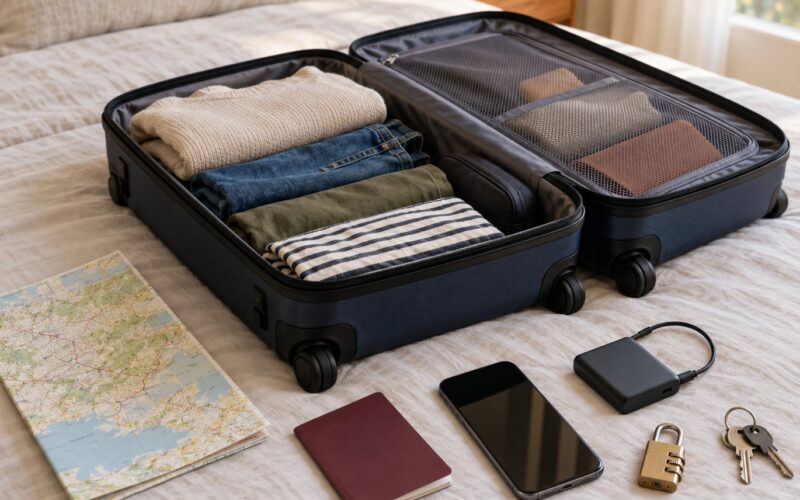
Learning how to keep a travel journal comes down to one habit: write one short entry a day, at the end of that same day, while the details are still sharp. Most people quit within three days, and the fix is not willpower, it is a smaller kit and a lower bar. If you capture what you will forget rather than what you already remember, the whole thing takes five to fifteen minutes a day.
Photos hold what a trip looked like. They lose what made it yours: the smell outside the bakery on the corner, the name of the street musician outside the bar, what the meal actually cost when you split it four ways. A travel journal is a notebook or an app you write in while you are still there, one entry per day, so the trip stays recoverable years later.
Here is the setup, the seven-step routine, and the mistakes that quietly kill a journal before it reaches page ten.
Table of Contents
- What You Need
- How to Keep a Travel Journal Step by Step
- 1. Choose a journal format that fits your trip
- 2. Set up a simple structure before you leave
- 3. Write a short entry while the experience is fresh
- 4. Add useful details without turning it into a report
- 5. Use prompts when you do not know what to write
- 6. Add photos, keepsakes and evidence of the trip
- 7. Review and complete the journal after the trip
- Common Mistakes That End a Travel Journal
- Frequently Asked Questions
- Conclusion
What You Need

The whole kit fits in a jacket pocket. A notebook or a notes app, one pen that works where you are going, a way to attach paper, a short prompt list, and a place to keep the small paper things.
- One notebook or one digital place. Two systems means neither gets used. A cheap pocket notebook beats an expensive one you leave behind.
- One pen, tested before you leave. Cheap ballpoints smear when they get warm and run out when you need them. A fountain pen writes beautifully and bleeds straight through thin ringed-notebook paper, which is the single most common gear complaint from people who write in notebooks.
- A glue stick and one roll of washi or masking tape. For ticket stubs, receipts, a folded map corner, a napkin with a name on it.
- Your prompt list, written out. Ten questions on a card or in a note. This is the thing that saves you on a day when nothing seems worth writing.
- A folder or envelope for ephemera. A ziplock bag works and takes no room. Glue everything at home when you get back, not on a train.
If you plan to use a fountain pen, pick paper around 100 gsm or heavier, or one sold as fountain-pen friendly. If you plan to use a rollerball, almost anything works. Test the combination on a scrap page at home, on the actual notebook, before the trip.
How to Keep a Travel Journal Step by Step
1. Choose a journal format that fits your trip
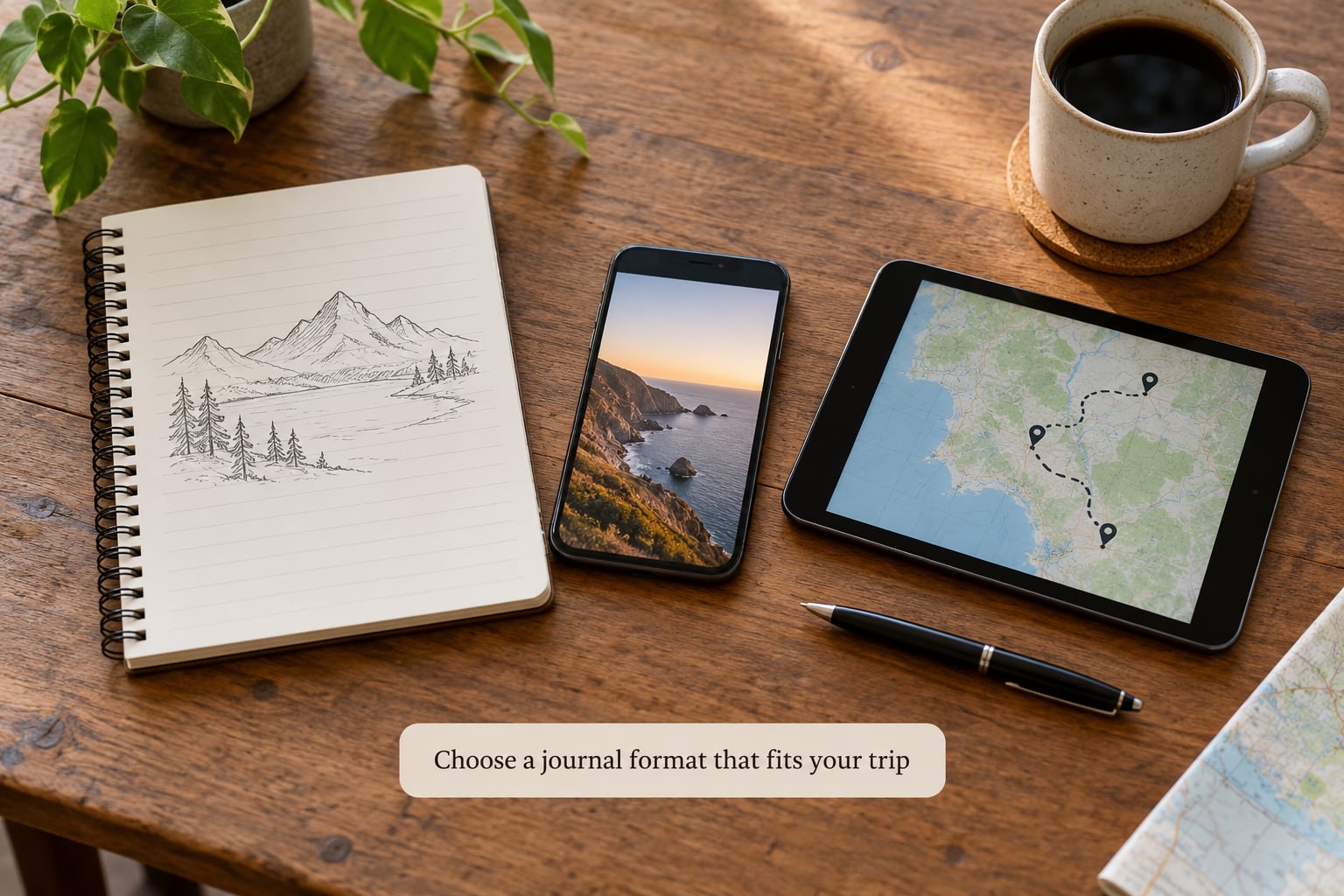
Pick based on trip length, connectivity and who else is travelling. There is no best format, only the one you will still be holding on day nine.
- Paper notebook. Suits long trips, poor signal, and anyone who wants a physical keepsake afterward. Watch out for the weight in your pack, loss or theft, and wet weather.
- Phone notes. Suits day trips and short breaks, where quick captures on the move are the whole game. Watch out for small screens and scrolling instead of writing.
- Digital document. Suits multi-week trips, photo and map inserts, and easy backup. Watch out for needing data or power, and for the fact that it feels less permanent.
- Shared blog or group journal. Suits family trips and friends travelling together who want to post later. Watch out for one person quietly taking ownership of it.
How you know it works: at the end of day one you have written something, not planned to write something.
2. Set up a simple structure before you leave
Ten minutes at home saves you thirty on a crowded train station. Draw the same template on the first three pages and copy it as you go.
Head the page with the date, the place, and how many days in. Then five slots: highlights (three things that happened), details you’ll forget (sounds, smells, prices, names), practical (route, timings, where you ate, what cost what), today’s photo, and a closing line — one sentence about how the day felt.
The closing line is the part people skip and the part they read back years later.
3. Write a short entry while the experience is fresh
Use the three-part rule: one sensory detail, one feeling, one small fact you will not recall later. That is a complete entry. A surprising number of good travel journals are built on entries shorter than that.
Write it before bed rather than at breakfast. The night version has the tiredness and the smell of the day still in it; the morning version is tidier and vaguer.
4. Add useful details without turning it into a report
Some logistics genuinely fade. Write down the route you wished you had, the guesthouse address before you forget the street name, what the bus cost, which museum was worth it and which was not, what the weather did.
Keep it to a sidebar. The emotional story stays in the middle, and logistics support it rather than replace it.
5. Use prompts when you do not know what to write
Some days are just transit and rain. Rotate a prompt instead of staring at a blank page.
- What is the first sound you heard this morning?
- Who did you talk to, and what did they say that stuck?
- What did you eat, and what did it cost?
- What surprised you today?
- What would you repeat tomorrow?
- What did you change your mind about?
- What is one thing nobody writes down here?
- What did this place smell like?
- What are you carrying that you did not expect to need?
- What are you glad you did not do?
6. Add photos, keepsakes and evidence of the trip
Pick three to five things per trip, not everything. A boarding pass, a stamp from a passport control page, a restaurant napkin with a recommendation on it, a postcard you decided not to send.
Photograph every written page at the end of the day, before you close the notebook. That single habit protects against a lost bag, spilled water, and the fact that faded ink on a sunny windowsill is not really readable three months later.
Two rules for the digital side. Keep a geotagged journal off public platforms while you are still travelling, since a live, dated account of where you are is information you would not hand to a stranger. And turn backups on before you leave, not during the first wifi you find.
7. Review and complete the journal after the trip
Within a week, while you still remember the order of things, reread it. Fill the gaps you skipped, mark the three pages you would keep if you could only keep three, and write a closing reflection: what the trip changed, and what you would do differently.
Then photograph the whole thing, print the pages into a book if you want a physical copy, and put the real book somewhere you will actually find it. A journal in a moving box is a journal that never gets reread.
Common Mistakes That End a Travel Journal
Waiting too long to write. By the time you sit down three days later, the trip has already blurred into impression. Fix: a minimum viable entry of thirty seconds — one sentence per slot — beats no entry.
Documenting everything. A full day of notes takes an hour and turns the journal into homework. Fix: cap it. Fifteen minutes, then stop.
Writing for an audience. The moment you are composing entries for strangers, you polish, censor and stop noticing things. Fix: write for yourself. The rule people in travel forums keep coming back to is simple — the mishaps make the best material.
Chasing aesthetics. Perfect headers, decorated pages, coloured pens. It looks lovely and it stalls people on page one. Fix: a plain page with a date at the top is a finished entry.
Keeping only one format. Paper without a backup, or an app with no signal and a flat battery. Fix: nightly page photos plus a cloud backup for the digital route.
Letting one person own a shared journal. On a family or group trip, one traveller’s handwriting takes over and the rest contribute a signature. Fix: a page per traveller per day, or a shared digital document anyone can edit.
Mismatching pen and paper. Fountain pens feather through cheap paper, and plastic waterproof sheets will not let some inks dry at all. Fix: test on a scrap page at home, and keep a backup pen that cannot fail.
Dropping the journal after a gap. A missed day feels like the start of a failure. Fix: leave a line saying where you picked it back up, then keep going.
Frequently Asked Questions
How do I restart a travel journal I abandoned years ago?
Do not reread the old entries first, that is where people stall. Open it, write a single line about the trip you took next, and keep going from there. Most people lose interest because the gap feels too big to bridge, and one honest sentence about what happened next bridges it faster than any plan.
Can I keep a travel journal on my phone?
Yes, and for day trips or short breaks it is often better, because the notes are already in the same device as your photos. The risk is scrolling instead of writing. Use a single note with your template at the top, type the entry when you stop moving, and turn on backup before you leave.
How long should a travel journal entry be?
One page or half a page, five to fifteen minutes. A useful test is whether you wrote one sensory detail, one feeling, and one fact you would not remember later. If all three are there, stop writing. Entries longer than that get skipped on tired days, and skipped days are what end a journal.
What should I write in a travel journal?
The details you will forget: what a place smelled like, what a meal cost, the name of someone you spoke to for twenty minutes, which detour was worth it. Photos already record the view. Your journal exists for the part the camera missed, including the parts that did not go well.
Is it safe to write and publish a travel journal while travelling?
Keep it off public platforms until you are home. A dated, geotagged account tells a stranger where you are and when you will be there. Travel forum regulars warn about this specifically, and it costs nothing to wait. Photograph your pages for your own backup instead of posting them as you go.
How do I keep up the habit on an exhausting travel day?
Write while you are still in the middle of the day, not at the end of it. A five-minute note on the train or in a cafe queue captures the day while it is happening, and a full entry is optional. Forum writers also use voice dictation in the evening, which is faster than typing when you are tired.
Conclusion
Pick one format tonight, paper or phone, and write the five template slots on the first page. Then write your next entry the same evening you get home, three sentences long if that is all you have. Anyone asking how to keep a travel journal past the first week lands in the same place: systems do not keep it going, small finished entries do.