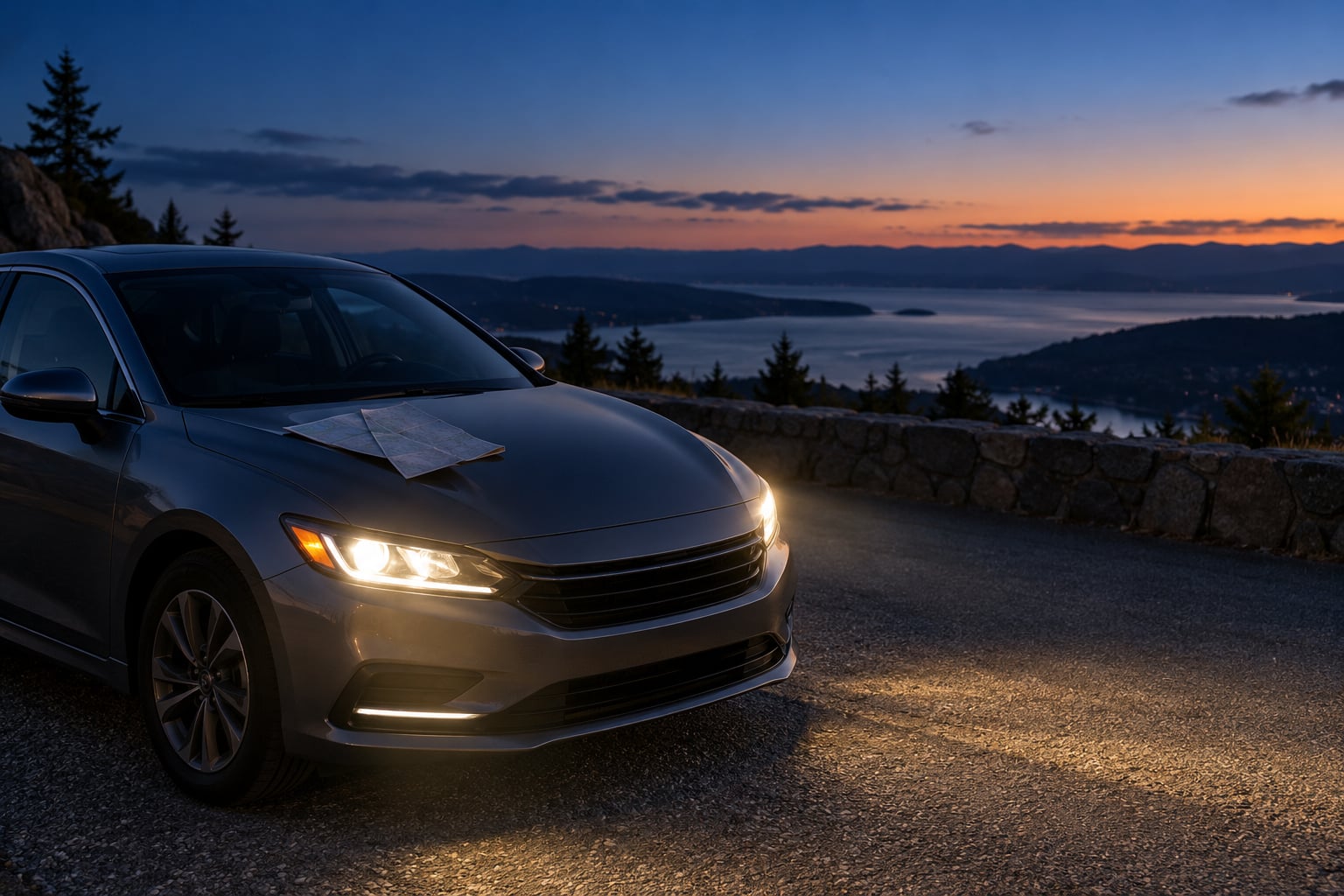
Night driving is harder because your eyes, your judgement and your attention all degrade at the same time. Knowing how to drive at night more safely comes down to a repeatable routine: check the route and the car before dark, keep the glass clean and the beams correct, leave room to stop, and stop the moment you feel tired. Most night crashes come down to a driver who overran the distance their headlights could actually show them.
The National Safety Council puts the night fatality rate at roughly three times the daytime rate, even though only about a quarter of all driving happens after dark. Over half of driver deaths and around 76% of pedestrian deaths happen in the dark. That gap is not about skill. It is about visibility, glare, fatigue and speed judgement all working against you at once.
Here is the routine I use. It takes about fifteen minutes before you turn the key and about one extra line of attention every hour after that.
Table of Contents
- What You Need
- How to Drive at Night More Safely: Step-by-Step
- 1. Plan the route and inspect the vehicle before leaving
- 2. Make the cabin and windshield as clear as possible
- 3. Drive within a speed that allows a safe stopping distance
- 4. Manage glare, headlights, and oncoming traffic
- 5. Use the high beams only when they improve visibility
- 6. Take a fatigue break before your attention declines
- 7. Anticipate pedestrians, wildlife, and road hazards
- 8. Handle rain, fog, snow, and icy roads conservatively
- 9. Keep an emergency plan and stay aware of your surroundings
- 10. Leave a clear itinerary and expected arrival time
- 11. Reassess conditions during the trip and stop when safety changes
- Common Mistakes
- Frequently Asked Questions
- Are high beams safer at night than low beams?
- How far ahead should you be able to see when driving at night?
- What can I do if I feel drowsy while driving at night?
- How do I avoid being blinded by oncoming headlights at night?
- What should I do if a deer or other animal steps into the road at night?
- Is night driving more dangerous than driving during the day?
- Conclusion
What You Need
Night driving does not need special equipment. It needs a few ordinary things checked before you leave rather than discovered on a dark road.
- A route you have looked at. Weather, closures, exits, tolls and the location of fuel or charging stops, checked before departure rather than on the move.
- A clean windshield, mirrors and headlight lenses. A microfibre cloth and glass cleaner do more for night visibility than most drivers expect.
- A charged phone, mounted out of the glare zone, with the route downloaded for offline use. Signal drops in exactly the places you least want it to.
- Enough fuel to reach a populated area, not just the next exit. Road-trip veterans on r/roadtrip repeat the same advice: fill up and take breaks where other people are.
- An emergency kit with reflective triangles, a first-aid kit, a small torch, a bottle of water, a blanket, and a can of tire sealant or a spare if your car does not have one.
- Roadside assistance details saved offline, plus your insurer’s number. Reading a phone screen on a dark shoulder is harder than it sounds.
- Driver licence, registration and insurance documents. Required at night more often than people expect, particularly at traffic stops.
- A second passenger, if you can arrange one. Talking and sharing the driving are the two oldest anti-fatigue tools there are.
Add a paper copy of your itinerary somewhere in the car that is not the glovebox. If the phone dies at a rest stop, you still know where you meant to be.
How to Drive at Night More Safely: Step-by-Step
1. Plan the route and inspect the vehicle before leaving
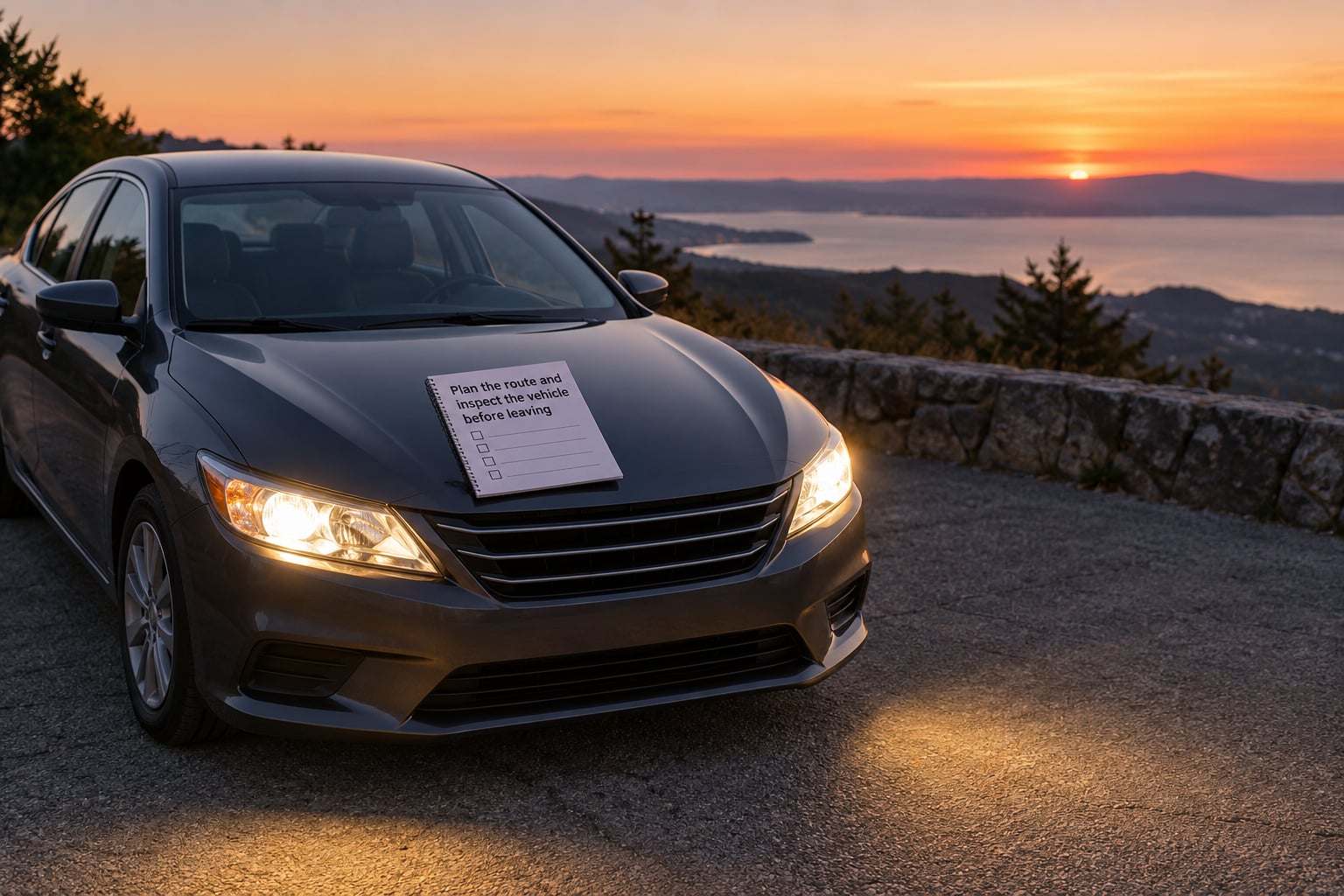
Before darkness rather than during it, check the forecast for the hours you will actually be driving, not just for the departure town. Look at road closures and construction on the route and note where the exits are before you need one.
Then walk the car. Tires with tread, lights working at both beams, washer fluid full, wipers clearing the glass, fuel above a quarter. If a tire looks soft in daylight it will feel worse after three hours on a cold highway.
How you know it worked: every light on the exterior check functions, and you could reach a rest stop on a quarter tank without passing one.
2. Make the cabin and windshield as clear as possible
Clean the inside of the windshield as seriously as the outside. Road film, hand grease and dashboard reflection compound every headlight you meet, and a streaked windshield turns oncoming low beams into a wall of white.
Dim the instrument cluster and the phone screen. Set the rearview mirror to its night or anti-glare position, the single most-repeated tip across night-driving forums. Angle the side mirrors down slightly so following vehicles’ headlights land on the road rather than in your eyes.
Worth knowing: many drivers on r/drivingsg discovered the anti-glare mirror setting for the first time years into holding a licence. It is fitted on most cars and almost nobody uses it.
How you know it worked: you can read a road sign at 200 feet without leaning forward, and the mirror shows the road rather than a field of white light.
3. Drive within a speed that allows a safe stopping distance
Low beams throw useful light roughly 160 to 250 feet ahead. High beams reach about 350 to 500. From highway speed, stopping needs somewhere around 200 to 300 feet. If those numbers overlap, you are already overrunning your headlights before trouble appears.
AAA’s headlight testing found low beams inadequate at around 40 mph, with high beams improving forward illumination by about 28%. So the posted limit is a ceiling, never a target at night. Sitting 5 to 10 mph under it buys you reaction time you cannot manufacture any other way.
How you know it worked: you can see the lane markings and the fog line well beyond the vehicle in front, and you are not leaning forward to read the road.
4. Manage glare, headlights, and oncoming traffic
When an oncoming driver leaves you blinded, the instruction is physical and specific: ease off the accelerator, do not look at the headlights, and hold your line using the right-hand fog line or lane marker. Speed up to get past the glare faster and you meet it at a closing speed with worse control.
Flip the mirror to night mode, check the windshield is clean, and keep your side windows down a finger’s width to move air across your face. If your own glass is dirty, cleaning it mid-drive is more effective than anything else you can do in the moment.
How you know it worked: the oncoming vehicle passes and the road is legible again immediately, with no afterimage lasting more than a second or two.
5. Use the high beams only when they improve visibility
High beams belong on unlit roads, curves outside town and open two-lane highways where nothing is coming toward you. Drop to low beams when you are within 500 feet of an oncoming vehicle, when following someone closely, and whenever you can see street lighting, signs or other vehicles ahead.
High beams in fog or heavy rain light up the moisture directly and return glare. Fog lights, used correctly, cut low and stay useful because they throw light under the mist. They are not a substitute for low beams at highway speed.
On the flashing question the forums genuinely disagree. You will hear people recommend flashing your high beams at an offender to force them to dip. It is not worth it. Flashes are ambiguous, they escalate, and if you cannot see the other road well enough to judge their beam pattern, you should be slowing down instead of signalling.
How you know it worked: high beams are on only when the road ahead is empty and dark, and low beams the moment anything approaches.
6. Take a fatigue break before your attention declines
Fatigue at 3 am is not a motivation problem. It is circadian, and cold air, a loud playlist and an open window do not reverse it. Forums are blunt about this: nothing beats stopping and sleeping, and anything that feels like it is helping you is usually masking the problem rather than fixing it.
Watch for the early signs, not the collapse. Repeated yawning, drifting between lane markers, missed exits you were watching for, that heavy-lidded feeling, and restlessness. A microsleep, a one or two second sleep you never register, is the real mechanism behind a lot of fatal night crashes.
Plan breaks every two hours or 100 miles and stay within about 50 miles of a rest stop. Caffeine buys a short window and then a trough; a 20-minute nap at a rest area beats it. If you are driving after a long shift, drive home later rather than now.
How you know it worked: you can count full stops without losing track, and you would notice if a cyclist appeared between you and the truck ahead.
7. Anticipate pedestrians, wildlife, and road hazards
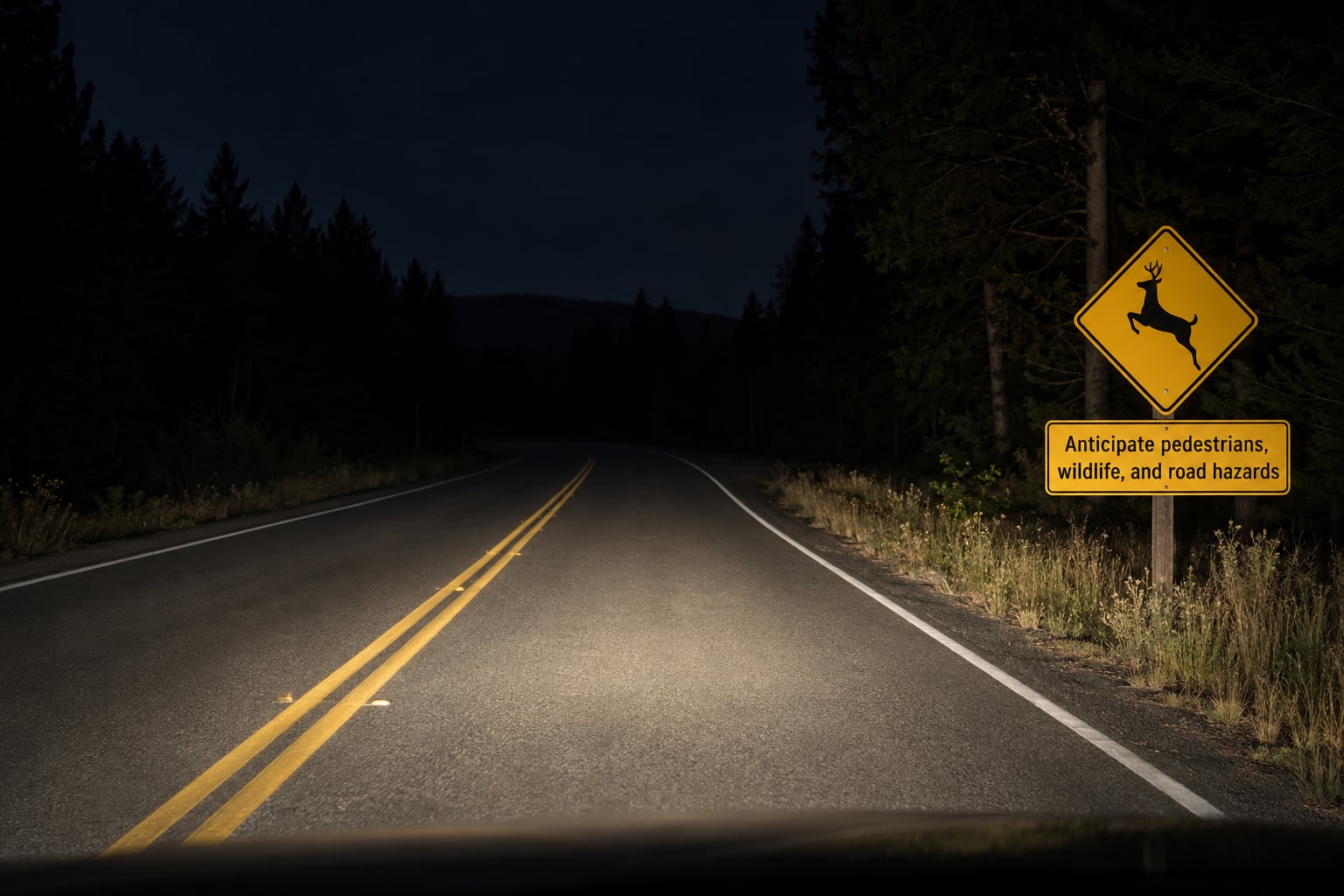
Pedestrians in dark clothing are nearly invisible until they are in your lane, which is why so many deaths happen after dark. Watch shoulders and driveway edges, and expect someone at every bus stop, every gas station and every marked crossing.
Animals concentrate at dawn and dusk and along wooded edges with open farmland beside them. Slow down where deer-crossing signs appear and where the forest opens onto fields. If an animal appears, brake firmly rather than swerving: a firm stop preserves your line, while a swerve trades a deer for a tree or an oncoming car.
Curves, hill crests and blind corners deserve more caution than the speed limit implies, because the far side is unlit and your headlights hit nothing until you are committed.
How you know it worked: you saw the person or the animal before they entered your lane, not in the mirror afterwards.
8. Handle rain, fog, snow, and icy roads conservatively
Wet roads at night cut your stopping distance and turn oncoming headlights into glare off the surface rather than the air. Fog removes your useful sight distance entirely and can hide a stopped vehicle until it is far too close.
Reduce speed, double your following distance, keep more room from the vehicle ahead so their spray clears, and use the edge line as your guide when markings disappear. On snow and ice, especially black ice on bridges and shaded bends, make small steering inputs and avoid cruise control. It holds a set speed through a corner and removes the braking control you need.
How you know it worked: your stopping point on dry pavement is comfortably shorter than the road ahead you can see.
9. Keep an emergency plan and stay aware of your surroundings
Move as far off the road as you can, turn on hazard lights, and stay in the vehicle with the seat belt on. Place reflective triangles behind the car as the driver’s manual specifies, not wherever is convenient. If you have to leave the vehicle, do it on the passenger side where you are least likely to be hit.
Share your roadside assistance number and location with someone outside the car, and note the road number, direction of travel and nearest exit before the phone dies. Do not climb the barrier or stand on the carriageway to wave traffic down; r/scarystories threads on driving alone in the dark make the same point in blunter terms. Stay on the carriageway where help can find you.
How you know it worked: someone outside the car knows where you are, what side of the road you stopped on, and roughly when you expect them.
10. Leave a clear itinerary and expected arrival time
Text your planned route, the stops you intend to make, the vehicle registration and your expected arrival to a person who will notice if you do not message. Add check-in times at fuel stops rather than one final arrival message. Someone expecting a call from a lay-by at 11 pm will act; someone waiting on an arrival five hours from now cannot.
Do all of it before you move. Reading and typing on the phone at 60 mph at night is one of the worst combinations available to a driver.
How you know it worked: your contact could answer three questions about your current position without calling you.
11. Reassess conditions during the trip and stop when safety changes
At every fuel or rest stop, look up. Check whether fog has closed in behind you, whether rain has become something heavier, whether you are getting the alert attention you think you are, and whether the vehicle is behaving oddly. A burning smell, a pulling brake or a warning light ends the night drive rather than delaying it.
Have a rule in advance for when you abandon night driving altogether. Wait for daylight rather than pushing through rain, unlit back roads or a second hour of fighting fatigue. Waiting four hours is always cheaper than the alternative, and arriving exhausted at a destination ruins the trip anyway.
The table below is the short version to keep in your head for the rest of the drive.
| Hazard | What actually happens | What to do |
|---|---|---|
| Oncoming high beams | Temporary blindness, worst at modern LED and HID brightness | Ease off the gas, look at the right fog line, mirror to night mode, never retaliate |
| Drowsiness | Microsleeps and slowed reaction, worst 2 to 6 am | Pull into a lit rest area and sleep; caffeine buys only minutes |
| Unlit road | Only your headlight cone is available, markings fade | Drop speed, hold the edge line, increase gap to six seconds |
| Wildlife | Sudden movement at the road edge | Brake firmly in a straight line, do not swerve |
| Pedestrians and cyclists | Dark clothing against an unlit verge | Scan shoulders and crossings, slow through built-up areas |
| Rain, fog or ice | Stopping distance grows, glare spreads across the surface | Halve speed, double the gap, low beams and fog lights, no cruise control |
| Vehicle trouble | Headlights fail and nobody is behind you | Hazards on, triangles placed per the manual, stay belted in the vehicle |
Common Mistakes
These come up again and again, and each has a simple correction.
- Leaving straight after a long day. The most reliable crash-prevention decision is timing. If you finish work at midnight, leave at 6 am.
- Staring into the oncoming headlights. Look at the right-hand fog line instead, and drop speed rather than accelerating past the glare.
- Holding a two-second gap. Two seconds assumes daylight and dry roads. At night, four seconds or more, six in rain.
- Forgetting reflective gear and triangles. An emergency kit in the trunk is equipment. Triangles set out behind the car are what other drivers actually see.
- High beams in fog, rain or against oncoming traffic. Back to low beams earlier than feels necessary.
- Ignoring a dirty windshield. Grime turns every headlight into a smear. Clean the glass inside and out before you leave.
- Cruise control at night. It holds speed through curves and delays your braking on ice.
- Treating fatigue fixes as real. Cold air and loud music keep you awake at the cost of concentration. They are not a substitute for sleep.
- Assuming every headlight is legal. Aftermarket HID and LED conversions dazzle oncoming drivers and are illegal in many states.
- Wearing yellow-tinted night driving glasses in ordinary conditions. They can make the road dimmer in tunnels, rain or on unlit roads.
Two habits cover most of that list. Slow down before darkness and stay rested. Everything else is detail.
Frequently Asked Questions
Are high beams safer at night than low beams?
High beams are safer only on unlit, open roads where nothing approaches you, and they reach roughly 350 to 500 feet ahead instead of the 160 to 250 feet of low beams. Drop to low beams within 500 feet of an oncoming vehicle, when following closely, near street lighting, and in fog or heavy rain, where the beam bounces off the moisture and returns glare toward you.
How far ahead should you be able to see when driving at night?
Aim for a headway of about four seconds: enough road for your headlights to illuminate the lane, the markings and the vehicle ahead before you need to react. From highway speed, stopping takes roughly 200 to 300 feet, so if your lights only reach 160 to 250 feet you are overrunning them. Slowing 5 to 10 mph below the limit usually restores the gap.
What can I do if I feel drowsy while driving at night?
Pull into a lit rest area, park safely and sleep. Drowsiness at night is circadian, and cold air, an open window and loud music mask it without reversing it. A short nap of about 20 minutes beats caffeine, which buys a brief window followed by a trough. On a long trip, break every two hours or 100 miles and stay within about 50 miles of a rest stop.
How do I avoid being blinded by oncoming headlights at night?
Ease off the accelerator, do not look directly at the headlights, and hold your line using the right-hand fog line or lane marker. Slowing rather than speeding up gives you more time to recover. Set the rearview mirror to its night or anti-glare position, dim the dashboard and keep the windshield clean inside and out. Never flash your high beams back at another driver.
What should I do if a deer or other animal steps into the road at night?
Brake firmly in a straight line and keep the steering wheel steady. Swerving trades an animal for a tree, a barrier or an oncoming vehicle, and on a dark road you rarely have the visibility to make that correction safely. Sound the horn if it helps, hold your line and brake hard in a controlled way rather than swerving or standing on the brakes suddenly.
Is night driving more dangerous than driving during the day?
Yes, and the numbers are not close. The National Safety Council puts the night fatality rate at roughly three times the daytime rate, even though only about a quarter of driving happens after dark. Over half of driver deaths and around 76% of pedestrian deaths occur at night, largely because visibility drops, glare rises and drivers who are already tired drive the hours when they are least alert.
Conclusion
If you take five things from this, make them the first five. Inspect the car and the route before dark. Clean the windshield, mirrors and headlight lenses inside and out. Drive at a speed that lets you stop inside your headlights. Leave at least four seconds of road and do not fight oncoming glare. Break every two hours and stop when you are tired rather than when you have proved you can keep going.
Updated for 2026. Advice here is general guidance; your vehicle owner’s manual takes priority on anything mechanical.