Flying with a toddler for the first time is a preparation problem, not a skill problem. The parents who have calm flights pick one that lines up with nap or bedtime, arrive two to three hours early, bring more snacks and new toys than they think they need, and accept that some crying through takeoff and landing is completely normal. Everything else is detail.
This guide walks through the whole process, from picking the flight to landing the bags at your destination. It assumes a toddler roughly 12 months to 3 years old, whether you are flying with a second adult or on your own.
One thing to sort out early: do toddlers have to have a car seat on an airplane? No. In the US, the FAA does not require a child restraint for a 2-year-old, though airlines can set their own rules, and most will let you fly with an approved child restraint seat or a car seat with an aircraft rating. International carriers and other countries follow different rules, so confirm before you book.
Table of Contents
- What You Need
- Step-by-Step: How to Fly With a Toddler for the First Time
- Common Mistakes
- Helpful Tips for a Smoother Trip
- Frequently Asked Questions
- Do toddlers have to have a car seat on an airplane?
- How far in advance should I arrive at the airport with a toddler?
- What documents does my toddler need to fly?
- What is the best time of day to fly with a toddler?
- Is it normal for a toddler to cry during takeoff and landing?
- How do I help my toddler sleep on a plane?
- Conclusion
What You Need
Get these arranged the week before, not the night before. Scrambling for a passport photo at 6am is how people end up rebooking.
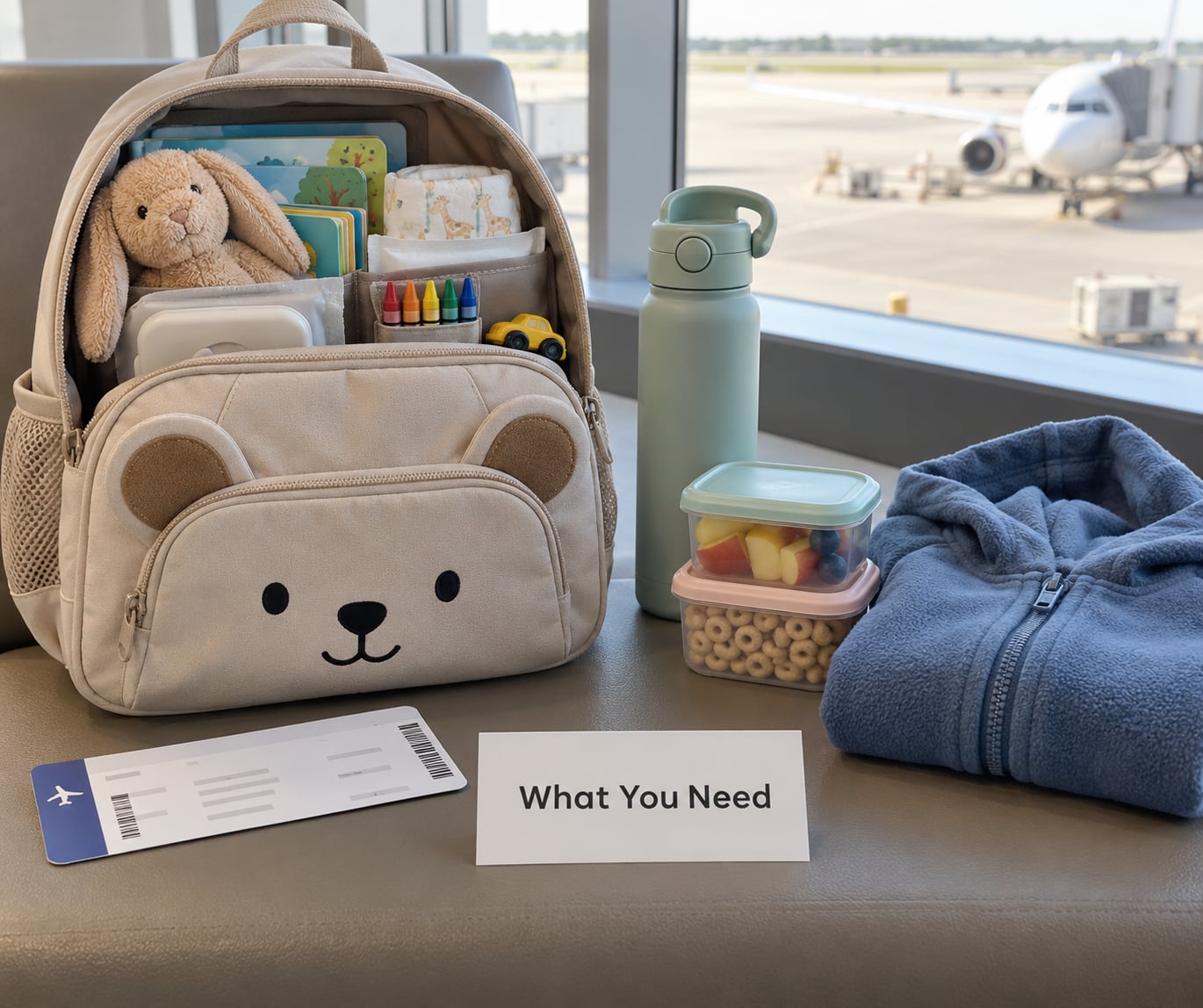
- Travel documents. Your toddler’s passport, a photocopy of the birth certificate, your own ID, and the booking confirmation for every traveler on the itinerary. For international trips, check whether the destination requires a notarized consent letter from the other parent.
- Boarding passes and the itinerary saved offline. Phone screens die and airport Wi-Fi fails. Screenshot everything before you leave home.
- A carry-on diaper bag that you never check. Two diapers more than you think, wipes, a change of clothes for the toddler and for you, hand sanitizer, and any prescribed medication in its original labelled container.
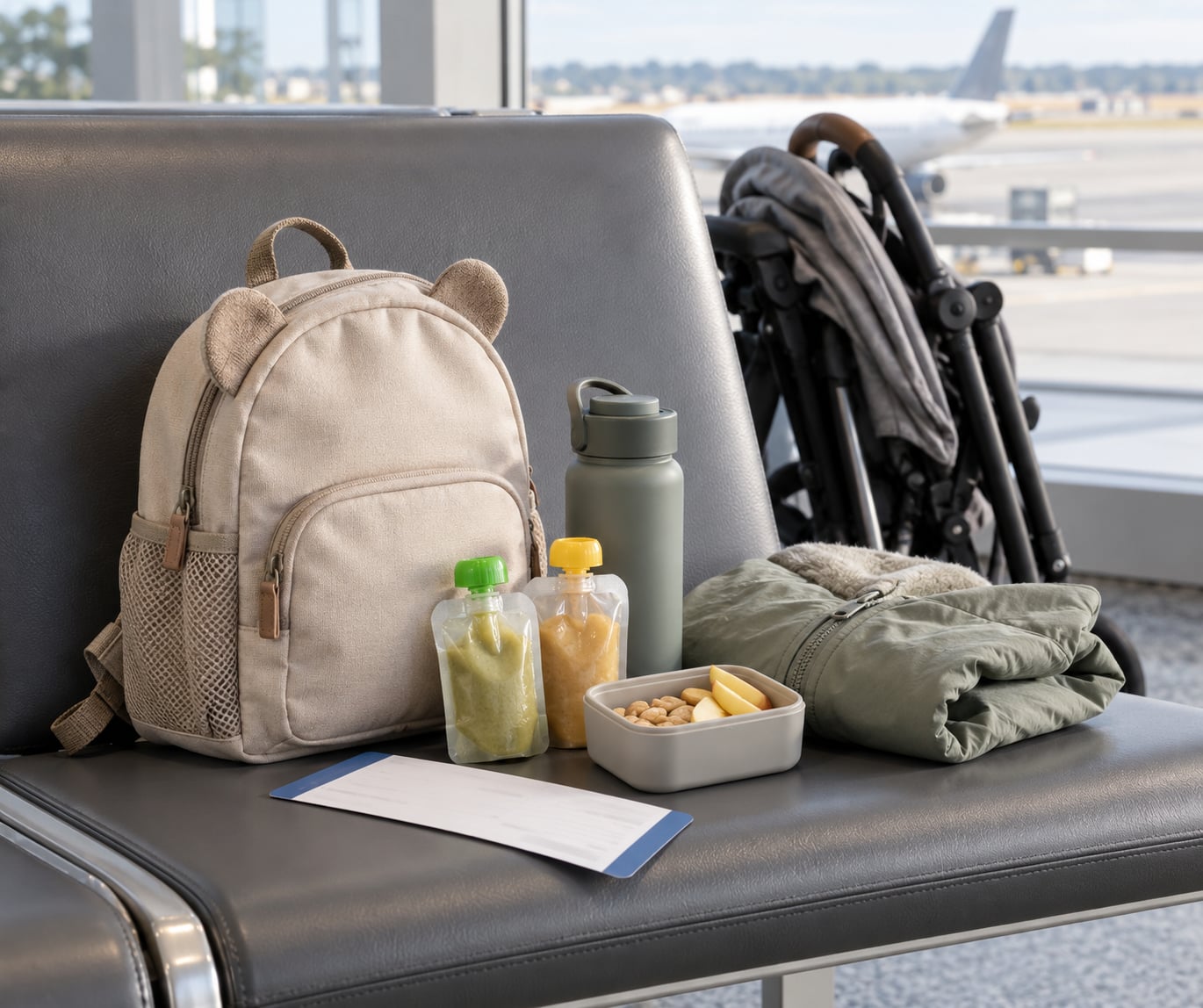
- Snacks that do not crumble. Think pouches, soft crackers, cheese sticks, whole grapes cut lengthwise, and a small cup of juice. Snacks in compartment boxes slow a toddler down far better than an open bag.
- New, unwrapped activities. One or two things your child has never seen, left sealed until boarding. Tear-away packaging is a real problem in turbulence.
- A portable changing mat and, if your child is potty training, a pull-up and a foldable toddler toilet seat you can hang off a closed toilet lid.
- A travel stroller and car seat if you use them. Airlines will gate check the stroller at the jet bridge for free, but you will carry it plus your bags through security and down the aisle yourself.
Leave the full-size diaper bag, the car seat base, and half the outfit options at home. Overpacking is the most common first-flight mistake, and a bag you cannot lift is a problem you cannot solve alone at the gate.
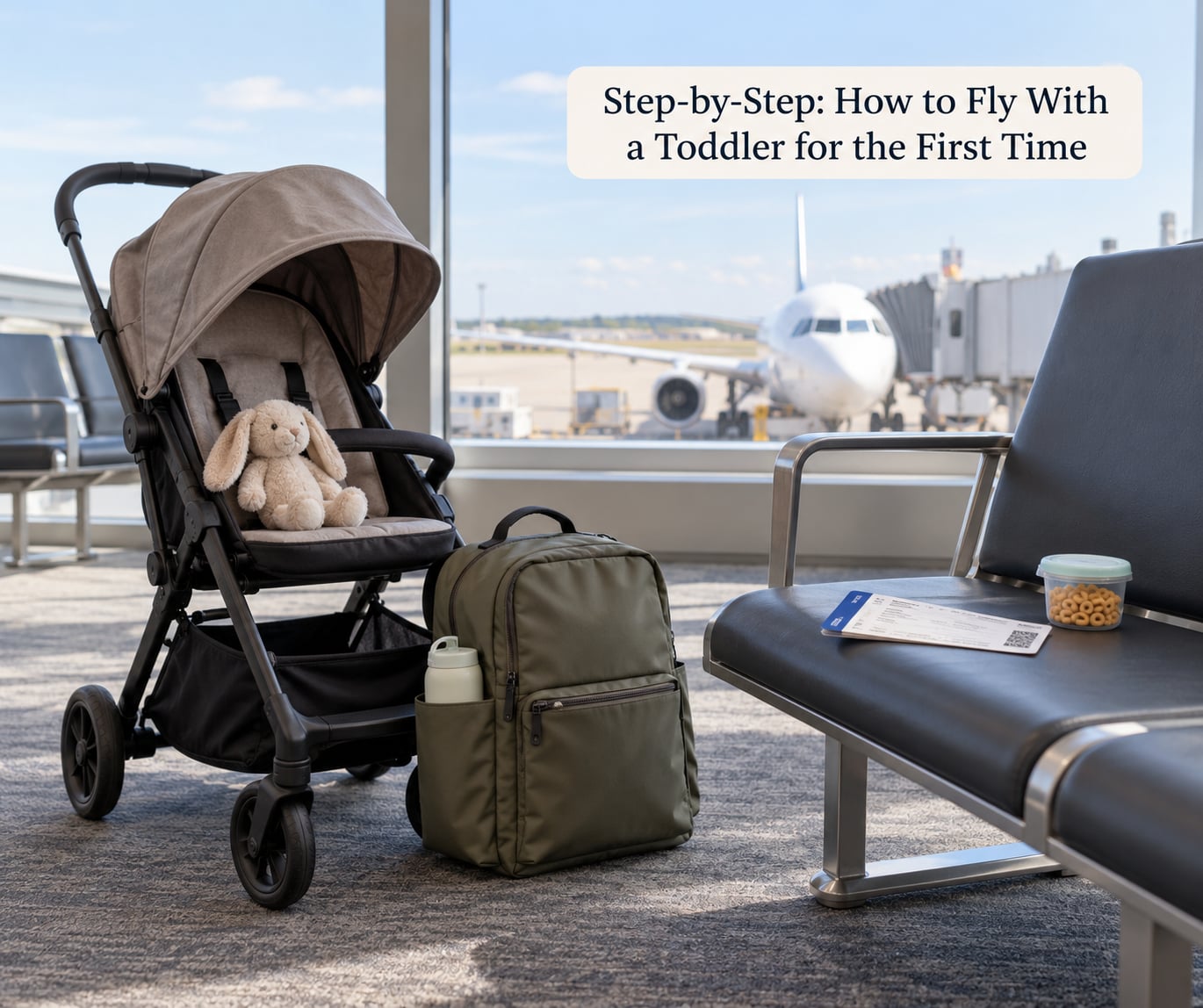
Step-by-Step: How to Fly With a Toddler for the First Time
How to Choose Flights and Check Airport Rules
Short flights beat long flights with a toddler almost every time. If you have the choice, pick one under three hours with no connection, because a two-year-old who is content for two hours will unravel by hour five.
Match the schedule to your child’s rhythm. A flight that leaves mid-morning lets you do the travel during the natural nap window, which means they fall asleep somewhere over the clouds. A red-eye works if your toddler sleeps through the night, though jet lag takes a toll for a day or two after.
Then check the details that bite people:
- Seat availability. Choose seats together at booking. An aisle near the restrooms saves a mid-flight scramble; a bulkhead row gives legroom but is not allowed with seat extenders.
- Connection time. Under 90 minutes is tight with a toddler and a gate change. Two hours is comfortable.
- Car seat and bassinet rules. Bassinets are limited and usually requested at the time of booking, not on the day.
- Airport security rules. TSA allows formula, breast milk, and toddler food through screening regardless of the 3.4 oz liquid limit, and you can request a screening outside the line. Other countries differ.
Confirm the airline’s current policy directly rather than trusting a blog post, including whether your car seat has an aircraft rating sticker.
Pack a Simple Toddler Travel Kit
Keep the kit small enough that you can reach it in the seat without standing up. A wipeable pouch that clips to the stroller, or a personal item with one open pocket, does more for you than a packed diaper bag in the overhead bin.
What goes in: four snacks minimum for a three-hour flight, a sippy cup or straw cup, wipes, one spare outfit, a comfort object from home, and two activities you introduce one at a time. Save the tablet or the noisier toy for the last hour, when you need it.
What stays home: loose board games with tiny pieces, anything with a battery you can’t silence, and the entire toy box. A toddler who empties a bag in ninety seconds has just created a problem for the final hour.
Prepare the Toddler Without Creating a Big Expectation
Toddlers understand more than we assume, and vagueness makes everything worse. Say it simply: we are going to the airport, we will ride in a big airplane, there will be new snacks, and you will sit in your own seat with the buckle on.
Do not promise it will be fun or that they will sleep. The promise you cannot keep is the one that produces the meltdown.
Practice makes the mechanics less strange. Walk through boarding at home: sit in the row, buckle a harness, look out a window. For a neurodivergent or anxious child, a simple visual sequence on paper or a social story, plus a practice run through a terminal a few days before, can take a lot of the surprise out of the day. Airports and airlines also run pre-flight rehearsal programs specifically for families.
Get Through the Airport with a Simple Routine
The airport is not where the flight goes wrong, but it can eat the reserves you need later. Aim to arrive two hours early for a domestic flight and three hours early for an international one, with a toddler. TSA PreCheck shortens that but does not change the toddler part of the equation.
Work the same order every time: check in, drop bags, security, bathroom, then find the gate and burn off energy nearby. That last part matters. Parents on Reddit who fly with small kids consistently say the same thing: run them down the corridor or find the airport play area before boarding.
At security, ask the officer for help with liquids and with carrying the stroller and car seat together. You are allowed to request a private screening for a child, and it is normal to ask.
On boarding, you have two defensible strategies. Pre-board for a calmer settle-in with no overhead-bin scramble, or board late so your toddler gets as much running time as possible. Both work. Pre-boarding means stashing bags overhead while your toddler is calm, which is a real benefit on a first flight.
Handle Takeoff, Feeding, and Entertainment
Takeoff and landing are the hard part, and the reason is pressure on the eardrum. What helps, roughly in order of usefulness:
- Swallowing during the climb and descent. A snack to eat slowly, sips from a straw cup, a pacifier, or a lollipop works better than waiting it out.
- Distraction. A new activity keeps the fussing down, which in turn reduces the crying that makes pressure worse.
- Timing. Start the snack before the doors close rather than when the plane is already moving.
If you are considering medication for ear pain, talk to your pediatrician before the trip rather than at the gate. Children’s dosing and choices change, and the American Academy of Pediatrics is the right place to confirm what is safe for your child’s age.
After takeoff, build a loose rhythm: snack, drink, activity, walk to the bathroom when you can, repeat. Change of state matters more than any toy. A toddler who moves, sips, and snacks on a schedule usually gets through a three-hour flight without a serious meltdown.
Keep one small thing to yourself, a book or headphones, because you will want ten minutes of quiet and you may not get them otherwise.
Prepare for Delays and Unexpected Problems
Something will go wrong on the first flight. It might be a three-hour delay, a cancelled connection, or a sick toddler at 9pm with no plan. Decide in advance what you would do, so you are not making decisions at the worst moment.
Keep the diaper bag stocked for a long wait rather than a normal flight, because that is when you will use the change of clothes twice. Charge your phone at the gate. Have a second snack round that was meant for hour four of the flight, because it is now hour six of airport sitting.
If you get stranded overnight, ask the airline desk about vouchers and hotel policy for the whole family, not just the ticketed travelers, and note that many airlines will not give a hotel to an involuntary rebooking caused by weather. A delay that becomes a cancellation is when a travel insurance policy earns its place.
If your toddler melts down, drop your voice rather than raising it, and get low and close. Calm adults shorten these episodes. Nobody else on the aircraft is holding a schedule you are ruining, and most passengers who look unhappy are mostly just tired.
Common Mistakes
Packing like you are moving. Two outfit changes and four snacks cover most flights. Everything else can be bought at the destination. Fix: pack the carry-on the night before, then take one thing out.
Choosing a 6am departure and a 9pm connection. Neither suits a toddler. Fix: aim for mid-morning or an evening flight that lines up with bedtime.
Buying seat extenders with a bulkhead seat. Bulkhead rows do not allow seat extenders, and the family may be bumped to a different seat at the gate. Fix: pick the seat layout first, then the gear.
Putting every toy on the tray table at once. All of it gets bored in ten minutes. Fix: reveal one activity at a time and keep the best one in reserve.
Assuming screens solve it. Plenty of parents report flying four times without a tablet, with snacks, a novel activity, and a drink to sip. Tablets also fail when they die, which is a bad moment at altitude. Fix: treat the screen as a backup, not the plan.
Skipping the security rules check. Formula, milk, and toddler food pass through regardless of the liquid limit, but you have to ask. Fix: tell the officer before you reach the front.
Expecting the perfect day. Fix: plan for the good case, pack for the bad one, and judge the trip by whether everyone arrived.
Helpful Tips for a Smoother Trip
Some small habits consistently pay off on a first flight:
- Dress in layers and skip jeans. A plane is cold, a diaper may leak, and elastic waistbands matter more than style when you are changing a toddler in a lavatory.
- Check the car seat rules early, and note that gate checking means carrying it yourself through the terminal with no cart. Some families check it at the ticket counter instead; others rent one at the destination.
- Keep your child buckled during takeoff and landing. For a toddler who will not comply, practice at home with a harness first, and consider talking to your pediatrician about motion sickness or calming options ahead of time.
- Book an airport lounge if one is available through your credit card. Quiet, bathroom access, and a soft surface are worth a lot at hour five.
- If you are flying solo with a toddler, ask the airline for pre-boarding, gate check early so you are not last in line, and board the plane first with the stroller rather than last.
- Look up your airport’s play area before you leave home and route around it on the way to the gate.
Frequently Asked Questions
Do toddlers have to have a car seat on an airplane?
No. In the US the FAA does not require an approved child restraint for a toddler over 2, and a 2-year-old must have their own paid seat unless the airline offers a discount. Airlines can still set their own rules, so check yours. If you want a car seat on board, it needs an aircraft rating, and most carriers will gate check it for free.
How far in advance should I arrive at the airport with a toddler?
Plan on two hours early for a domestic flight and three for international. That leaves room for the car seat and stroller at the ticket counter, a bathroom break, security with a toddler who may not cooperate, and finding the gate after a long concourse walk. If you already have TSA PreCheck, most of that time still applies because the toddler part takes just as long.
What documents does my toddler need to fly?
For a domestic US trip, bring the boarding pass and an ID for the adult traveling with them; most airlines do not require a separate document for a toddler under 18. International trips need a passport for the child, often issued to infants, plus a birth certificate copy. Some destinations require a notarized consent letter when one parent is not traveling.
What is the best time of day to fly with a toddler?
Mid-morning departures usually work best because they ride along with the nap, and evening flights work when your toddler sleeps at night. Early morning departures are the hardest because the child has woken up, needs breakfast, and is at peak crankiness. The red-eye is worth it only if your child genuinely sleeps through the night and you can manage the jet lag afterward.
Is it normal for a toddler to cry during takeoff and landing?
Yes, and it is the part parents worry about most in advance. Pressure changes on the eardrum during the climb and descent make crying worse, so give your toddler something to swallow and something to look at before the doors close. Start with a snack, a straw cup, or a pacifier. If you are considering pain medicine, check with your pediatrician before you travel.
How do I help my toddler sleep on a plane?
Match the flight to their sleep schedule rather than fighting it. Keep the routine the same as home, use the comfort object they sleep with at night, dim your screen and the overhead light, and walk the aisle during boarding so they are tired. On a red-eye, an empty middle seat gives a two-year-old room to lie down, though it is not something you can count on.
Conclusion
Start with the flight, not the packing. Pick a short, direct departure that matches your toddler’s nap or bedtime, choose seats together at booking, and check the airline’s car seat and bassinet rules before you pay.
Then pack light, explain the trip honestly in two or three sentences, and run through the airport in the same order every time: bags, security, bathroom, gate, movement, boarding. Have a snack and a drink ready before the doors close, keep one good thing in reserve for the last hour, and expect some noise during takeoff and landing.
Judge the trip by whether everybody got there. The next one is always easier.