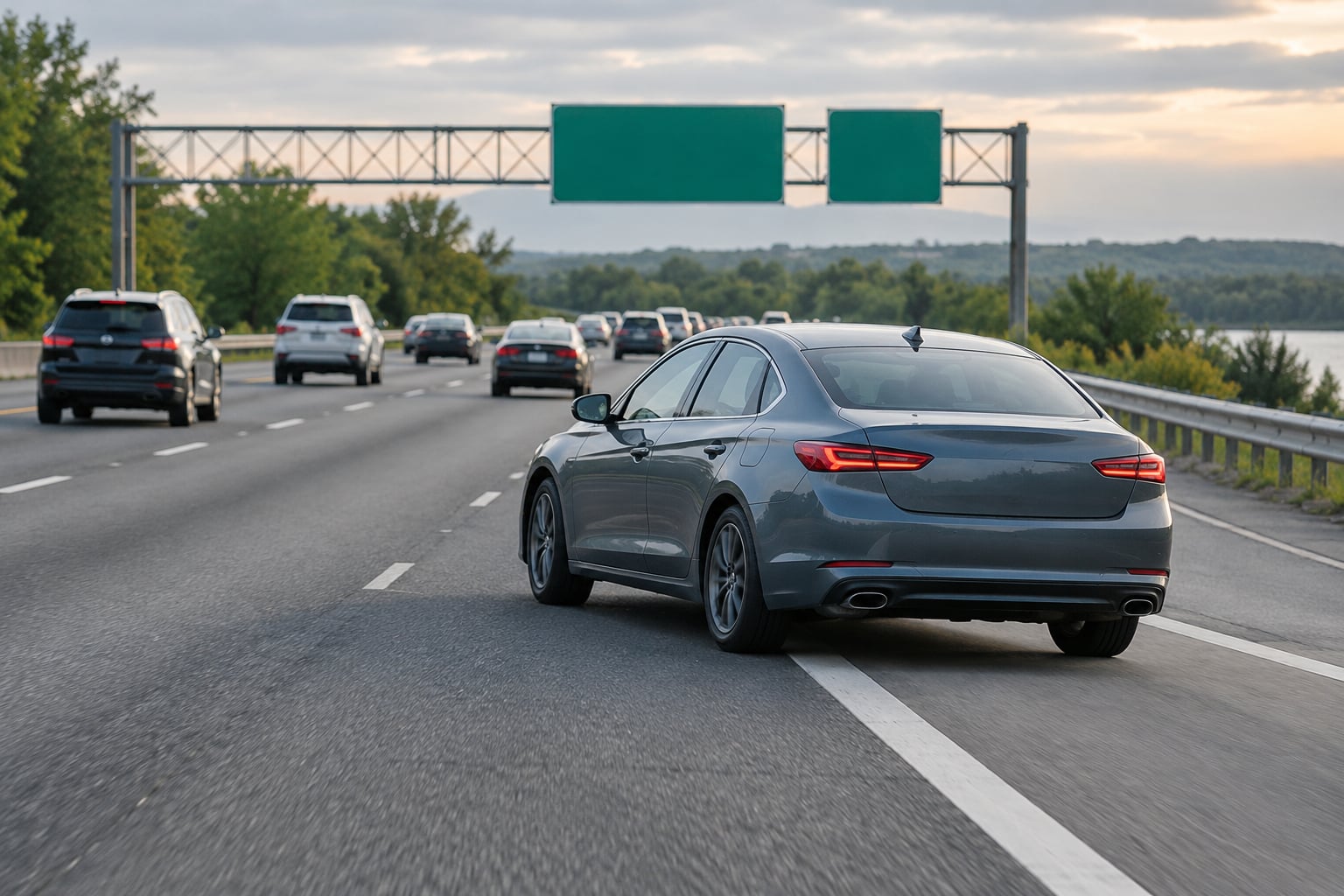
To know how to merge onto a busy interstate safely, use the whole acceleration lane to reach the speed of traffic already out there, signal, find a genuine gap, and go. Vehicles on the interstate have the right of way, so you adjust to them, never the other way around. It takes about ten seconds and gets much easier with repetition.
The drivers who struggle most are usually the ones who try to enter at highway speed off a slow ramp entrance, then dab the brake mid-merge and lose the flow. Here is the sequence that works, in the order it actually happens.
Table of Contents
- What You Need Before You Merge
- How to Merge onto a Busy Interstate Safely: Step by Step
- Frequently Asked Questions
- How fast should I drive on the interstate acceleration lane?
- What should I do if no gap appears while merging?
- Should I use the shoulder to get onto a busy interstate?
- How long should I signal before merging onto an interstate?
- Is it safer to merge slowly or accelerate quickly onto the interstate?
- What should I do if another driver refuses to yield during a merge?
- Conclusion
What You Need Before You Merge
A calm merge starts well before the ramp splits off. Have these basics handled first.
- A valid license and a registered, insured vehicle. Nothing about the merge technique matters if the car is not legal to drive.
- Working signals, brake lights and mirrors. A turn signal you cannot see in your mirror reflection is a signal nobody else sees either. Check that the dashboard indicator matches the bulb outside before you get on the ramp.
- A vehicle you know well. If you have never driven this car before, you are learning acceleration, braking and lane position all at the same time. Borrow a familiar vehicle for your first interstate run.
- Full fuel and correct tire pressure. An underinflated rear tire changes how the car behaves under load at highway speed.
- An early look at the traffic. As the ramp climbs, glance over the guardrail. What speed is traffic doing, how dense is it, and is a vehicle stopped up ahead?
- Roadway signs. A merge sign means one lane joins yours and you give way. A converge sign means the lane is about to end and you must merge. A ramp meter is a traffic light on the ramp itself, and you stop there until it tells you to go.
Knowing what is coming is half the merge. On short ramps, the decision has to happen before you reach the top.
How to Merge onto a Busy Interstate Safely: Step by Step
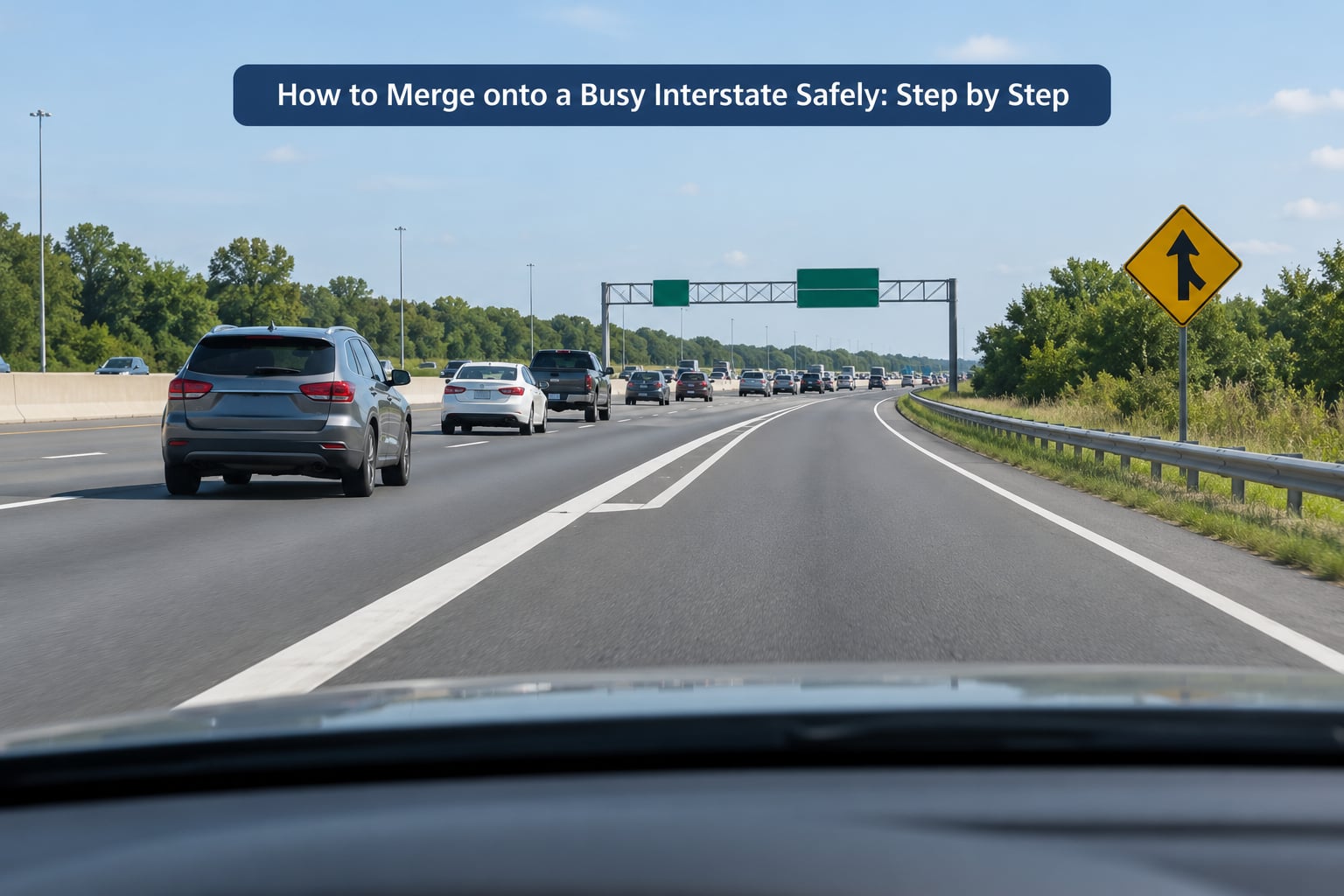
Step 1: Read the Traffic Before You Get to the Ramp
Look over the guardrail while the ramp is still climbing. You are trying to answer two questions: how fast is the traffic moving, and how large is the space between those vehicles.
On a clear interstate, traffic usually runs near the posted speed. In a jam, it crawls, and merging means matching that crawl rather than the posted limit. If a lane is packed solid with no visible openings, an on-ramp is not a gap you can force.
Step 2: Match the Speed of Traffic in the Lane
Use the full length of the acceleration lane. Press the accelerator down and hold a steady throttle until your speed lines up with the vehicles in the lane you intend to enter, ideally within about 5 to 10 mph.
A slow entry is the single biggest cause of merge collisions, because every driver in that lane has to lift off to avoid hitting you. Avoid the opposite error too. Matching speed does not mean exceeding the limit to pass a slower vehicle on the ramp.
If the car ahead of you on the ramp is crawling, stay patient and keep moving. A slow vehicle on the ramp is a nuisance, not a reason to reach the top of the merge area out of position.
Step 3: Signal and Check for a Real Gap
Signal once you have committed to a gap, and keep the signal on until you are fully established in the lane. A turn signal communicates intent to the driver beside you, not to the one two cars ahead.
Use the standard scan: mirrors, then outside mirror, then a shoulder check over your own shoulder into the blind spot. The shoulder check is the step people skip, and it is the only thing that tells you about the motorcyclist in the blind spot.
Judge the gap by time, not by eye. Pick a vehicle ahead in the lane you want, count the seconds until you reach it, then count the seconds for the vehicle behind it to reach the same point. Four seconds in each direction is a workable target in normal conditions, more in bad weather.
Step 4: Yield and Enter the Lane Smoothly
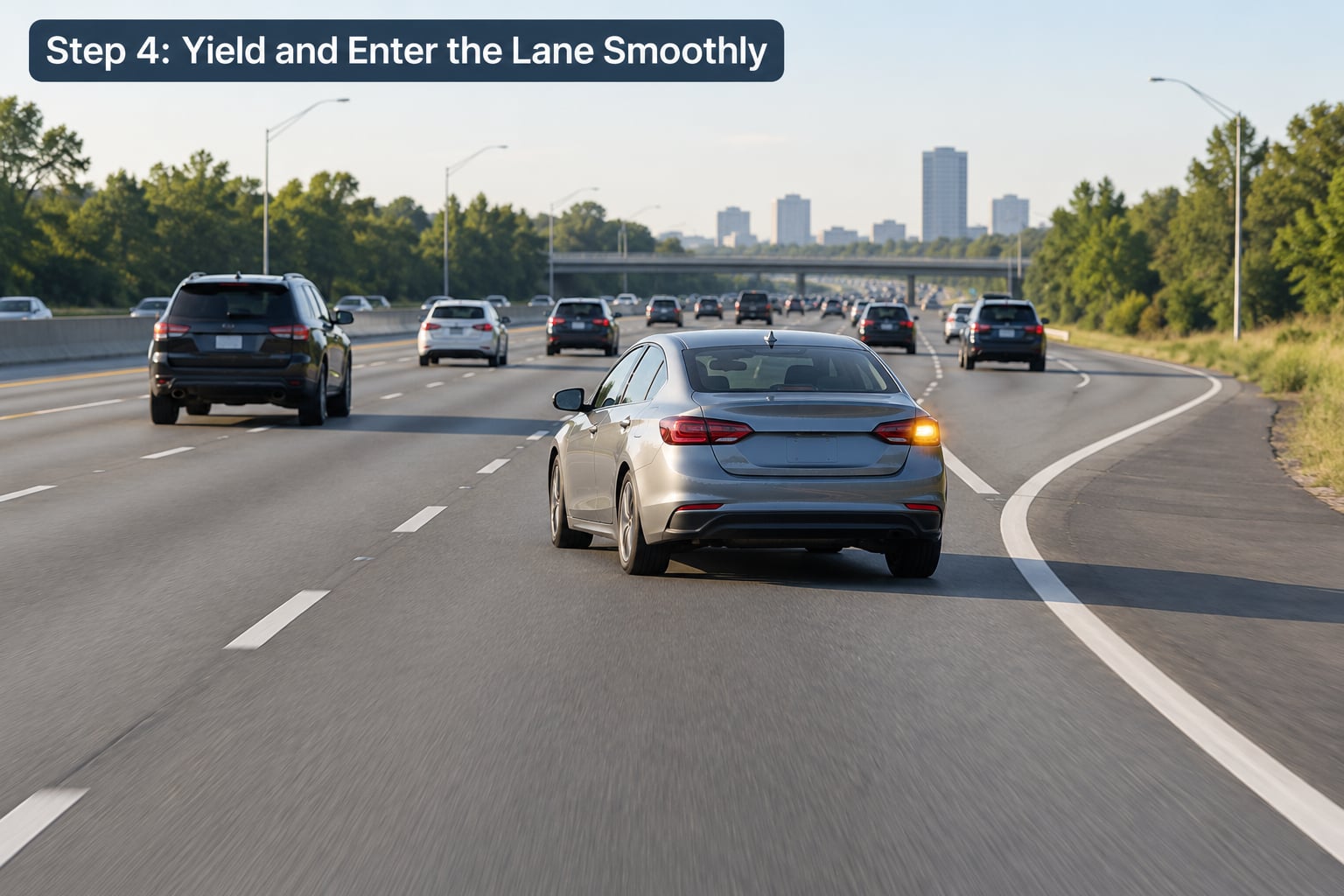
The vehicle behind you has the right of way, so check that its front bumper can see the pavement your vehicle will occupy. If it is still accelerating hard, the gap is not yours yet.
When the gap is real, turn your head once more over the shoulder, then steer smoothly across the line. Move the wheel a few degrees at a time rather than yanking it. Do not brake during the lane change unless something forces you to.
Keep accelerating slightly until your vehicle is fully in the lane and centered between the markings. A vehicle still halfway across the line is invisible to lane changes behind it, and it is the most common setting for sideswipe collisions.
Step 5: Settle Into a Safe Following Distance
Let the signal cancel itself. Then look for the vehicle ahead of you in your new lane and settle back into a four-second following distance, which is more in rain or darkness.
Watch for lane changes around you. Interstate traffic drifts constantly, and the truck that looked far away two seconds ago may now be beside your front bumper. Leave space on both sides when you can.
Common Mistakes That Cause Rear-End Collisions
- Stopping on the acceleration lane. It turns a ramp into a parking spot that nobody expects. If you need to stop, pull over past the gore area where there is room, switch on your hazard lights and wait.
- Entering well below the flow of traffic. You are asking a 65 mph driver to react to a 35 mph obstacle. Correct it on the ramp instead, where you have room.
- Forcing the gap. A gap you have to accelerate hard to reach will close. Pick the next one.
- Skipping the shoulder check. Mirrors show you lanes, not the strip of road directly beside your door.
- Leaving the signal on after merging. It tells following traffic you intend to move again.
- Ignoring zipper merge rules. When a lane genuinely ends, the zipper merge is the courteous, often legally required method: each driver takes turns at the point the lane closes, alternating until the merge point. When a lane continues, take the next available gap rather than alternating. Early mergers who race to the front of a zipper often end up merging onto a shoulder that no longer exists.
On short ramps, start looking for the gap from the moment the ramp splits from the main road. Traffic on the interstate genuinely cannot see you until you clear the guardrail, so the merge begins before you can signal.
Frequently Asked Questions
How fast should I drive on the interstate acceleration lane?
Aim for the speed of traffic in the lane you are joining, usually close to the posted limit. Staying about 5 to 10 mph below it is workable, but far below causes rear-end conflicts. If the lane is congested, match the slower flow instead of the posted speed.
What should I do if no gap appears while merging?
Keep accelerating and hold your position on the acceleration lane. Most short ramps are designed so a patient driver can merge, and traffic opens up as vehicles change lanes. Never shoulder-surf past a queue or drive on the shoulder to reach a gap.
Should I use the shoulder to get onto a busy interstate?
No. The shoulder is not a passing lane and it narrows sharply on most ramps. Using it risks a sideswipe with traffic already in the lane, and it is illegal in most states. If the car ahead of you on the ramp is too slow, stay patient and keep moving rather than trying to pass near the merge point.
How long should I signal before merging onto an interstate?
Signal once you have decided on a specific gap, not when you first get on the ramp. A signal sent too early is ignored by drivers who cannot yet see you. Keep it on through the lane change and cancel it with the lever once you are centered in the new lane.
Is it safer to merge slowly or accelerate quickly onto the interstate?
Match the traffic and merge at a steady, even pace. Slamming the accelerator to force a gap creates a speed difference the other lane has to absorb, and coasting in slowly invites rear-end collisions. Smooth and continuous beats both fast and slow.
What should I do if another driver refuses to yield during a merge?
Do not speed up or lean on them. Ease off the accelerator, hold your position in the acceleration lane and take the next gap. Most drivers simply did not see you. If someone holds a solid line and forces the issue, back off and let them through rather than matching speed beside them.
Conclusion
If you remember one thing, make it the acceleration lane. Use all of it to match the speed of interstate traffic, signal once you have chosen a gap, check your blind spot, and wait for a generous opening rather than forcing your way in. Practise on a quiet stretch at an off-peak hour, and the busy ramp stops being a test.