The short version: create space, stay predictable, and refuse to engage. Most encounters end within a mile once you stop reacting, and the only response that reliably makes them worse is treating another driver like an opponent.
Knowing how to deal with aggressive drivers on the highway matters because a car is a weapon in the wrong hands, and freeway speeds leave you very little room to correct a mistake. You cannot change the other driver’s personality, but you can control your lane, your speed, and your attention, and those three things decide how most of these stories end.
Table of Contents
- What You Need
- Step-by-Step: How to Deal with Aggressive Drivers on the Highway
- Common Mistakes
- Frequently Asked Questions
- Should I report an aggressive driver to the police?
- What should I do after a road rage incident?
- Can I legally record an aggressive driver with my phone or dash cam?
- How do I stay safe if the aggressive driver is following me?
- Should I slow down to make a tailgater back off?
- How do I stay calm when another driver cuts me off at highway speed?
- Conclusion
What You Need
Most of the work happens before an aggressive driver is anywhere near you. A few minutes of preparation turns a stressful encounter into a boring one.
- A vehicle in decent shape. Tires with tread, working brakes, a full tank, and lights that all function. Mechanical problems are a top trigger for other drivers losing patience around you.
- A charged, mounted phone. Mounted and hands-free, with your local emergency number saved. Reaching for a loose phone is a distraction of its own.
- A dash cam or a phone mount that records. Footage is what turns an anecdote into a report an officer can actually act on, and many drivers find out later that they wish they had been running one.
- Local move-over law knowledge. Many states require you to change lanes or slow for stopped emergency vehicles. Know yours before a trooper has to explain it.
- An exit plan. Know the next two exits on a route you drive often, and know where the nearest gas station, police station, and busy parking lot sit.
- A rule for your own temper. Decide now that you will not honk back, gesture, or match speed, so the decision is made before adrenaline picks it for you.
If you share the car with kids or a nervous passenger, give them a job. Saying watch for trucks on the shoulder for us turns a bystander into a spotter, and it takes about ten seconds to say.
Step-by-Step: How to Deal with Aggressive Drivers on the Highway
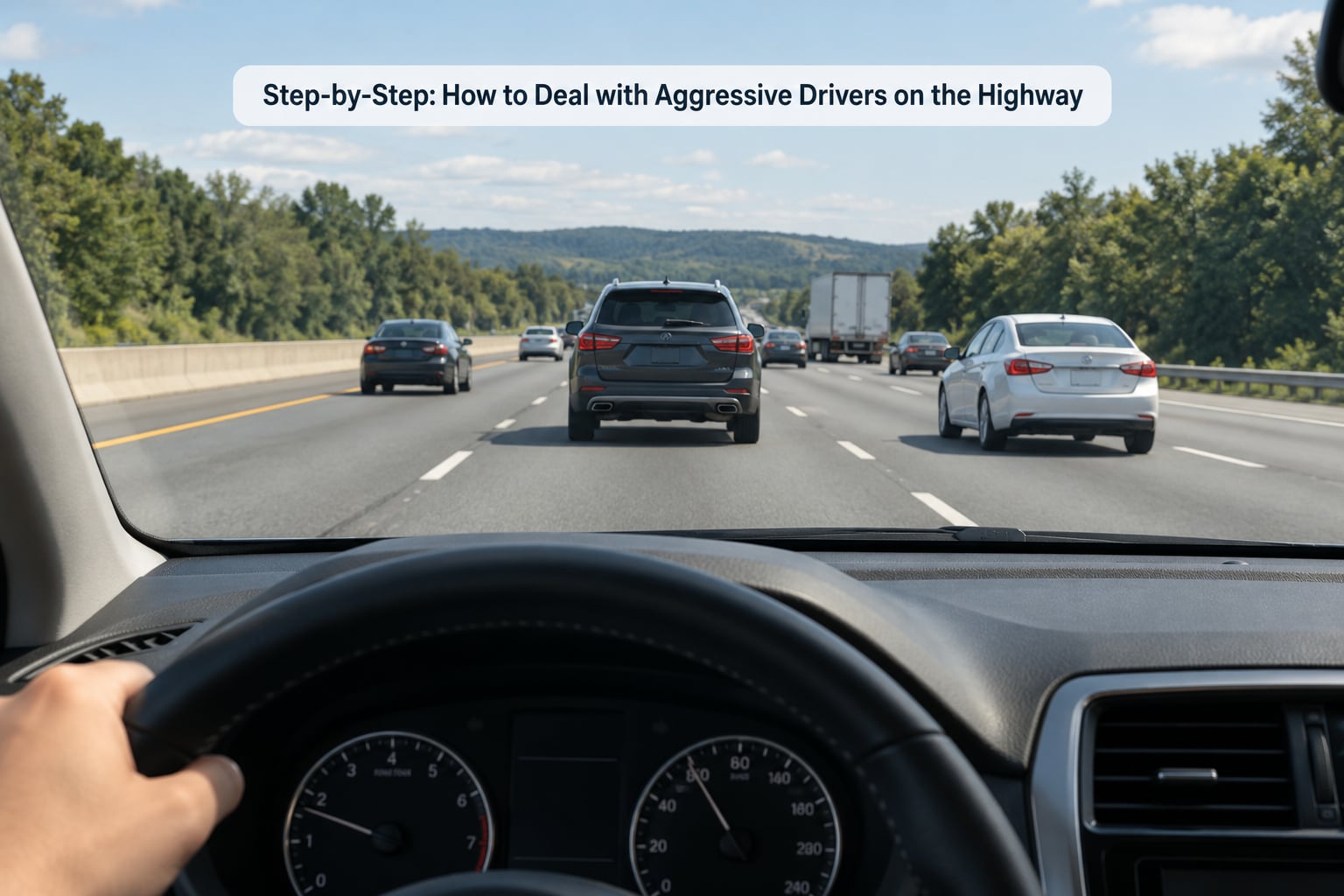
Notice the behavior early, give the driver more room than feels necessary, make one predictable move to remove yourself from the situation, and disengage completely. Never treat it as a contest, and never treat your right of way as something worth defending at highway speed.
These six rules cover almost every freeway encounter you will meet.
- Do not engage. No eye contact, no honking, no hand gestures, no raised voice, nothing that reads as a challenge.
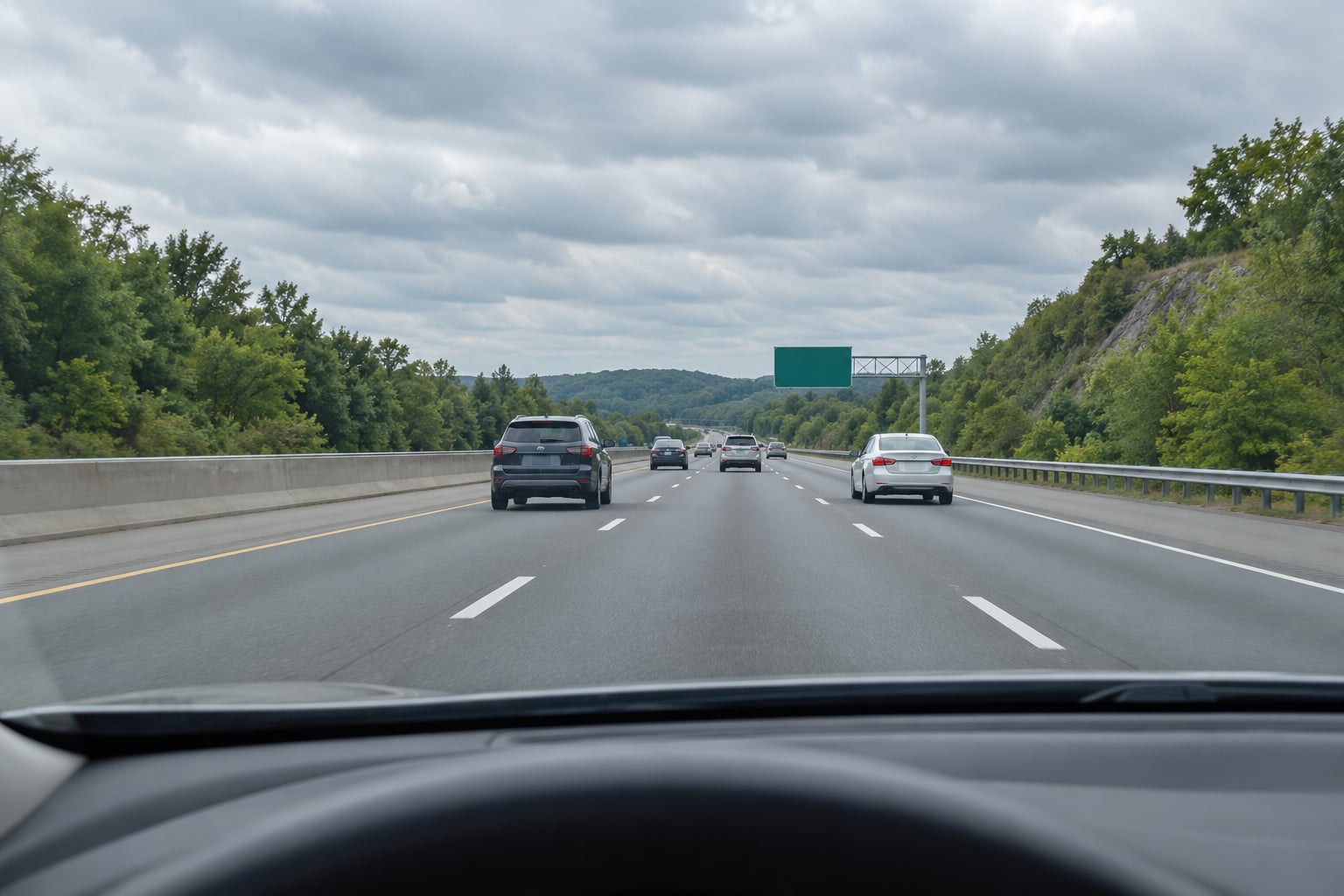
- Create distance. Lift off the accelerator and add a three-to-four second following gap. Space buys reaction time.
- Get out of their way early. Move toward the shoulder-side lane, stay out of the passing lane, and let them go by.
- Stay predictable. Hold a steady speed, signal before lane changes, and never change lanes twice to avoid them.
- Keep both hands on the wheel and your eyes forward. Do not film them while driving, and do not turn around to look.
- Break contact or call for help. If it escalates, drive to a populated place, then call emergency services or file a report once you are safely parked.
Here is how those rules translate into specific behaviors you will actually meet.
| What they do | What you do |
|---|---|
| Tailgate you at high speed | Lift off the gas, add distance, stay in your lane, do not brake suddenly |
| Cut you off during a lane change | Release the accelerator, back off the wheel, let them have the lane |
| Ride alongside in the shoulder-side lane | Maintain a steady speed and let them run out of road or pass |
| Weave through traffic | Never match their speed, keep your gap, stay out of the passing lane |
| Sit in your blind spot | Move a lane away when safe, or nudge forward to open your mirror view |
| Honk or flash headlights | Ignore it completely and keep your rhythm |
| Block an exit ramp | Slow early, signal, and merge behind without touching them |
| Follow you off the freeway | Do not go home, drive to a staffed public place, call authorities from there |
| Get out of the vehicle | Lock doors, keep driving, do not stop, call emergency services |
| Follow you home later | Do not open the door, do not confront, report it and talk to someone you trust |
How to deal with aggressive drivers on the highway when they tailgate
A close follower wants one thing: to get past you. Give them that reason, and the pressure dissolves in seconds.
Do not brake suddenly to teach them a lesson, because sudden braking is how a low-speed situation becomes a rear-end collision. Instead, lift your foot off the accelerator and let the gap widen naturally, or ease your speed down a notch within the limit so they overtake without flooring it.
If your car has adaptive cruise control, turn it off for the encounter. Those systems happily match a nearby vehicle’s speed, which is exactly the response you do not want when the vehicle beside you is the problem. Use your own judgment on the throttle instead.
How to deal with aggressive drivers on the highway when they cut you off
A cut-off at 70 miles per hour is startling mainly because it is abrupt. Your response should be uninteresting: get out of the accelerator, do not swerve, and let your car’s momentum settle.
Do not match their speed out of irritation, and do not try to hold them to the law by positioning yourself alongside. Signal early if you change lanes, and change once. A driver who cuts one lane usually cuts again, so pick the position with the most open space ahead of it rather than the most dramatic one.
How to deal with aggressive drivers on the highway when they follow you
If a vehicle stays with you for several exits, treat it as a possible follower and switch to plan B. Do not turn onto your street, and do not pull into your driveway.
Drive to somewhere staffed and open: a gas station with people outside, a large grocery lot, a police station. Park in a well-lit spot with your vehicle visible and lock the doors. From there, call the non-emergency line, give a description and direction of travel, and let a dispatcher decide whether an officer responds.
One caution: a follower is not always a follower. Construction vehicles, tow trucks, and slow vehicles can appear to follow you for miles. Locking doors and seeking a public place costs nothing, so do it anyway.
How to deal with aggressive drivers on the highway when they make threats
Rank the threat by what the driver is actually doing, not by what you think they mean. Loud words in one vehicle are one category. Dangerous driving aimed at you is another. Getting out of the vehicle, following you, or blocking the road is a third, and only the third requires you to leave.
For verbal intimidation, do nothing. Look forward, keep your speed steady, and let the moment pass. There is no winning line in a shouting match at highway speed, and silence is a strategy.
For a driver who exits the vehicle or stands in your path, stay in your car with the doors locked, keep the engine running, and drive around or back off if you can do so without a collision. Do not get out. Once you are somewhere safe, call emergency services, then write down what you saw while it is fresh: time, highway and direction of travel, make and model, color, and plate number if you caught it. If a camera recorded it, keep the file.
If anyone is injured or you believe a weapon is involved, that is a 911 call. Make it hands-free or pull over first if you can do either.
Common Mistakes
Almost every response that turns a nuisance into a real confrontation is on this list, and each one has a calm replacement.
- Honking back. It reads as a challenge and tells the other driver you are engaged. Fix: silence.
- Flashing headlights or high beams. Intended to shame, received as aggression, and it reduces your visibility at night. Fix: do nothing.
- Gesturing or mouthing off. A stranger with nothing to lose and access to a two-ton vehicle is the common final step in every account of a confrontation turning physical. Fix: eyes forward.
- Tailgating them back. Two vehicles braking hard at 65 is a crash with extra steps. Fix: pull away, do not press.
- Speeding up to prove a point. You lose the argument and gain a ticket, or worse. Fix: match the limit, not their speed.
- Staring or filming while driving. Both take your eyes and hands off the driving task. Fix: if it matters, record after you are parked.
- Following them after they cut you off. This is how a fender bender becomes a road rage assault. Fix: let them disappear.
- Arguing at a stop sign or parking lot. The vehicle is stopped, so they are not really going anywhere. Fix: drive on.
One debate comes up constantly among drivers: should you slow down to make a tailgater back off? Both camps make a fair point. Slowing slightly can end the encounter in a few seconds and give them room. But the driver learns nothing, and the same person does it to the next car. If you ease off, do it inside the speed limit and stay predictable, so it reads as normal traffic rather than a game.
The other half of the fight is your own temper. Long drives, heat, caffeine, and boredom stack up quietly. If you notice your grip tightening or your speed climbing for no reason, pull in for ten minutes. Losing ten minutes is cheaper than the kind of crash that follows a bad hour.
Frequently Asked Questions
Should I report an aggressive driver to the police?
Yes, when it is safe and the behavior was genuinely dangerous, and many drivers are skeptical it is worth the effort. Reports with a plate number, vehicle description, direction of travel, time and location are the ones that can be acted on. Never make a call while driving unless there is an immediate threat, in which case use hands-free emergency calling. Otherwise wait until you are parked.
What should I do after a road rage incident?
Get somewhere safe first, then deal with the paperwork. Write down what happened while you still remember it clearly, save any dash cam or phone footage, and photograph your vehicle if there was contact. If anyone was hurt or you felt threatened, contact emergency services. For insurance claims, your own coverage often handles damage to your car, but keep every detail for the adjuster.
Can I legally record an aggressive driver with my phone or dash cam?
In many states, recording the public view from your own vehicle while driving is permitted, but the rules differ by state and some states limit how you may use the footage. A dash cam with a mounted, legal installation is the simplest option, and many states expect a timestamp for footage to carry weight. Check your own state law before you publish anything online.
How do I stay safe if the aggressive driver is following me?
Do not go home and do not confront them. Drive to a staffed public place such as a police station, a busy gas station or a large retail lot, park where your car is visible, and lock the doors. Call the non-emergency line from there and give a description and direction of travel. If the driver gets out of the vehicle or blocks the road, move away and call emergency services.
Should I slow down to make a tailgater back off?
Easing off within the speed limit is a reasonable way to open a gap and end the encounter quickly, but it is a traffic habit, not a confrontation. Never brake suddenly or drop well below the limit, because sudden braking is the main way a tailgating encounter turns into a rear-end collision. Keep a steady, predictable speed, stay in your lane, and let the driver pass.
How do I stay calm when another driver cuts me off at highway speed?
Give yourself a small physical reset: unclench your jaw, drop your shoulders, and put both hands back on the wheel. Then do three things in order: lift off the accelerator, keep your lane, and look further ahead than the vehicle in front of you. Most drivers find the emotional spike fades within ten seconds, and almost none of these encounters follows you for long.
Conclusion
Do one thing first, and the rest takes care of itself: create distance and disengage. Lift off the gas, add a three-to-four second gap, move out of the passing lane, and refuse every instinct to respond. If the driver escalates toward you, drive to a staffed public place and call authorities from there. Most aggressive drivers are gone in under a mile, and the ones who are not are not worth a single point of your safety.