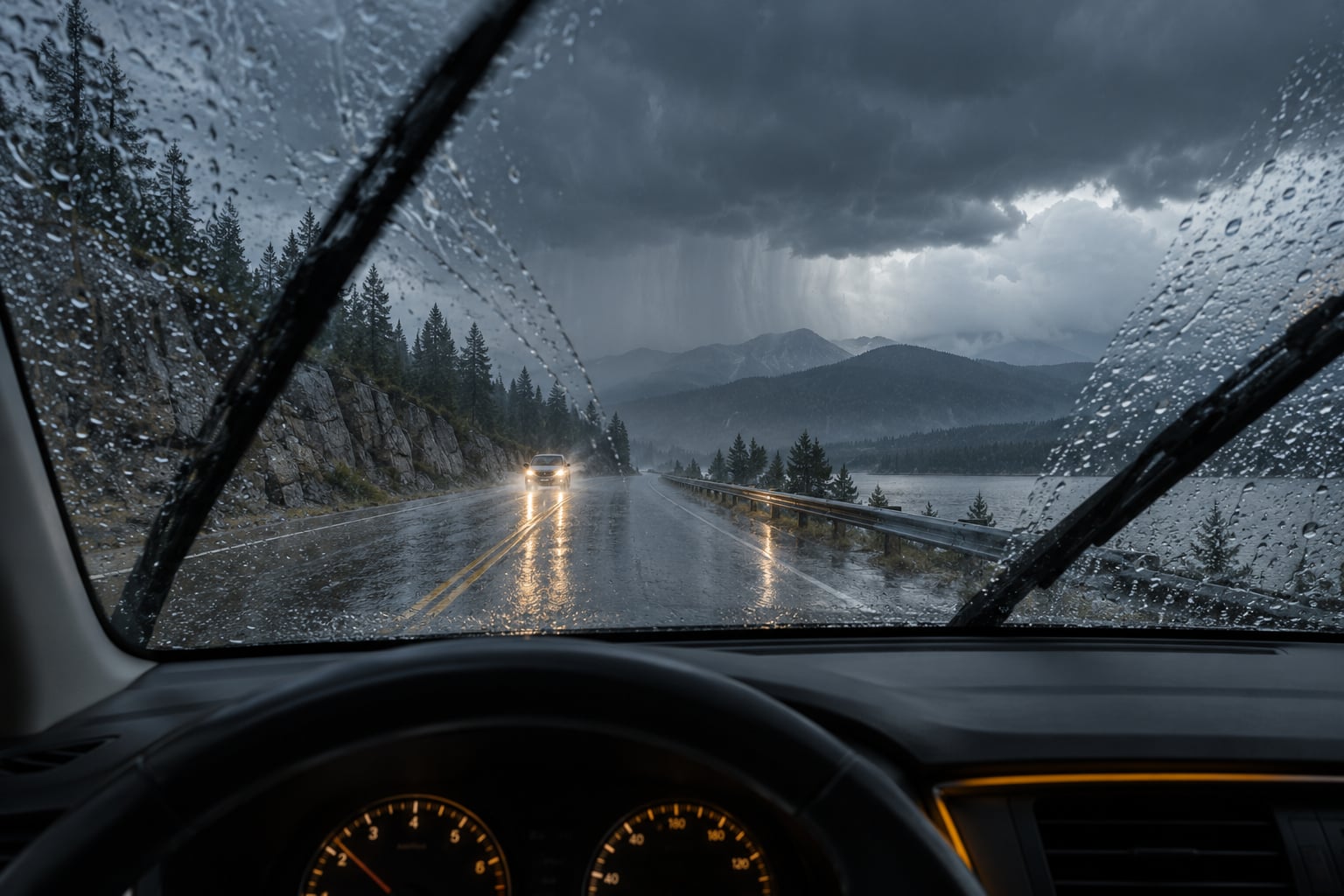
Heavy rain changes three things at once: how far ahead you can see, how much grip your tires have on the road, and how fast you can stop. To drive in heavy rain safely, slow below your normal speed, double the gap to the vehicle ahead, switch on low-beam headlights, and keep well clear of standing water.
That is the whole method. The rest of this guide is the detail that makes it work on a real commute, a highway at 65 mph, or an unlit rural road at night, when the wipers are on maximum and you still cannot see the car in front.
Worth knowing up front: roughly 75 percent of weather-related traffic crashes happen on wet pavement, with nearly half a million people injured in the US every year, according to the National Highway Traffic Safety Administration. A downpour is not a small version of a normal drive. It changes how your car behaves, and almost every accident chain in the rain starts with a driver treating it like a normal one.
There is also a counterintuitive wrinkle. The first 10 to 15 minutes after rain starts are usually the most slippery part of the whole shower, because the water is mixing with oil, grease, mud and rubber that have been sitting on the pavement since the last time it dried. Grip often comes back later, once that film has been washed off. Slowing down when the rain begins is not just caution, it is timing.
Table of Contents
- What You Need Before the Trip
- Step-by-Step: How to Drive in Heavy Rain Safely
- 1. Check the forecast and road warnings before leaving
- 2. Inspect tires, lights, wipers, and brakes
- 3. Leave extra time and build in distance
- 4. Turn on the right lights and control visibility
- 5. Reduce speed and smooth every input
- 6. Cross standing water cautiously and never flood a road
- 7. Handle a skid or sudden loss of traction
- 8. Pull over safely if visibility collapses
- Common Mistakes
- Frequently Asked Questions
- What should I do if my car starts hydroplaning while driving in heavy rain?
- Is it safer to pull over or keep driving when visibility is suddenly poor?
- Should I use high beams when driving in heavy rain at night?
- How much farther apart should I drive in the rain?
- Can I safely drive through a flooded road during a storm?
- Do I need special tires or equipment to drive safely in heavy rain?
What You Need Before the Trip
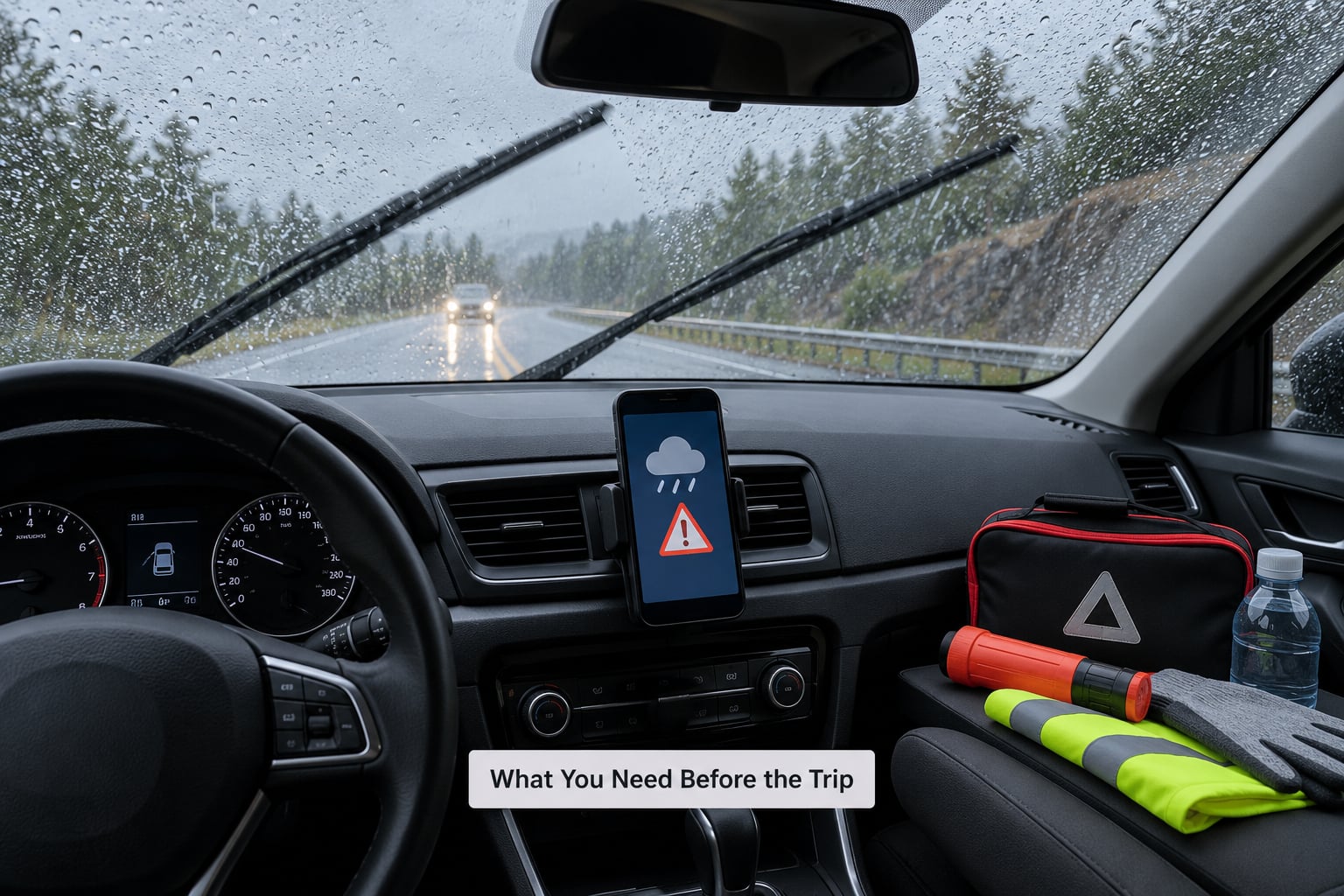
A good hour of preparation removes most of what makes a rainy drive frightening. You want four things in order: a car that is roadworthy, a car that can see, a plan that accounts for delay, and an honest read on whether you should go at all.
Tires you would trust in the dry
Four worn tires are the single biggest factor in whether your car hydroplanes. Water has to be squeezed out of the contact patch for the rubber to grip, and tread grooves are what do that squeezing. In the US the legal minimum is 2/32 inch, and tire makers generally recommend replacing at 2/32 or below; for heavy rain you want considerably more than the legal floor.
Check tread depth with a penny. Insert it into the grooves at several points around the tire, including the inner shoulder, and if you can see more than half the head you are near the end. Also look for uneven wear across the tire, which points at alignment or worn suspension, and for cuts or bulges in the sidewall.
On pressure, follow the label on the driver’s door jamb rather than the number on the tire sidewall. That is the figure the car was engineered around. Tire pressure rises in warm weather and falls in cold, so a tire that passed in January can be low by March.
Visibility gear that actually works
Wiper blades that streak or chatter are a rain-day problem long before the rain arrives. Rubber perishes with age and UV exposure, so blades that have been on the car for a couple of seasons often smear no matter how clean the glass is. Replace them, and top up washer fluid before you leave rather than discovering an empty reservoir halfway down the interstate.
Know where your defogger and demister controls are before you need them. Cabin humidity rises fast in a downpour, and most cars clear a windscreen faster with air conditioning running against the demister than with heating alone. On many vehicles the air conditioning button works with the heat.
Clean the inside of the glass, not just the outside. Wiping a damp inner surface with a bare hand spreads a thinner, more uneven film that fogs faster, which is a change that costs you nothing and helps immediately.
Lights, brakes and driver aids
Walk around the car and confirm that every bulb works: headlamps, brake lights, indicators, fog lights and the licence plate lamp. Have somebody watch while you press the pedal and turn the signals so you can check the brake lamps and indicators rather than guessing from the reflection in a garage door.
If the car has anti-lock brakes, electronic stability control or traction control, leave them on in the wet. They are the systems doing the fast, sensible braking and stability corrections that a human under stress will not manage, and your owner’s manual will tell you exactly what your car does when those systems engage.
An emergency kit and a phone that works
Carry at minimum warning triangles or flares, a flashlight, a reflective vest, a bottle of water, a tyre inflator or at least a spare and jack, and a phone charged and mounted where you can reach it without looking down. In real rain breakdowns you want to be able to work at the side of the road while still seeing.
Put the weather app on a screen you can glance at without handling the phone, and download an offline map of the route. Mobile coverage drops in exactly the places where a flooded road is most likely, in valleys, underpasses and low rural stretches.
A route plan with a stopping point
Pick at least one safe place to pull off before you leave, a fuel station, a car park, somewhere lit and above the flood line. When visibility collapses you should not be choosing between unfamiliar turn-offs. Know which exits on your route can take a flood, and check for official weather warnings or road closures before departure rather than discovering them at the flood line.
Step-by-Step: How to Drive in Heavy Rain Safely
Each step below covers what to do, why it matters, and how you can tell it is actually working. The order is deliberate: the cheap, high-value adjustments come before the ones that require you to change how you drive.
1. Check the forecast and road warnings before leaving
Look at the timing of the rain, not just whether rain is forecast. A shower at noon on your commute is a different problem from sustained rain through the afternoon. Check for flood warnings, road closures and storm alerts, and check whether the route you normally take passes through known low-lying spots.
Postpone or reroute when conditions are dangerous, and be honest about what that means. Water across a road, a flooded underpass, or a police closure is a decision made for you, and arguing with it wastes the time you should have saved.
You have worked this step when you can say, before pulling out, when the rain arrives, where the water is likely to collect, and where you will stop if it gets bad. If you cannot answer those three, you are not ready to leave.
2. Inspect tires, lights, wipers, and brakes
Run through the checks above before you turn the key for anything longer than a short hop. Tire tread and condition, wiper blade condition, washer fluid, every exterior light, and brake pedal feel are the ones that matter most.
Postpone the trip when tires are bald or damaged, when a light is out, when the wiper blades smear, or when the brake pedal feels soft, spongy or pulls to one side. A service booking is cheaper than a roadside recovery in a storm with 40 mph crosswinds.
You have worked this step when the tread check came back with real margin, the wipers clear the screen in one pass, and the pedal feels the same as it did yesterday. If you are squinting to check the brake lights alone, find someone to help or accept that you have not checked them.
3. Leave extra time and build in distance
Wet pavement increases stopping distance, sometimes by roughly double compared with a dry surface in the same conditions. Whatever gap felt comfortable on a dry commute is now too small.
Use a gap of about four seconds in the wet, against the usual two seconds in dry conditions. Time it by picking out a fixed roadside object and counting the seconds after the vehicle ahead passes it until your own windscreen reaches it. Four seconds in the rain feels generous and looks excessive. That gap is what lets you avoid the crash that a two-second gap turns into a collision.
The same thinking applies to your schedule. Leaving late and driving calmly beats leaving on time and driving at the limit, because pressure is what produces the tailgating, the missed exits and the sudden lane change.
You have worked this step when you reach your first turn or exit without needing to brake hard, and traffic ahead becomes visible in your mirrors before it becomes a problem in your windscreen.
4. Turn on the right lights and control visibility
Use low-beam headlights, or dipped beams, whenever visibility is reduced by rain. They make you easier for other drivers to see and they light the road edge and the surface texture just ahead of your bumper, which is what you actually need at night in a downpour.
Keep high beams off in rain and in fog. The light from oncoming low beams reflects off the falling water and off the wet road right back at you, and the result is a wall of white glare with nothing visible behind it. High beams also light the spray thrown up by the vehicle in front of you, which is the exact thing you are trying to see past.
Run your wipers in intermittent mode rather than maximum whenever the rain allows it. Continuous wiping on dry glass drags grit across the surface and smears what is left. Max speed is for genuine downpour, where slower settings leave you effectively blind between sweeps.
Switch the demister onto the windscreen, side glass and rear screen if you have it, and run the air conditioning if the cabin starts to mist. Wipers only clean the windshield and the rear screen, so the side windows, quarter glass and mirrors stay blind without defogging. That blindness is the single most common complaint in rain-driving discussions, and it is where most lane-change collisions start.
Hazard lights are for when you are genuinely stopped, or moving so slowly in traffic that others need warning. Running them while moving at normal speed confuses people and washes out your turn signal entirely.
You have worked this step when the road ahead is easier to see than it was a minute ago, and no one is flashing headlights at you.
5. Reduce speed and smooth every input
Hydroplaning risk rises with speed. Hydroplaning becomes significantly more likely at higher speeds, with around 35 mph commonly cited as the threshold where the risk climbs sharply on a wet road surface.
Slow below the posted limit in heavy rain, by enough that stopping still feels routine. Then make every input gradual. Progressive braking means pressing the pedal firmly and steadily rather than jabbing it, releasing and pressing again does nothing useful in a straight line and can unsettle a loaded or high-center-of-gravity vehicle. Accelerate softly, and take wide gentle turns rather than tight ones that load the outside tires.
On a manual, use a lower gear than you would in the dry and keep the engine revs up, which stops you bogging down and keeps you slow enough to avoid throwing up a bow wave of water in front of the vehicle behind you. On an automatic, select a lower gear manually on a sustained downhill so the brakes do not overheat and lose effectiveness.
You have worked this step when the vehicle stays planted through a curve and braking, and you can still make small corrections without feeling the back move.
6. Cross standing water cautiously and never flood a road
Water depth is very hard to judge at speed, especially on a road that dishes toward the shoulder or hides a dip under a film of moving water. Slow down early and well before the water, so you arrive at it at a speed that lets you stop or change course.
Keep the steering straight and gentle. A sudden input at the edge of a puddle is what rolls a car, and one of the reasons moving to a new lane in the rain is risky is that you are often crossing into water tracks the car in front has just cleared, which is where grip is thinnest.
Never drive through floodwater of unknown depth. Moving water of around 12 inches can carry a light vehicle off the road, and deeper or faster water will do considerably worse than that. If you cannot see the road surface under the water, if the water is moving, or if it reaches the bottom of the doors, turn around and find another route. Being late is a recoverable outcome.
Two more hazards travel with heavy rain. Crosswinds get much stronger in storms and will push a tall vehicle around, particularly a pickup, an SUV, a camper or anything towing. And unlit rural roads give you no reference points for depth or for flooded verges, which is exactly where flood damage tends to appear.
You have worked this step when you chose a dry route rather than testing the water, and you can say why without hesitating.
7. Handle a skid or sudden loss of traction
Hydroplaning feels like the car has suddenly left the road, but it is a thin film of water forming between the tires and the surface. Common symptoms include an engine revs that climb without the car accelerating, steering that feels loose or slightly disconnected, the vehicle drifting within its lane, or braking that takes noticeably longer than expected. On an automatic the same thing shows up as the transmission hunting between gears.
If it happens, ease off the accelerator progressively. Do not slam the brake pedal and do not turn the wheel sharply. Keep the wheel pointing roughly where you want the car to go and hold it there with a light, steady grip rather than a death grip. Let the speed fall until the tires bite again, then brake gently and continue.
Whether you have ABS changes the braking advice. With ABS, stand on the brake pedal firmly and let the system do its work; the pedal will pulse and the system will release and reapply pressure for you. Without ABS, the wheel lock that causes a skid can be broken by pumping the brake pedal quickly and lightly, while keeping the wheel steered in the direction you want to travel. On a rear-wheel-drive car in a low-speed turn, a momentary loss of grip on the inside rear wheel is often a normal part of the corner, not a crisis.
Do not use cruise control on a wet road. A cruise system holds a throttle position without reacting to the surface, which leaves the wheels spinning at a set speed on water that needs less speed to stay safe, and the fishtailing that follows when grip returns is harder to catch than a skid you were managing yourself.
You have worked this step when the vehicle settles, you can feel the tires through the pedal again, and you can steer normally without it fighting back.
8. Pull over safely if visibility collapses
If rain is so heavy that you cannot see the road edge, lane markings or the vehicle ahead, you are not driving, you are guessing. Get off the road in a controlled way rather than at emergency speed.
Signal, ease off the accelerator, and move as far toward the shoulder or edge of the roadway as you safely can. Hazards on, seat belt still fastened, and stay in the vehicle with it parked. Never stop in a live lane, on a bridge deck with no shoulder, or at the top or bottom of a flooded dip where other drivers may not see you.
Wait until the intensity drops enough to see the road surface and lane markings properly, even if radar still shows rain nearby. You will not save meaningful time by guessing at a visibility you cannot verify, and you will lose a great deal of it if the wrong driver has to swerve around you.
Weather guidance from forecasters is consistent on this point: if the rain is so heavy that you cannot see, pull over and stop. That applies to high winds too. Sustained winds of 20 to 30 mph make roadside work dangerous, especially for tall vehicles and anyone standing near a carriageway or an exposed structure.
You have worked this step when the car is stationary, fully out of the traffic lane, hazards set, and you are waiting for a real improvement rather than an optimistic one.
Common Mistakes
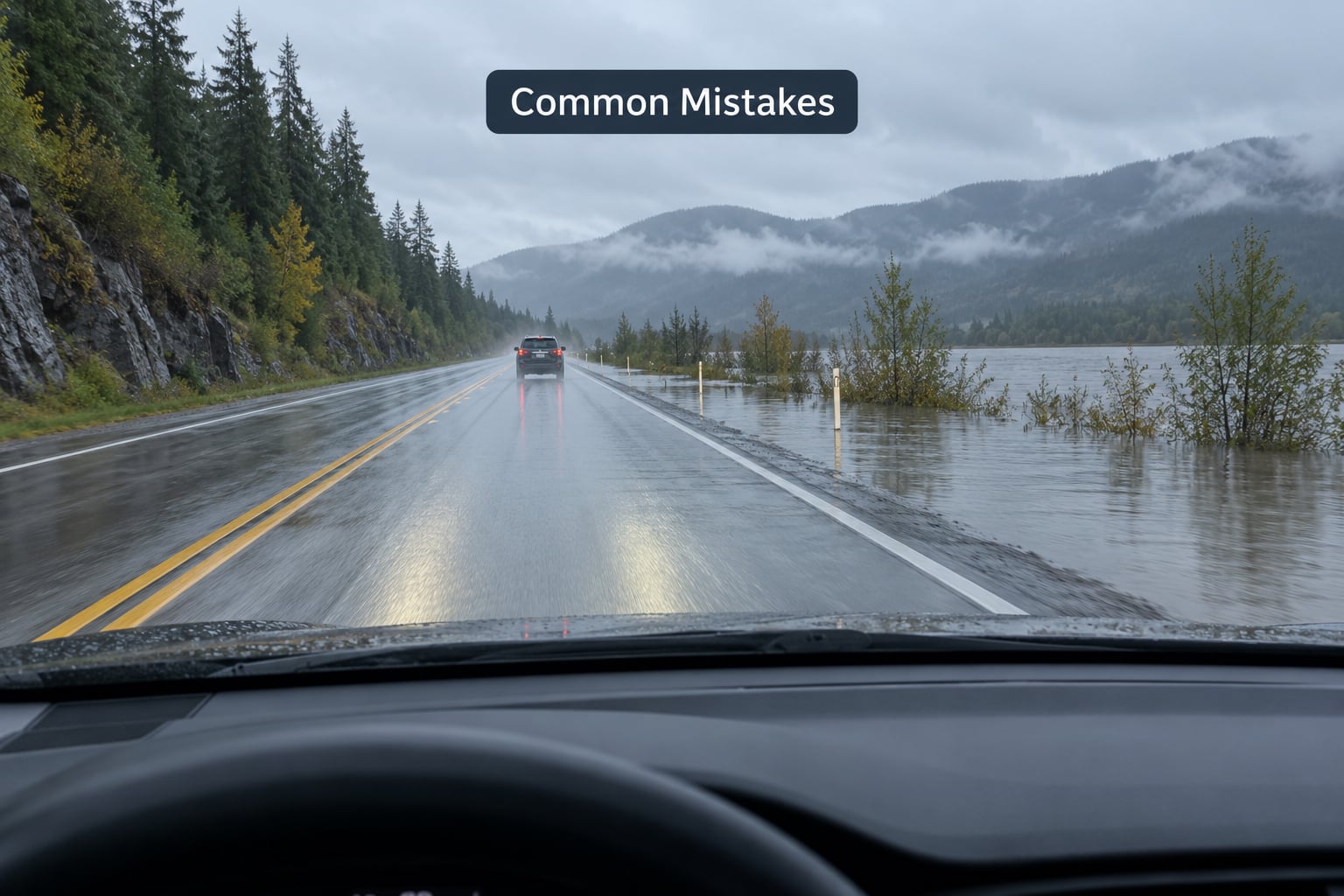
Nearly every rain accident I have read about in forums involved a driver doing one of a short list of things, usually while fully aware they were doing them. Each mistake has a simple correction, and the correction is almost always slower than instinct wants.
Driving at the speed limit because it feels normal
On a wet road at highway speed, the posted limit stops being the safe speed. Cut back to a speed where you could stop within the distance you can see, and adjust as visibility changes.
Sitting in the driver’s usual gap
Two seconds in the dry, roughly four in the wet. A driver following a normal gap in the rain has already lost the option of reacting gently.
High beams at night
They bounce back off falling water and wet pavement and reduce your visibility to near nothing. Low beams are what you want.
Stabbing the brakes or the throttle
Both break traction. Firm progressive braking and smooth, gentle acceleration give the tires time to do their job.
Using cruise control
It holds speed across surface changes you cannot feel. Drivers on forums are consistent about switching it off the moment the road is wet.
Changing lanes in the rain
You are usually crossing into the water tracks the vehicle in front just cleared, which is the least grippy part of the road. Signal early, move once, and keep the steering smooth.
Driving through floodwater
If you cannot see the surface, do not drive through it. Turn around, reroute, or pull over and wait for the water to drop.
Stopping in a bad place
A shoulder at the bottom of a dip, a bridge with no refuge, a bridge or tunnel, an unlit verge. If you cannot get fully out of the traffic lane, keep moving slowly to the next place you can.
Two smaller ones that catch people out. Washing the side mirrors and quarter glass is not possible with wiper blades, so build in extra overlap when changing lanes. And driving in a low gear is genuinely useful on a manual in the wet, because it keeps revs up and stops you bogging down into a bow wave, but it is not a licence to sit in second gear at highway speed.
The shortest version of all of it: lights on low beam, speed down, gap doubled, water avoided, inputs smooth. Those five cover most of the risk.
Frequently Asked Questions
What should I do if my car starts hydroplaning while driving in heavy rain?
Take your foot off the accelerator gradually, do not slam the brakes, and do not turn the wheel sharply. Hold the steering wheel in roughly the direction you want to travel with a light grip and let the car slow down until the tires grip again. Then brake gently and continue. With ABS fitted, stand firmly on the brake pedal and let the system pulse; without ABS, pump the pedal lightly to avoid locking the wheels.
Is it safer to pull over or keep driving when visibility is suddenly poor?
Pull over if you cannot see the lane markings, the road edge or the vehicle ahead. Signal, ease off the accelerator and move as far onto the shoulder or roadway edge as you safely can, then set your hazard lights and stay belted in the vehicle. Never stop in a live lane. Wait until you can properly verify the road surface again, even if rain still shows on a radar nearby.
Should I use high beams when driving in heavy rain at night?
No. High beams in heavy rain produce glare: the light reflects off falling water and off the wet road back toward you, and they also illuminate the spray thrown up by the vehicle ahead, which is exactly what you are trying to see past. Switch on low-beam, or dipped-beam headlights instead. They light the road edge and the surface texture just ahead of you, and they let other drivers see you clearly.
How much farther apart should I drive in the rain?
Double your usual gap, from two seconds to about four. Time it by choosing a fixed point at the roadside and counting the seconds after the vehicle ahead passes it until your windscreen reaches it. Wet pavement lengthens stopping distance substantially, sometimes by roughly double compared with a dry surface in the same conditions, so a normal dry-weather gap removes your margin for a gentle correction.
Can I safely drive through a flooded road during a storm?
Not if the depth is unknown. Moving water of around 12 inches can sweep a light vehicle off the road, and deeper or faster water is far more dangerous. Turn around and find another route whenever you cannot see the road surface under the water, whenever the water is moving, or whenever it reaches the bottom of the doors. Do not follow another vehicle through; it may be deeper than it looks where its tires enter.
Do I need special tires or equipment to drive safely in heavy rain?
You need good tires, not exotic ones. The legal minimum tread in the US is 2/32 inch, but tire makers recommend replacement at that level and heavy rain demands more margin than the legal floor. Also check pressure against the label on the driver’s door jamb, keep wiper blades and washer fluid in good order, and keep anti-lock brakes, stability control and traction control switched on. Know where your defogger controls are before you need them.
Start with the two changes that cost nothing and matter most: drop your speed below the limit and double the gap. Then run the rest of the list in order, lights on low beam, wiper and defogger set before you need them, cruise control off, water avoided rather than tested.
If the visibility goes, stop properly and wait it out. Knowing how to drive in heavy rain safely is not only about what you do while moving; it is also knowing when the sensible move is to be parked in a lay-by with your hazards on instead of pushing on.