Short answer: what TSA allows in a carry-on bag is nearly everything that is not a weapon, a flammable material, or an oversized liquid, as long as liquids, gels and aerosols sit in containers of 3.4 ounces (100 ml) or less inside one clear quart-sized bag. Everything else is mostly up to your airline’s size and weight rules. Last updated October 2026; rules change, so verify anything unusual with TSA’s Ask TSA tool before you fly.
I fly a lot of short domestic hops on a budget, and the checkpoint is where trips get complicated. A full-size sunscreen bottle repacked at the belt in front of a line of forty people is a bad morning. Knowing the rules ahead of time is boring, and boring is the goal.
Table of Contents
- What TSA Allows in a Carry-On Bag at a Glance
- How TSA Checks a Carry-On Bag
- Liquids, Aerosols, and Gels
- Food, Snacks, and Drinks
- Medications and Medical Items
- Toiletries, Cosmetics, and Personal-Care Items
- Electronics, Tools, and Everyday Carry Items
- Duty-Free Purchases and Connecting Flights
- Baggage Limits Are Not the Same as Screening Rules
- How to Pack for a Smooth TSA Check
- What to Do If TSA Says Your Item Is Not Allowed
- Frequently Asked Questions
- Conclusion
What TSA Allows in a Carry-On Bag at a Glance
Searches for what TSA allows in a carry on bag usually come back as one long undifferentiated list, which is not much help at 5 a.m. with a connection to catch. Think of the rules as four buckets instead. Most ordinary belongings pass, liquid-shaped items have a volume cap, a few items get looked at more closely, and a short list is never allowed.
| Category | Generally permitted | Watch for |
|---|---|---|
| Everyday personal items | Clothing, shoes, wallets, keys, glasses, books, headphones | Remove laptops and large electronics into bins when asked |
| Liquids, gels and aerosols | Containers of 3.4 oz (100 ml) or less, all in one clear quart bag | A full-size bottle fails even if it is half empty |
| Medically necessary liquids | Prescriptions, CPAP, ostomy supplies, medically necessary gel | Declare them at the checkpoint before screening |
| Food | Solid snacks, sandwiches, most non-liquid foods | Spreads, jams and peanut butter count as liquids |
| Batteries and power banks | Carry-on only, up to 100 Wh; 160 Wh with approval | Airlines may cap how many you may bring |
| Tools and blades | Scissors under 4 inches from the pivot, tools under 7 inches | Full-size pocketknives and batons are not allowed |
| Special screening | Umbrellas, tent poles, walking canes, hangers, collapsible chairs | Officer discretion applies item by item |
| Not allowed in carry-on | Nothing | Firearms and ammo, most tools over 7 inches, tasers, pepper spray, glass bottles, fuel, most sporting weapons |
One thing to keep separate from the start: TSA decides what can pass the checkpoint, and your airline decides how big the bag may be and what it costs to check it. Those are two different rulebooks, and passing one does not mean you passed the other.
How TSA Checks a Carry-On Bag
Screening runs in a predictable order, and knowing it removes most of the stress. First your ID is checked against the flight and the rules for that departure. Then the bag goes through an X-ray machine, or a CT scanner at many airports that rotates the bag and builds a 3D image. At some lanes you also step through a body scanner or a metal detector.
Several things happen in parallel. Laptops and larger electronics are usually lifted into a separate bin at CT lanes. Liquids bags come out and go into their own bin. If something on the image is unclear, a resolution officer opens the bag by hand, and that step may lead to a secondary screening room with a more thorough check.
When an item cannot be resolved, you get one of three outcomes. It is permitted and goes back in the bag. It is not allowed in carry-on, so you move it to checked luggage or leave it behind. Or it is prohibited outright, in which case it is confiscated and you receive a notice you can use to file a claim later.
Officers have final discretion on anything borderline. That is not a loophole, it is how the system functions, and it is the reason two travelers carrying the same item can get different answers at different airports.
Liquids, Aerosols, and Gels
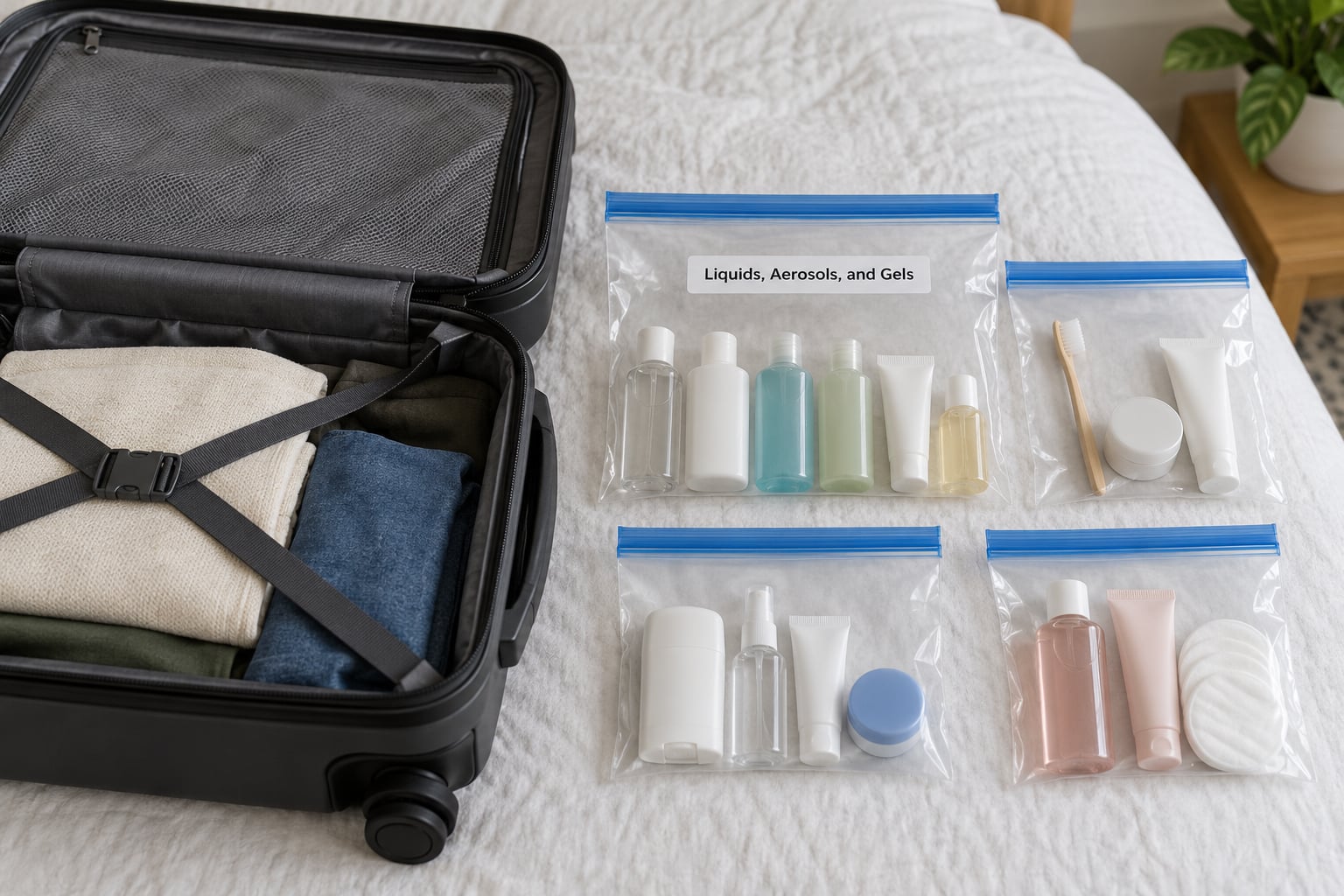
The 3-1-1 liquids rule is the single most quoted TSA rule. Each container must hold 3.4 ounces (100 ml) or less. All of them must fit in one clear, resealable, quart-sized plastic bag. And each traveler gets one such bag.
Container size is what counts, not how much liquid is actually inside. A half-empty 8 oz shampoo bottle is still an 8 oz bottle in the officer’s eyes and it still fails. This is the rule that surprises people most, because a nearly empty bottle looks harmless.
Toothpaste, lotion, gel, and sunscreen count as liquids, along with liquid cosmetics, room spray, and most deodorant in roll-on form. Solid items like powder makeup, lipstick, and stick deodorant are treated as ordinary belongings.
There are three real exceptions. Medically necessary liquids are allowed beyond the limit when you declare them before screening. Baby formula, breast milk, and other infant feeding items are permitted and may be inspected. And liquids bought after security in a duty-free shop come with a sealed tamper-evident bag that lets them through a connecting checkpoint in many cases.
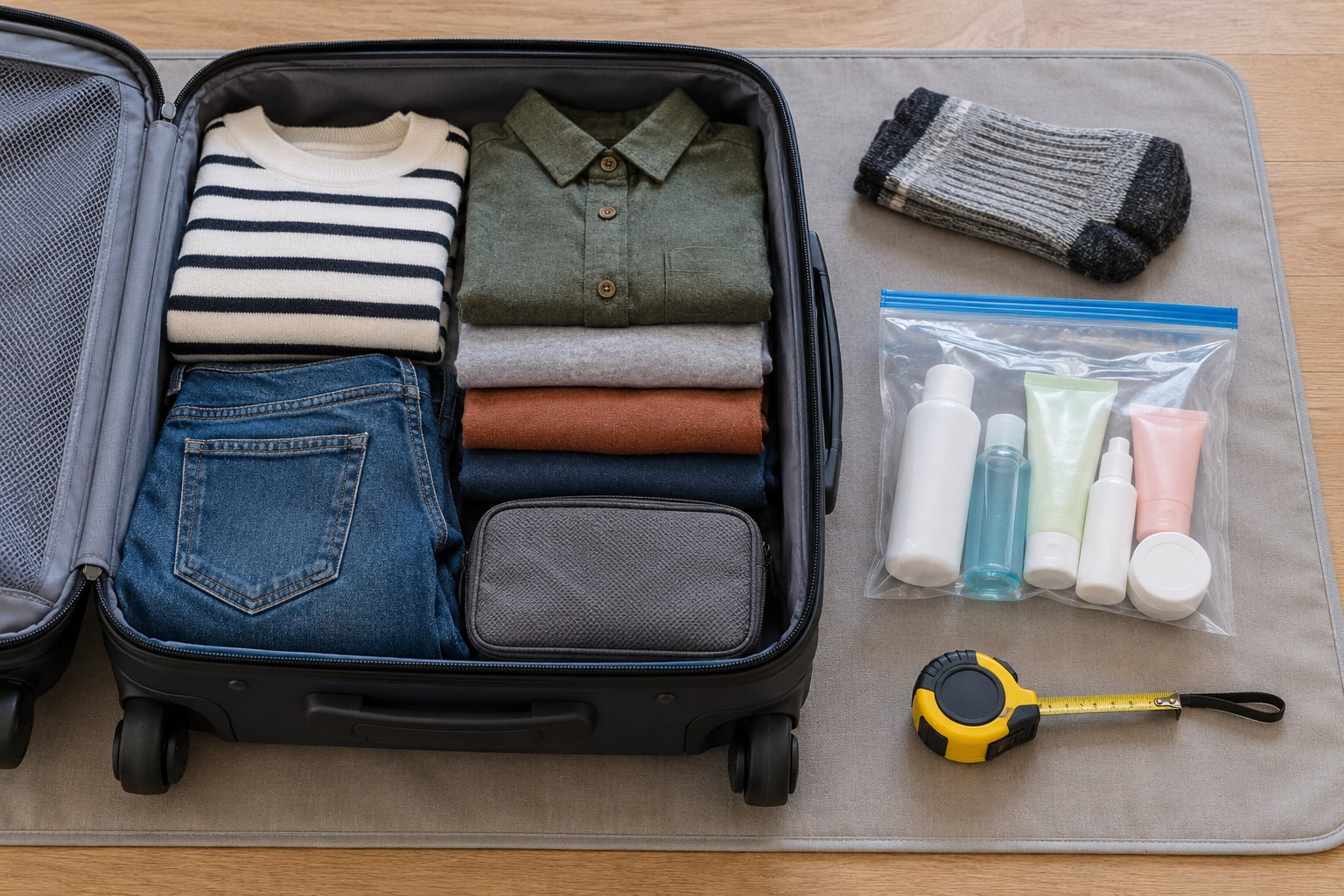
A practical packing setup: one clear bag, three travel-size bottles, one tube, whatever you use most often. Decanting at home takes five minutes and completely removes the risk.
Food, Snacks, and Drinks
Solid food travels well through the checkpoint. Sandwiches, crackers, nuts, dried fruit, protein bars, and most packaged snacks pass without any volume limit, which makes them the easiest way to stay comfortable on a long trip.
The line between solid and liquid is where surprises happen. Peanut butter, hummus, jam, jelly, and salad dressings are treated as liquids or gels, so they count against your 3.4 oz container limit. Viral posts claiming peanut butter was newly banned tend to be recycled lists rather than policy changes. It has been subject to the liquids rule for years.
Bottled water and drinks have to be empty at the checkpoint. An empty bottle is fine to carry and fill after you pass. Ice packs and frozen gel packs must be frozen solid at screening, and an X-ray machine sees them as a solid block; if the ice has melted into liquid, expect it to be treated under the liquids rule.
Alcohol under 24 percent by volume is allowed in carry-on, and TSA enforces the limits your airline imposes. Anything stronger than that cannot travel in the cabin at all. Customs and agriculture rules at your destination are a separate matter entirely, and clearing security says nothing about what you may bring into a country.
Inspect your food before you travel. A leaky jar or crushed package is easy to spot and gets opened or discarded on the spot.
Medications and Medical Items
Carry medicines in your carry-on, not in checked luggage. Checked bags get delayed, and a lost medication bag is a genuinely bad outcome. Keep prescriptions in their original labeled containers, and keep the pharmacy label visible, because that makes any questions at the checkpoint short and routine.
Loose pills in a Ziploc bag work for many travelers, though TSA does not require that format. Officers can ask to see what a pill is, so a labeled bottle makes the interaction easier, and some medications are controlled substances that attract a second look.
Medically necessary liquids are exempt from the 3-1-1 rule. That covers liquid medication, injectable insulin, nutritional supplements taken by mouth, and items such as saline or liquid over-the-counter medication. Declare them before screening and keep them in a separate bag so the officer can see them quickly.
CPAP machines, nebulizers, ostomy supplies, wheelchairs, and similar devices pass through screening with extra time allowed. Tell the officer before you are asked to put the bag in the machine so the screening can be handled properly rather than rushed.
For dosing, storage temperature, or travel letters for controlled medication, ask your pharmacist and your airline. This article covers screening only.
Toiletries, Cosmetics, and Personal-Care Items
Toiletries split cleanly into three groups, and knowing which one you are holding removes almost all the repacking at the belt.
Ordinarily allowed: solid deodorant, powder makeup, lipstick, mascara, eyeliner, brushes, hair ties, a full-size razor if you remove the blade cartridge, a small mirror, dental floss, and a toothbrush.
Subject to the liquids rule: lotion, liquid foundation, shampoo, conditioner, body wash, liquid mascara, most sunscreens, spray deodorant, hairspray, nail polish, perfume, cologne, and any cream or gel. All of these must be 3.4 oz (100 ml) containers in your quart bag.
Not allowed in carry-on: aerosol cans over 4 oz that are not personal care or insect repellent, and any item TSA lists as prohibited. Perfume is the item people most often assume is fine because it is in a little bottle; the container is still the container.
Discretionary aerosol rules do allow limited amounts of non-flammable aerosol products in carry-on, subject to a per-container cap and a total limit. Aerosols in the cabin are subject to FAA rules too, and personal care and insect repellent aerosols are treated differently from lacquers, paints, and cleaning sprays.
Rather than chasing an item-by-item list that goes stale, the fastest method is to search the item in TSA’s What Can I Bring tool the night before. It returns the rule for that exact object and shows the checked-baggage alternative.
Electronics, Tools, and Everyday Carry Items
Your everyday carry is mostly fine. Phones, laptops, tablets, chargers, headphones, smartwatches, cameras, and battery packs all pass. At CT scanner lanes you can usually stay packed, but laptops still get pulled into their own bin at many checkpoints, so keep them in an easy-access sleeve near the top.
Power banks and spare lithium batteries are the tightest electronics rule. They are not permitted in checked baggage at all, and they ride in the cabin only within a watt-hour limit: 100 Wh without approval, up to 160 Wh with airline approval. A power bank stays under the seat, not in an overhead bin, because loose batteries in the overhead compartment are the main in-flight fire risk. Airlines have also started capping how many power banks a passenger may bring, so check with your carrier.
Blades and cutting tools: scissors are allowed when the blades measure under 4 inches from the pivot point, and the measurement is from the pivot, not the handle to the tip. Screwdrivers, wrenches, pliers, and similar tools are allowed when they measure under 7 inches. Longer blades and tools go in checked luggage, and full-size pocketknives, box cutters, and skateboards are not allowed in carry-on.
Everyday oddities are mostly permitted. Umbrellas, tent poles, walking canes, trekking poles, hangers, corkscrews, razors with removable cartridges, and collapsible camp chairs pass, subject to officer discretion. Sports equipment like bats, golf clubs, and skis belongs in checked baggage, and firearms, ammunition, tasers, and pepper spray are prohibited in the cabin entirely. Checked baggage has its own separate list, and some items are prohibited on both sides of the security line.
Duty-Free Purchases and Connecting Flights
Anything you buy after the checkpoint at the duty-free shop comes in a sealed tamper-evident bag with the receipt inside. Under the conditions set by the airline and the airport, that bag lets you carry liquids through a second checkpoint without hitting the 3.4 oz limit again.
Keep the bag sealed the whole time. Opening it, even to rearrange luggage, can invalidate the exemption and put you back to the liquids rule. Airlines have also been stricter in recent years about how much duty-free liquid a passenger may bring on board a connecting flight, so check before you buy.
International connections work differently. You clear security in the departure country, then often clear it again in the connection country, and the second checkpoint is where sealed bags and receipts get tested. A few international airports arrange for pre-screened transit so some passengers skip that second screening, but coverage varies by airport and itinerary. Screeners at international checkpoints may apply different rules to items that TSA permits, including guns, knives, duty-free alcohol, and food items.
Baggage Limits Are Not the Same as Screening Rules
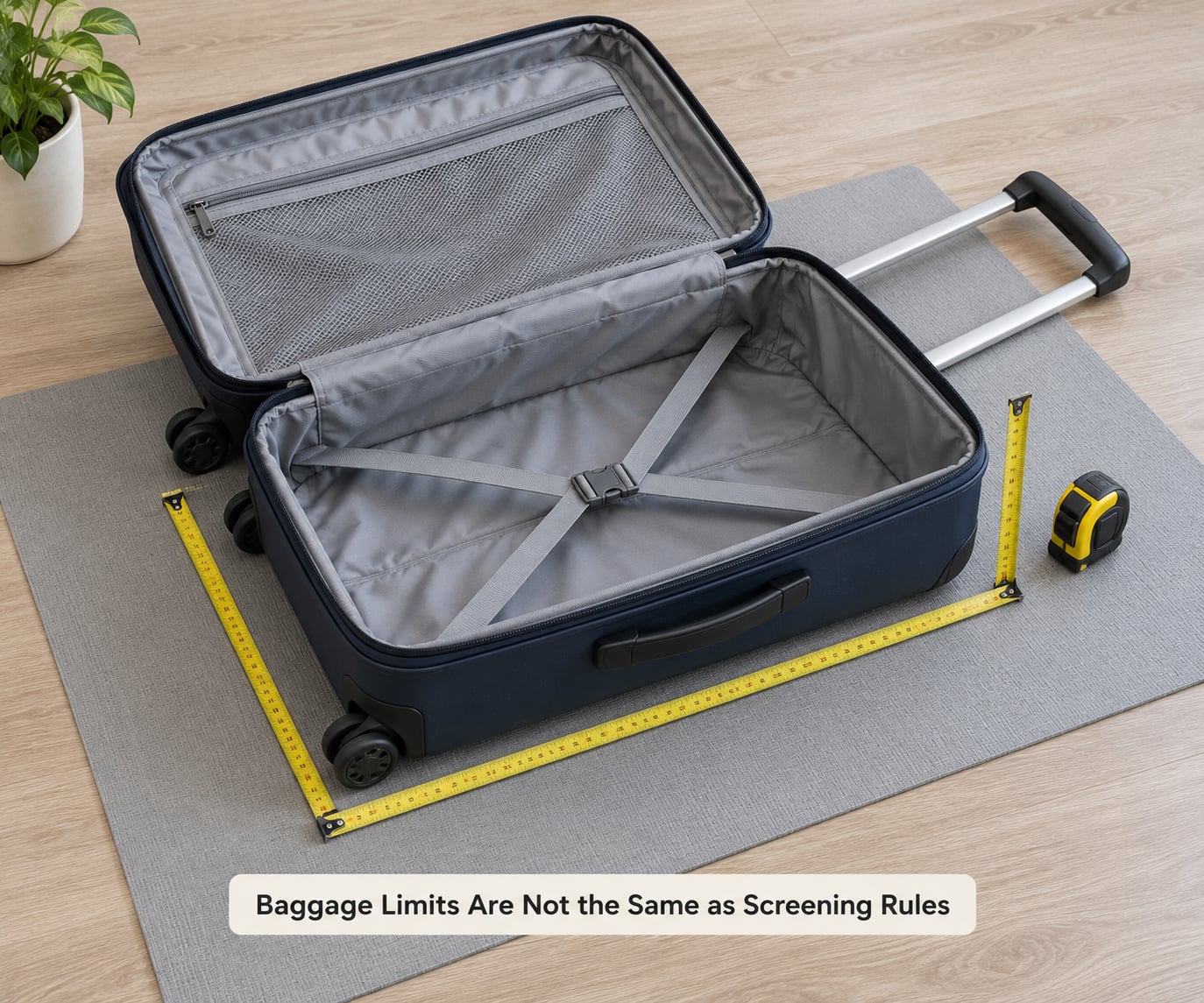
TSA does not set carry-on dimensions or weight limits. The common maximum is 22 x 14 x 9 inches, and many domestic carriers use that as a published ceiling, but each airline sets its own and some enforce it with scales and sizer boxes at the gate.
The pattern to watch: low-cost carriers often sell only a personal item on the cheapest fare, and regional aircraft frequently have smaller overhead bins, so a compliant 22 x 14 x 9 inch roller still gets gate-checked. That is an airline policy and it comes with a fee, entirely separate from screening.
How to check your own bag before the trip: measure the outside including wheels and handles, add up the weight including the personal item, and compare both with your airline’s published allowance. Your quart bag counts inside the carry-on, it is not a separate allowance.
TSA screening does not care how big your bag is, and your airline does not care what is inside it. Both apply, and you need to pass both.
How to Pack for a Smooth TSA Check
This is the sequence that keeps the checkpoint uneventful.
Step 1: Look up what TSA allows in a carry-on bag
Open the What Can I Bring lookup the night before and search the one or two items you are unsure about. Tent poles, fishing gear, a camping stove fuel canister, a CPAP machine. It takes two minutes and removes the guessing.
Step 2: Consolidate every liquid into one quart bag
Pour out full-size bottles into travel-size ones you own. Keep the quart bag at the top of the bag so it comes out in one motion rather than emptying the whole bag into a bin.
Step 3: Protect medication and medical items
Keep medicines in labeled containers in your carry-on, and pack anything medically necessary where you can show it immediately. Declare it before screening, not after.
Step 4: Pull the question marks out
Anything large, bladed, powered, or unclear in a crowded checkpoint is a delay. If you would not want to explain it, move it to a checked bag before you leave home rather than at the belt.
Step 5: Check the airline’s limits, not just TSA’s
Confirm the fare you bought includes a carry-on, then measure the bag including wheels and handles. Basic economy and regional aircraft are where surprises live.
Step 6: Pack batteries and power banks for the cabin
Charge them before you leave, keep them in your carry-on, and note the watt-hour rating. They cannot go into checked baggage, and they need to stay under the seat on board.
What to Do If TSA Says Your Item Is Not Allowed
The instinct to argue gets expensive in time. Officers make the decision on the spot and their call is final at that checkpoint, so a debate only adds minutes to a line you already have to stand in.
What you can do instead: stay calm, ask what the officer would prefer you do, and decide between checking the item, leaving it behind, or shipping it home. For prohibited items there is no option to check, because they are not permitted on either side of security.
If something was confiscated, you will get a notice explaining the decision. TSA handles claims through its TSA Claims process, and you file that claim online after the trip. Items that are merely not allowed in carry-on are usually still waiting for you in the lost-and-found or returned to the airline, so ask before you leave the airport.
For anything you plan to carry regularly, get the current answer from TSA before your next trip rather than relying on a single checkpoint decision. A checkpoint decision is a snapshot; the published rule is the rule.
Frequently Asked Questions
Does TSA use the same liquids rule for every airport?
In the United States, yes, the 3-1-1 rule applies at every TSA checkpoint: 3.4 oz (100 ml) containers in one clear quart-sized bag per traveler. Outside the country, screening is run by the local authority and their rules differ. International checkpoints may also apply stricter rules to duty-free liquid, food, knives and other items TSA permits, so a domestic answer does not always carry over.
Can I bring an empty water bottle through TSA security?
Yes. TSA does not prohibit empty bottles, so you can carry one through the checkpoint and fill it at a water fountain or bottle-filling station on the other side. The same applies to a travel mug or thermos. What cannot pass is a partially filled or full bottle, since any amount of water counts as a liquid and counts against your quart bag limit.
Do I need to show medication bottles to a TSA officer?
TSA does not require you to show prescription bottles, and loose pills are allowed. You are free to keep medication in a labeled container or another container you prefer. Officers may ask what a pill is if it is not recognizable, so having the labeled bottle or a pharmacy label nearby makes the check faster. Keep medicines in your carry-on, never in checked luggage.
Can I take a full-size razor or pocketknife in my carry-on bag?
A razor is allowed if you remove the blade cartridge before screening, and a travel razor with the cartridge removed goes through easily. A pocketknife is not allowed in carry-on, regardless of blade length, and goes in checked luggage. Scissors are different: they are permitted when the blades measure under 4 inches from the pivot point.
Does TSA regulate the size and weight of my carry-on bag?
No. TSA does not set baggage dimensions or weight allowances, so a bag can pass security and still be too large for your airline. The common maximum is 22 x 14 x 9 inches, but each carrier sets its own limit and some basic economy fares allow only a personal item. Gate agents enforce the airline rule, and an oversized bag is usually checked at the gate for a fee.
Conclusion
Start with the one item you are least sure about and search it in TSA’s What Can I Bring tool before you pack. That single step prevents nearly every problem people run into at the checkpoint, and it is the fastest way to get a straight answer about what TSA allows in a carry-on bag right now rather than a recycled forum post.
Then do the boring parts: every liquid, gel, and aerosol in containers of 3.4 ounces (100 ml) or less inside one clear quart bag, medicines in your carry-on in labeled containers, power banks in the cabin and under the seat. Finally, measure your bag and confirm what your fare actually includes, because that is a rulebook written by a different organization.
Rules shift between airports, airlines, and countries, so treat any list, including this one, as a starting point rather than a guarantee. When the officer makes a call you do not expect, the fastest path is to ask calmly what they would like you to do.