Boondocking in an RV for free means sleeping in your rig with no hookups at all on land where dispersed camping is legal, usually Bureau of Land Management or National Forest ground, or private property where someone has said yes. You run your own power and water, follow the agency’s stay limit, and leave nothing behind. The whole first trip takes an afternoon of planning and one night of setup. Updated for 2026, this guide covers legality first, because the rules are what make it free.
If you’re new to this, start within two hours of home. A first night on easy access near a town teaches you more than a month of planning, and it keeps the stakes low if something goes sideways.
Table of Contents
What You Need
Free camping is not the same as camping anywhere. Public land is divided among several agencies, each with its own rules about where you can park, how long you can stay, and what you can run off a generator. The land is open to you for casual recreation, not as a place to live.
How to Boondock in an RV for Free: Know the Rules
Four things decide whether a spot works. First, who owns it: federal, state, tribal, or private. Second, whether the spot sits inside a designated dispersed camping area, because a National Park campground loop or a developed recreation site almost always bans overnight parking from a vehicle. Third, how long you may stay, which on most federal land means 14 days in one spot before you have to move a substantial distance. Fourth, what the agency says about vehicles, generators, campfires, and pets.
Community advice across RV forums comes down to one line: you can boondock anywhere it is not prohibited. That is a useful filter, but you still have to prove it isn’t prohibited. Open space isn’t the same as open camping, and a gravel pullout beside a river can be closed to camping by signage posted twenty feet away that you never saw.
Beyond legality, you need a few practical things before you drive out:
- Self-sufficient water. Enough fresh to cover drinking, cooking, and a paper-wash shower for your group for at least two days beyond your plan.
- A way to hold gray and black water until you reach a dump station. Tanks are the constraint that ends most trips early, not the campsite.
- Battery headroom. Deep-cycle or lithium house batteries, plus an inverter if you plan to run a laptop, TV, or blender away from a generator.
- Food storage that matches local rules. A bear-resistant locker where it is mandatory, an approved canister elsewhere, and a plan for pet food and trash.
- Offline navigation. Downloaded maps on two devices, a paper map, and a satellite messenger or personal locator beacon for the places with no signal.
- Paperwork you should carry. Registration, proof of insurance, a driver’s license, and an emergency contact who knows your route and expected arrival.
Step-by-Step
Eight steps take you from an idea to a packed-out campsite. Do them in order, because the first six are all research and the last two are the physical work.
1. Choose a Legal Place to Camp
Start with dispersed camping areas published by the managing agency rather than a pin someone dropped in a forum. Bureau of Land Management field offices and National Forest districts publish maps of designated sites, and those maps are the difference between a legal night and a citation.
Rule out categories first. Developed campgrounds with pads and hookups are not for overnight parking. Day-use areas are for daylight hours. Wilderness study areas, designated routes in national parks, national wildlife refuges, and any area with a closure order are off the list. Private land is off the list unless the owner has told you otherwise in advance, and a No Trespassing sign inside an otherwise open landscape beats any map you were looking at.
Private-property options do exist. Boondockers Welcome and Harvest Hosts both connect you with hosts who expect RV guests, usually for a small donation rather than a nightly rate. Big-box lots, truck stops, casino lots, and restaurant parking areas sometimes allow it by custom rather than by policy, which is a weaker position. Ask, park in one space, keep it quiet, and move on if the answer is vague.
2. Check Land Status and Stay Limits
Open the agency’s page for the exact district, not the state. Most BLM field offices and Forest Service districts publish their own camping limits, closures, and seasonal restrictions, and those override anything generic you read online.
You are looking for four things: the managing agency, the official boundary, the stay limit, and whether a permit or fee applies to your kind of camping. On most BLM and National Forest ground, dispersed camping up to 14 days in one spot is free with no permit, provided you are there recreationally and not using the land as a primary residence. Special management areas often cut that window down. Wilderness areas usually prohibit it outright.
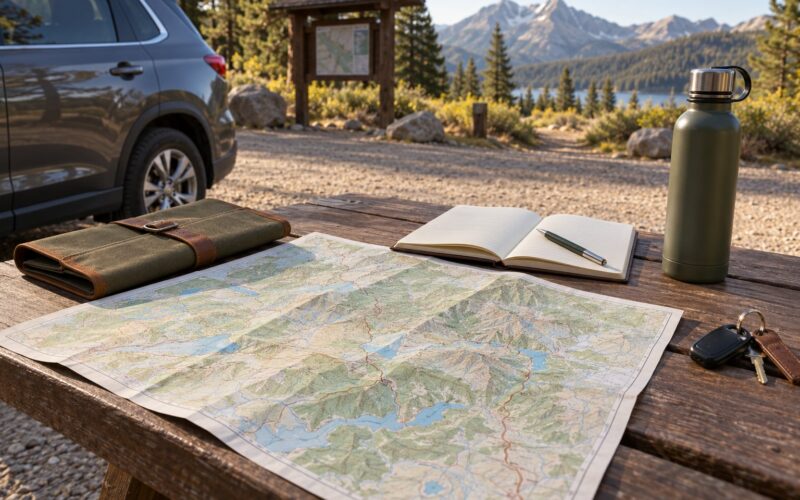
Before you leave, download the Motor Vehicle Use Map for that area. It is a PDF, it works without signal, and it shows which roads are designated for vehicle travel. Camping beside a road that is closed to vehicles is one of the fastest ways to get moved along.
3. Confirm the Route and Site Are Accessible
An RV on a washboard forest road is a bad afternoon. Compare your rig’s height, length, and turning radius against the road you’re about to take, and read recent reports about the surface rather than the map’s road classification.
Check wildfire closures, snow closures, and recent rain. Washboard ruts form after water runs over a dirt road, and they chew up suspension components and trailer frames faster than anything else you do off-grid. After heavy rain, soft shoulders become ruts that trap a rear axle.
Then check what happens if you get it wrong. Is there cell coverage along the route and at the site? If not, how far is the nearest town with a tow service? Do you have a recovery route that does not cross the same washboard road? Arrive before dark, always. Searching a hillside for a campsite at nine at night with a trailer behind you is how people damage rigs and scare wildlife.
4. Test Water and Power Resources
Most dispersed sites have nothing: no water, no dump station, no vault toilet, no electricity. Assume nothing and plan for a self-contained stay rather than hoping for a surprise hookup.
Do the water math before you leave. A person drinking, cooking, and washing at a paper-wash level can use somewhere around two gallons a day, so a 40-gallon fresh tank gives a couple of people about a week without refilling. If you have a macerator or portable toilet, less. Never open the gray or black tank onto the ground, and never pick up water from a stock tank, stream, or unknown source without treating it.
For power, run the math the same way. Propane runs the refrigerator, the furnace, and the water heater efficiently, so plan on it for those. House batteries handle 12V lighting, a fan, and phone charging. Solar adds to the batteries on a clear day. A generator covers 120V loads, but check the agency’s rules first, keep it well away from other campers, and never run one inside or under an awning. Air conditioning is the one thing most rigs cannot do off-grid without a large battery bank or a big generator budget.
5. Protect Food, Waste, and Wildlife
Food storage is the rule people get burned by, because consequences vary from a citation to a whole night’s sleep with someone pacing the perimeter. Where a bear-resistant locker is required, use it. Where a canister is required, use it. Do not argue with local rules because the bear habitat “did not look active.”
Everything scented goes in: pet food, trash, cooking grease, toiletries, even some canned goods. A metal locker with a working latch solves most bear-country problems; a lockable tote solves most of the rest. Never feed wildlife, and never park a food-storage container where a bear can watch you load it and learn the timing.
Handle waste the way you handle food. Bag trash and pack it out every time. Bury toilet waste only where it is legal and only 6 to 8 inches deep, far from water and campsites, and always follow the specific local guidance for the area. When in doubt, carry it out.
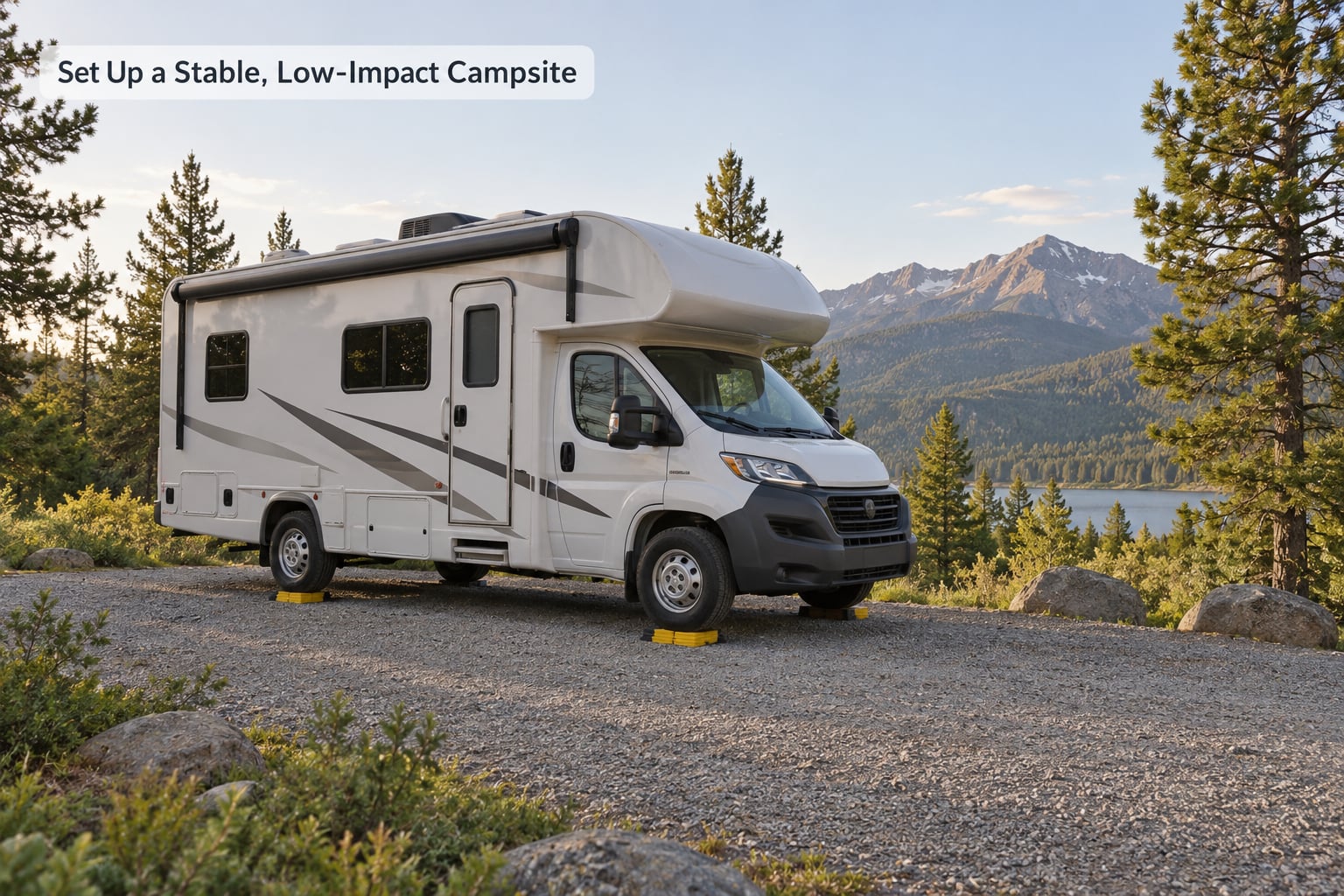
6. Set Up a Stable, Low-Impact Campsite
Use an existing site. A pullout, a hardened pad, or a bare patch of gravel already in place is the whole point of dispersed camping, and creating a new site on grass or bare soil is the fastest way to earn a restitution bill.
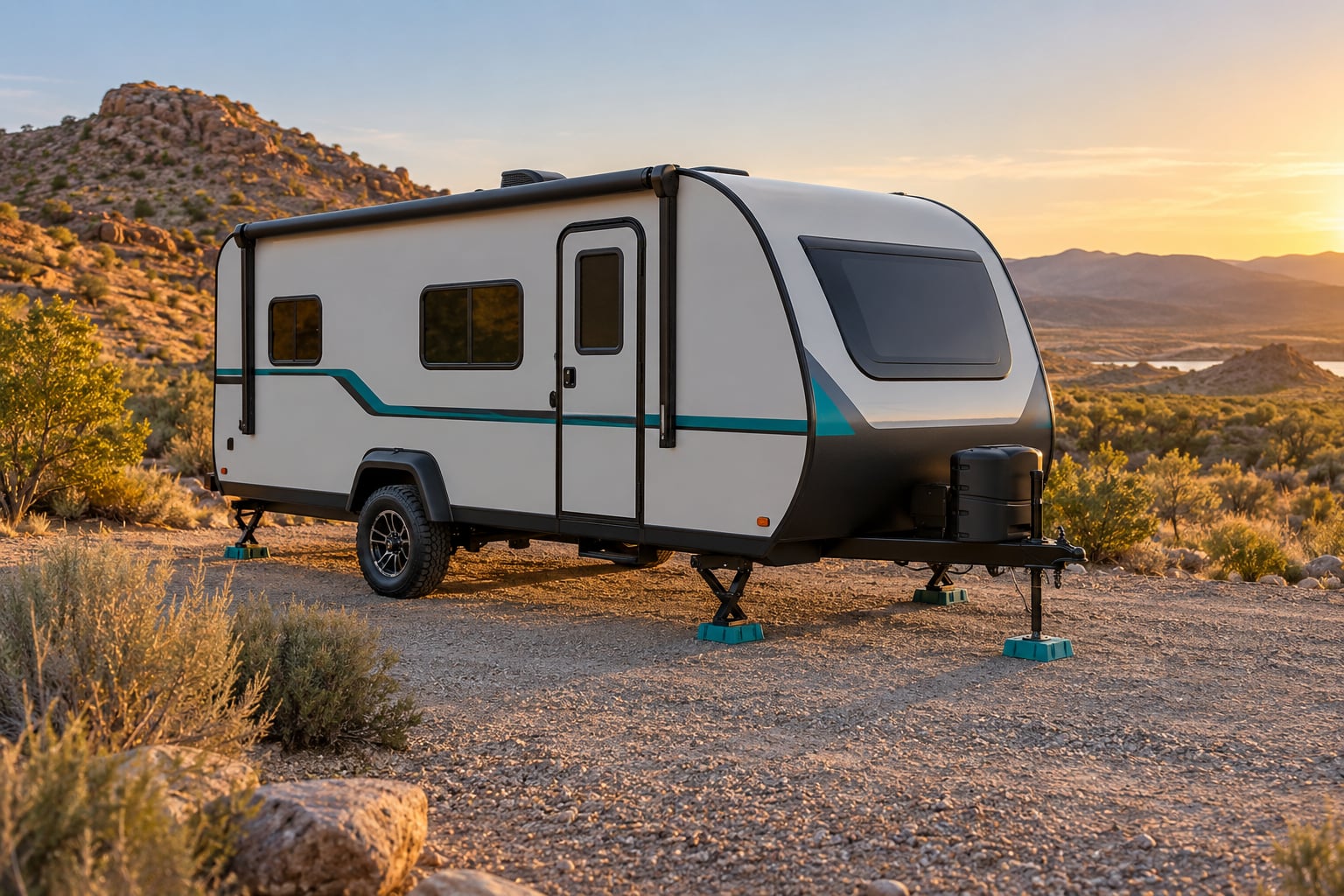
Level on solid ground with wood or composite blocks under the stabilizers at the points your manufacturer specifies, and never jack the RV on anything that can crush: pads, tree roots, rocks, or soft sand. Check that awnings and slides clear overhead branches before you deploy them, and retract them if wind picks up. Face the awning so it drains away from the entry door, and keep the stabilizer footprint out of the tire track.
No fire unless fire restrictions allow it and the site has an existing ring. Bring your own firewood from a source you know is clean. Keep the generator away from vegetation, never build a fire ring if one does not already exist, and never cut live branches for shade or firewood.
7. Handle Common Problems Safely
Most problems have a simple answer: leave. Wind, lightning, wildfire smoke, a road that washed out behind you, or an empty fresh tank in heat are all reasons to move to a town and pay for a night. That is what regular RV travelers do, and it is cheaper than a recovery.
High wind is the most common one. Close the awning early, retract the slide, and get away from dead branches and power lines. Heat matters more than most people expect in the desert. If the forecast pushes past 100 degrees, do not park on open BLM ground without a plan for cooling and refilling, because the difference between a comfortable morning and a dangerous afternoon is a few hours of driving.
Rain turns some dirt roads into soup. If the road back out is soft, drive over it before the water soaks deeper rather than after. Wildlife mostly means bears, and the answer is always storage, not noise or a gun. Mechanical trouble in a remote area is why you carry extra water, a full tool kit, a spare tire or a compressor, and a way to call for help that does not depend on a cell tower.
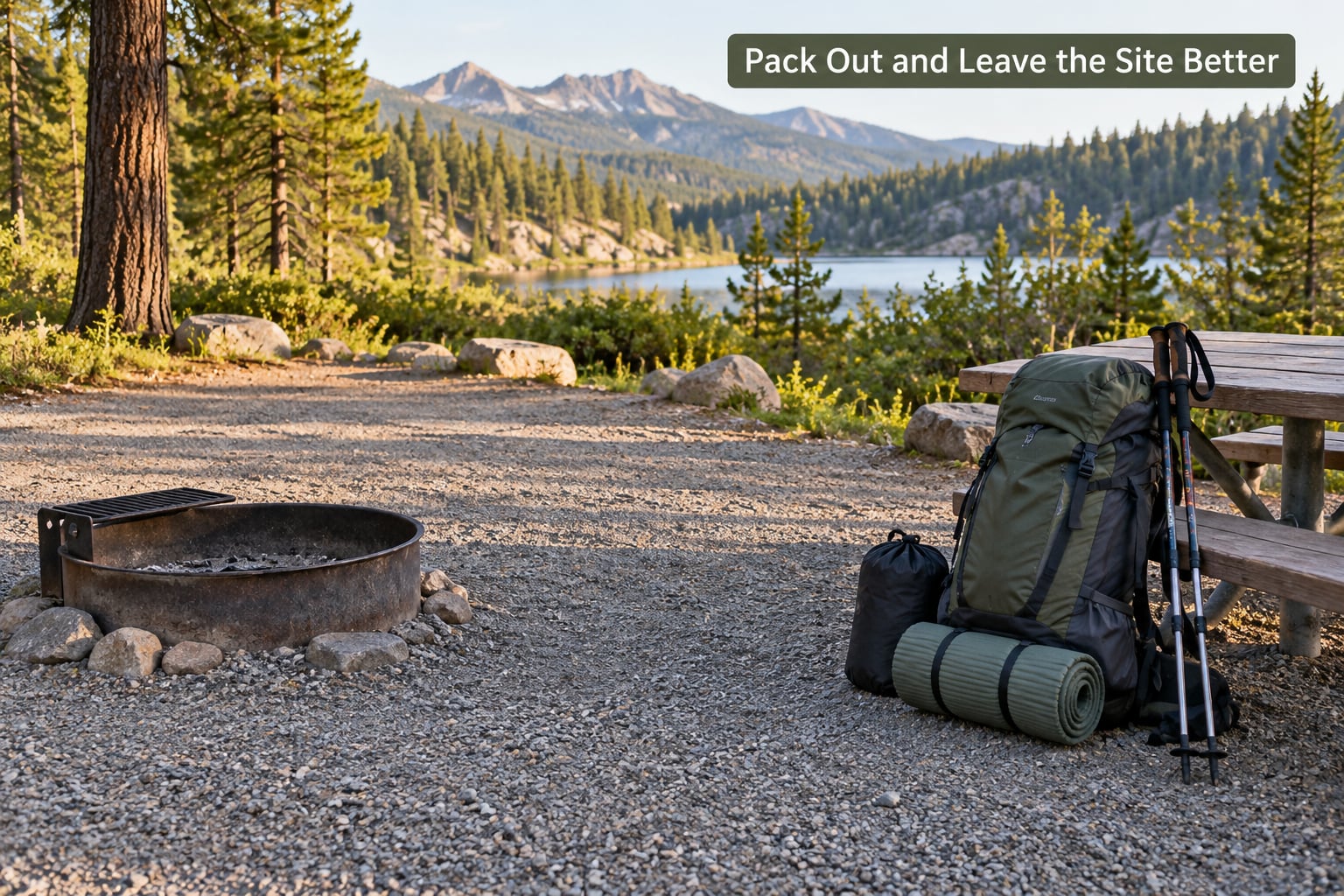
8. Pack Out and Leave the Site Better
The departure check takes five minutes and it is the standard every agency will hold you to. Walk the site before you pull forward.
- All trash, food scraps, packaging, and foil in the bag, not scattered around the ring.
- Fire ring cold and clear, ash scattered, nothing left burning or smoldering.
- Bathroom and kitchen waste contained and removed, not left in a shallow hole near camp.
- Tire tracks compared against how the site looked when you arrived; back out the way you came in.
- No leveling blocks, chocks, awning stakes, chairs, or laundry left behind.
- Nothing plugged in, no hitch left on the pile, no site markers you added.
- A final look from the road: does the pullout look exactly like public land that nobody used?
Common Mistakes
Nearly every bad boondocking story traces back to one of these, and each has a simple correction.
Assuming public land means open camping. A large tract of BLM ground can contain a day-use area, a livestock allotment, a closed road, or a private inholding. Look for the designation rather than the acreage.
Ignoring the stay limit. The common federal rule is 14 consecutive days in one spot, followed by a move to a different area, not a drive down the same road. Local limits are often shorter. Set a calendar reminder for the day before you have to move, so you are not the person still there on day fifteen.
Treating a recommendation as verified. A pin from a stranger is a starting point. Veteran campers scout candidate sites in person with a truck or 4×4 and pick two or three options before the trip, which is also how they avoid losing an evening searching in the dark.
Parking on fragile ground. Soft sand, wet meadows, and creek banks take damage that outlives your trip. Choose gravel, rock, or bare dirt that already looks used.
Running out of water. This is the resource that actually ends trips. Fill before you leave, watch the gauge rather than the sound of the pump, and know where the next town with a potable spigot sits along your route.
Ignoring food storage rules. A bear canister or locker is not optional in bear country, and neither is putting toiletries, pet food, and trash inside it.
Filling both tanks in the first two days. Grey and black capacity rarely matches a week of two people. Use a portable toilet, keep showers short, and plan a utility stop at a paid RV park purely to dump and refill.
Assuming there is a way out. If the road in washes out behind you and nobody knows where you are, the free night becomes a rescue. Tell someone your route, carry a satellite messenger, and check the recovery route before you commit.
Frequently Asked Questions
Can you really boondock in an RV for free?
Yes, on land where dispersed camping is legal and no permit or fee applies, which covers most designated Bureau of Land Management and National Forest sites for stays within the agency’s limit. Free covers the campsite only. You still pay for propane, generator fuel, dump station fees, and the wear on tires and suspension that rough roads cause.
How long can you camp on public land in an RV?
The most common federal rule is 14 consecutive days in one spot, after which you must move to a different area rather than a nearby spot on the same road. Some districts shorten that window, and some wilderness and special management areas close camping entirely or require a permit. Check the specific district page rather than relying on the general rule.
Can you boondock in a national park?
Sometimes, but not as a rule. Many national parks allow dispersed camping only in designated areas, require a permit, limit stays to a set number of nights, and close roads entirely in fire season. A few allow first-come vehicle camping outside developed campgrounds. The park’s own camping page is the only thing that tells you which case you are in.
Do you need a permit to boondock in an RV?
For casual dispersed camping on most BLM and National Forest land, no permit is needed. Permits come into play in designated wilderness, some recreation areas, national parks, national wildlife refuges, and anywhere a fire restriction or group-use rule applies. Long-term parking also requires care, since public land allows recreation and not use as a primary residence.
What should you do if you run out of water while boondocking?
Stop using water for anything but drinking and basic hygiene. Head for the nearest town with a potable water source at a hardware store, campground, laundromat, or rest area, and carry a container for filling. Do not drink from streams, stock tanks, or wildlife water, and do not dump grey water on the ground to make room.
Conclusion: Start With a Legality Check
Boondocking in an RV for free works because public land allows casual dispersed camping, not because the land is empty. Find the managing agency, confirm your rig is allowed, check the stay limit, and know where the water and a way out are before you turn off the pavement. Leave the pullout looking like nobody was there, and the campsite stays free and open for the next person.
Your first move is simple: pick one district within two hours of home, open its camping page and Motor Vehicle Use Map, and find a designated site your rig fits on. Do that for a weekend before you plan a trip around it.