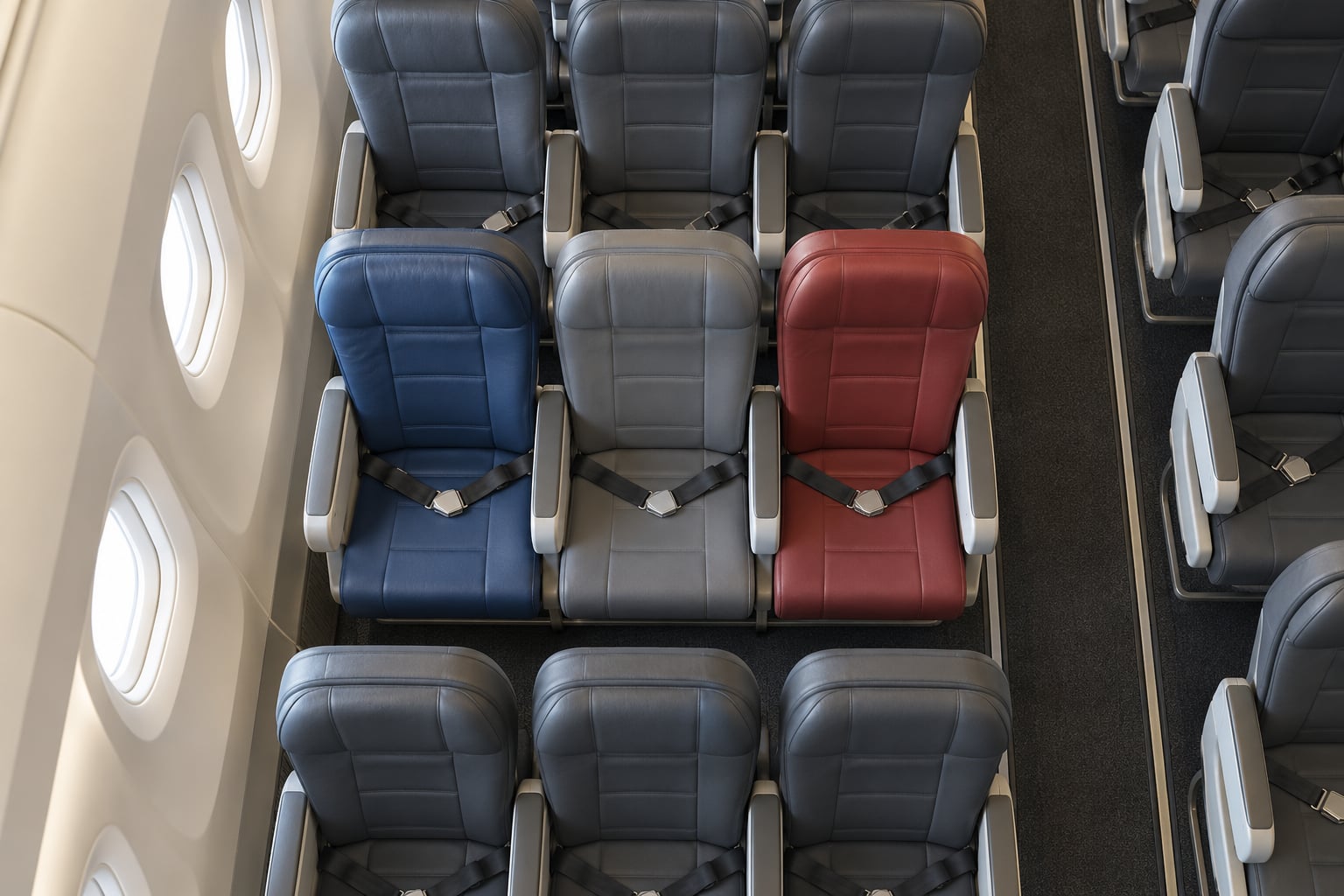
There is no single best seat on a plane. How you choose a seat on a plane comes down to one thing: what you need from that specific flight, whether that is legroom, sleep, a clear view, quick deplaning, or simply the lowest fare. You can pick or change your seat at booking, in your booking portal, at online check-in about 24 hours before departure, and at the gate. This guide walks through what to check and in what order.
Most seat regret comes from treating the seat map as a menu instead of a map of the aircraft. Row 22 on one plane is a quiet window seat; row 22 on another is next to the lavatories.
Table of Contents
What You Need Before You Pick a Seat
Choosing well means comparing six things. Which one matters most decides everything else.
- Aircraft type and layout. Seat letters, row count and legroom differ by aircraft, so the same seat number can mean two very different things on two flights.
- Seat pitch and seat width. Pitch is the distance front-to-back, width is how wide the seat is. Standard economy seats run roughly 30 to 34 inches of pitch on a narrowbody.
- Row location. Front rows deplane first and take the smoothest ride. The back is quieter but you feel more movement.
- Exit row eligibility. Extra legroom comes with rules on age, mobility and whether the seat reclines.
- What a paid seat costs. Preferred seats often carry a separate fee; standard seats are frequently included.
- Your own priority. Legroom, quiet, easy movement, a view, or price.
Start with the priority, because it decides the rest. Here is the shortcut most guides skip, matched to what travelers usually care about most.
- Most legroom: a bulkhead or exit row, because there is no seat in front, though exit row seats usually do not recline.
- Sleeping on a red-eye: a window seat in the middle of the cabin, away from galleys and lavatories. Fewer passers-by, a wall to lean against, less foot traffic.
- Quick deplaning: a front-row aisle seat. You are near the door and you are not stuck in a queue.
- Least turbulence: over the wings in the centre section, which sits at the aircraft’s point of balance.
- Stretching, or a stiff knee: an aisle seat, so you are not climbing over anyone at every lavatory trip.
- Quiet: the rear cabin, over or behind the wing, further from the engines and clear of the galley doors.
- Lower fare: any seat, chosen at check-in. Seat choice is usually where the money is saved.
- View and photos: a row ahead of the wing on the sunny side, for a clear forward view of the wing and the ground and fewer window frames.
Step-by-Step: How to Choose a Seat on a Plane
1. Start With Your Main Travel Priority
Write down the one thing that would ruin this flight if you got it wrong. Two hours of sleep ruined by an aisle request, a bad knee on a nine-hour flight, a connection you would miss on foot.
Then name the constraint. If you are six foot four, legroom is not a nice-to-have. If you are on a two-hour hop, the aisle for easy movement may beat the extra two inches.
2. Check the Aircraft and Seat Map
Open the seat map during booking and read the row numbers rather than guessing. Airlines usually label extra legroom, preferred and standard rows, and most offer the map in three or four seat configurations depending on the aircraft.
Row numbering skips letters for missing seats and often skips numbers around exit doors, so the tenth row you see may be the eleventh you count. In a three-across layout, A and F are windows, C and D are aisles, and E is the middle. In a two-across layout, A and C are windows and there is no middle seat.
Check the flight number, not just the route. Airlines swap aircraft for weather, maintenance and schedule changes, and a swap can move your seat without telling you.
3. Compare Window, Aisle and Middle Seats
A window seat gives you a wall to lean against, a view and fewer people to negotiate with. You will be the one to climb over for every lavatory trip, and on a full flight that adds up.
An aisle seat is the fastest in and out, the easiest to stretch, and the best spot if you get up often. You will absorb bumps when the person beside you stands, and kids and armrest hogs hit your shoulder.
The middle seat gets the short stick: two armrests, no wall, and the worst sleep of the three. It is still the right call when you are flying with a partner and want to split the aisle, or when the difference in fare is significant.
4. Consider Row Location
The first rows are calmest and deplane first, but they sit near the galley and often have a wall-mounted life jacket and no window. Rows behind the exit doors usually have a seat that does not recline, and on many aircraft that is the single worst seat in the cabin.
The last row is worth avoiding. The wall behind it is close, the row may not recline, and on some widebodies the window there looks out at nothing at all.
Stay clear of the galley and lavatory rows. People queue, lids slam, and the door opens and closes all flight. The middle of the cabin, forward of the wing and clear of those doors, is the quiet zone most people never think about.
5. Check for Extra Legroom and Seat Width
Extra legroom varies by several inches between aircraft, and the difference between one aircraft’s extra-legroom row and another’s standard row can be zero. If you need the space, check the aircraft seat map for the specific flight rather than the airline’s generic marketing.
Width matters more than people expect. A wider seat on a standard row often beats a narrow extra-legroom row, and the armrest in a middle seat is fixed and takes space off both sides.
6. Review the Price and Selection Rules
Seat selection is free on most full-fare economy tickets and charged on basic economy, on some low-cost carriers, and for preferred seats anywhere. Before assuming the seat map is open to you, check the fare rules on your own booking.
Some maps grey out seats because they are taken, blocked, or restricted by crew requirements. Basic economy travellers are often assigned a seat automatically at check-in and cannot change it, so if the seat matters, buy a fare that lets you choose.
7. Confirm Your Choice Before the Trip
After booking, open the confirmation and verify the seat assignment is there. Then check again the night before and the morning of travel. Airlines move passengers for aircraft swaps and flight merges, and the seat on your boarding pass is the one that counts.
If you asked for an aisle seat for mobility or medical reasons, or for an infant bassinet, confirm it by phone a few days ahead. Those requests are handled by the airline’s accessibility team rather than the standard seat map, and they need more lead time.
Common Mistakes
Judging a seat by row number alone. Row 20 is a good seat on one aircraft and a lavatory seat on another. Fix: check the seat map for the exact flight and look for the galley and lavatory icons.
Ignoring the aircraft model. Same airline, same route, same seat number, different plane, different cabin. Fix: verify the aircraft type before you pay for a preferred seat.
Assuming every bulkhead row is better. Bulkheads do give more room, but often no under-seat storage, sometimes less width, and they sit right next to the galley. Fix: pick bulkhead if you want legroom, avoid it if you want storage or quiet.
Booking an exit row without checking the rules. Exit rows usually do not recline, and airlines set a minimum age and require the ability to perform a safety role. Fix: confirm eligibility with the airline before selecting, and never book one for a child or someone who cannot meet the requirement.
Forgetting accessibility needs. A middle seat is a real problem after knee or hip surgery, and the standard map may not offer the aisle you need. Fix: request assistance through the airline’s accessibility channel as soon as you book, then reconfirm 48 hours out.
Skipping the final check. Your seat can change without notice. Fix: screenshot the seat assignment after booking and recheck at online check-in, about 24 hours before departure.
One more habit pays off: if you get a seat you dislike and the flight has not pushed back, ask the gate agent politely before boarding. Cabin crew can sometimes move you to an empty seat for a medical or mobility reason. They usually cannot move you for comfort alone, and boarding is the worst time to ask.
Frequently Asked Questions
What is the best airplane seat to choose?
There is no single best airplane seat. The best seat depends on the flight and on you: an over-the-wing seat for the smoothest ride, an aisle seat for easy movement and stretching, a bulkhead or exit row for legroom, or a mid-cabin window for quiet sleep. Decide what would spoil the trip for you, then find that seat on the seat map for your exact aircraft.
Is a window seat better than an aisle seat?
A window seat wins on comfort, view and sleep: you have a wall to lean on, fewer people to disturb you, and nobody climbs over you. An aisle seat wins on movement: you get in and out faster, stretch your legs whenever you want, and are safer with a stiff hip or knee. Choose the window if you sleep or watch scenery, the aisle if you move or get up often.
Which airplane seats have the most legroom?
Bulkhead rows, exit rows and dedicated extra-legroom rows have the most legroom. The catch is that exit rows usually have a non-reclining seat in front, and bulkheads often lose under-seat storage and sit near the galley. Extra legroom varies by several inches between aircraft, so check the seat map for the exact flight rather than trusting a general description.
Are bulkhead or exit-row seats always better?
No. Bulkhead rows give you space to stretch but often remove under-seat storage and can be narrower or non-reclining, and they sit beside the galley. Exit rows give the most legroom but the seat in front usually does not recline, and airlines set age and mobility rules for them. They suit tall passengers and anyone who needs space, not everyone.
Why can I not choose my airplane seat when booking?
Most often the fare you bought. Basic economy and low-cost fares frequently assign a seat automatically at check-in and block changes, and some low-cost carriers assign seats at random. Standard and full economy tickets usually let you choose free. Check the fare rules on the booking, or pay for a fare that includes seat selection before you reserve.
How do I request an aisle seat for accessibility or a medical need?
Do not rely on the seat map. Contact the airline’s accessibility or special assistance team right after booking and again about 48 hours before departure, and give them the reason. They handle aisle seats for mobility limits, recent surgery, service animals and infant bassinets, which the standard map often cannot. Ask for written confirmation and recheck a day before the flight.
Conclusion
Name the one thing that would spoil this flight, then open the seat map for the exact flight you booked and find the simplest seat that delivers it. Everything else, window or aisle, front or back, is a preference you can live without. Reserve it early, confirm it again at check-in, and stop thinking about it.