Your car overheats on long drives because the cooling system is asked to handle three things at once: hours of sustained engine load, warm outside air with nothing to vent into, and no relief from idling stops. When coolant is low, airflow is blocked, or a component has failed, that stored heat has nowhere to go and the temperature climbs.
Short trips hide plenty of cooling faults. A twenty-minute drive never fully heat-soaks the engine, so a marginal radiator, a slipping water pump belt or a slow thermostat can keep up. After two hours of steady highway speed, that same marginal system runs out of margin.
That is why the timing is the clue. If your car stays cool in town and only climbs after 20 or 30 minutes of highway driving, the fault is almost always in how heat is moved rather than how much air blows across the radiator.
Table of Contents
- Why Your Car Overheats on Long Drives: Common Causes
- How the Engine Cooling System Works
- The Difference Between Normal Heat and Engine Overheating
- Warning Signs That Your Engine Is Overheating
- What to Do If Your Car Overheats on a Long Drive
- Long-Drive Overheating Problems and Fixes
- How to Prevent Overheating on Long Drives
- When a Mechanic Should Inspect the Cooling System
- Frequently Asked Questions
- Can my car overheat just from driving on the highway for several hours?
- Does using the air conditioner make a car more likely to overheat?
- Is it safe to drive a short distance after the temperature warning light comes on?
- Why does my car overheat but the radiator still looks full?
- What should I do if steam starts coming from under the hood?
- How often should I check or change my engine coolant?
- Conclusion
Why Your Car Overheats on Long Drives: Common Causes
Heat builds on a long drive for four compounding reasons, and they stack.
Sustained load. Highway cruising sits in a narrow band of engine speed and torque, but it is load that lasts. Uphill grades, a full cabin, a roof box, a trailer and a running air conditioning compressor all add to it. A car can be perfectly healthy at rest and still run out of cooling margin while towing uphill at 105 degrees outside.
No relief from airflow. Moving air is a radiator’s best tool, and at highway speed you have plenty of it. The trouble starts the moment traffic thickens, because then the electric fan takes over the work. A fan that is slow, noisy or not switching on leaves the engine with almost no cooling at low speed.
High ambient heat. Outside air temperature is the radiator’s final destination. Desert highways in summer add 20 to 30 degrees to the temperature the coolant must shed, and a system with any capacity missing has nothing left to give.
Heat soak. After roughly 30 minutes of steady driving, every metal surface around the engine is saturated. The gauge reads higher than it does on a cold trip, and small problems that were invisible become obvious.
Underneath those conditions sit a short list of actual faults, listed in rough order of how often they turn out to be the reason.
- Coolant low from a slow external leak, or coolant lost inside the engine
- Radiator cap not holding pressure, or an aging radiator cap seal
- Radiator core packed with bug debris, road grime or bent fins
- Thermostat stuck open, so the engine never reaches full operating temperature
- Cooling fan, fan relay or fan clutch not delivering air
- Water pump impeller losing its blades, or a slipping accessory belt
- An air pocket trapped in the cooling system after recent service
- A head gasket or internal leak pushing combustion gases into the coolant
When it overheats and when it does not tells you a lot. Use this table to narrow it down before you buy a single part.
| What you notice | Most likely places to look |
|---|---|
| Only after 20 to 30 minutes of highway driving, fine in town | Radiator cap, radiator core, thermostat, air pocket in the system |
| Coolant disappears with no puddle underneath | Internal leak, head gasket, or slow evaporation from a hot radiator |
| Overheats in stop-and-go traffic but not on open road | Cooling fan motor, fan relay, fuse, clutch |
| Climbs on long grades or while towing | Weak radiator, weak water pump, partly blocked core |
| Warm exhaust, white smoke, sweet smell, bubbling reservoir | Head gasket or internal coolant leak |
| Sudden loss of power and a rough running engine | Severe overheating, possible head gasket failure |
How the Engine Cooling System Works
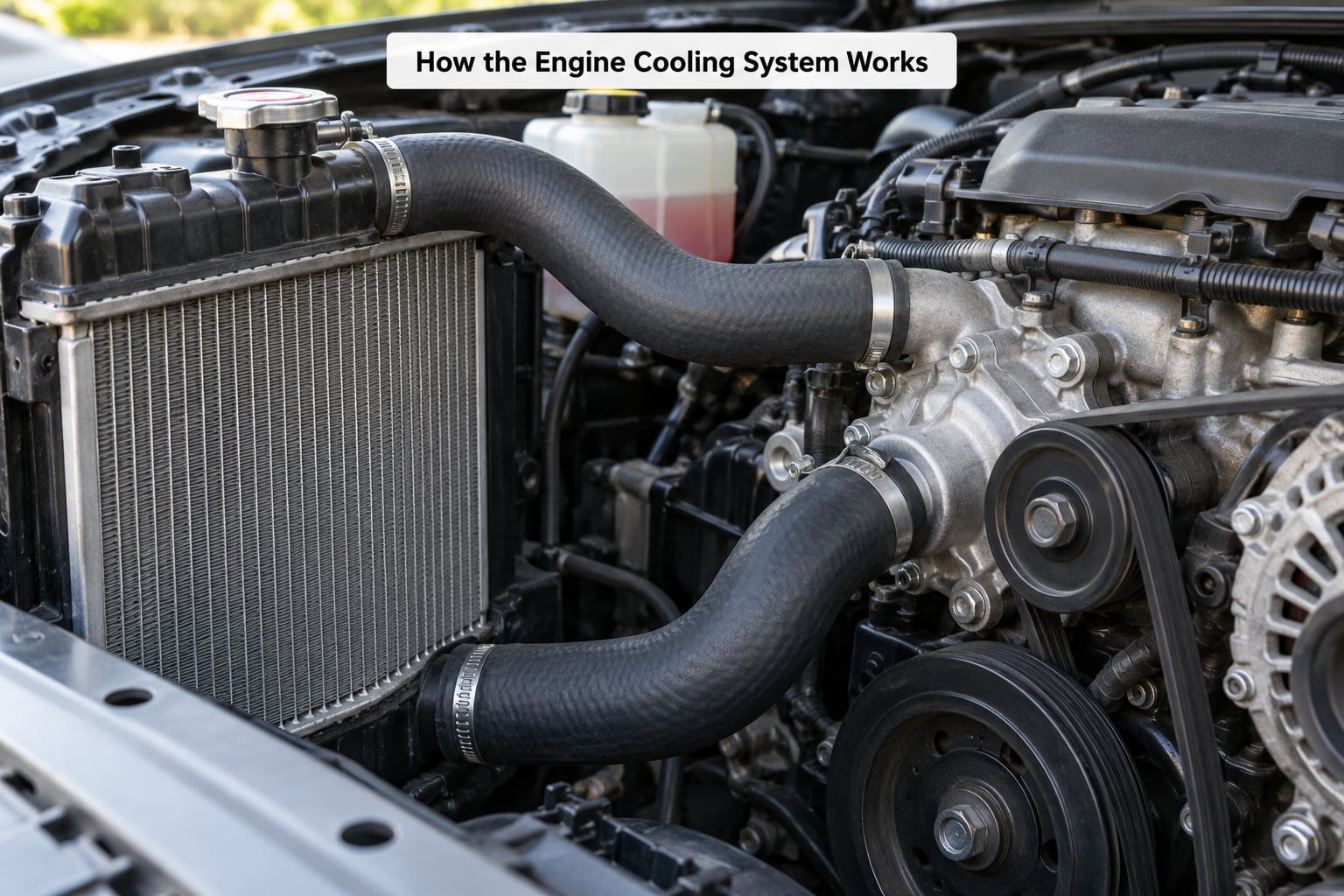
The whole system is one loop. Coolant circulates through the engine block and cylinder head, picks up heat, then travels to the radiator, where outside air pulls that heat away before the coolant returns to the engine.
The water pump, usually driven by the accessory belt or a chain, is what keeps the coolant moving. It is the part most owners never think about because it is hidden behind the timing cover.
The thermostat is a valve that blocks coolant flow until the engine warms up. Stuck open, the engine never reaches full temperature and the heater blows cold air constantly. Stuck closed, the gauge spikes within minutes of starting.
The radiator is a finned core, and airflow is its whole purpose. Radiator hoses carry coolant to and from it, and the radiator cap raises the system’s boiling point by holding pressure. The fans move air when you are slow or stopped, and the heater core is simply a small second radiator inside the dashboard.
The reservoir is the plastic tank you check the level in. It is not part of the main circulation loop; it feeds and accepts coolant as the system expands and contracts.
One important detail for highway diagnosis: at 65 mph the fan is not doing meaningful work because the air is already moving past the radiator fast enough. A new fan will not fix a car that overheats at highway speed, which is a point that comes up constantly on mechanic forums. The fault is in coolant flow or radiator capacity.
The Difference Between Normal Heat and Engine Overheating
Normal heat means the needle climbs to operating temperature, holds steady there, and stays put. Most engines settle somewhere between roughly 180 and 210 degrees once fully warm, and the gauge barely moves when you accelerate or climb a hill.
Some vehicles legitimately run at the warmer end of the dial. Turbocharged engines, diesel engines and heavy trucks often sit a bit higher than a small four-cylinder, and a gauge calibrated for a towing vehicle will look alarming in a sedan.
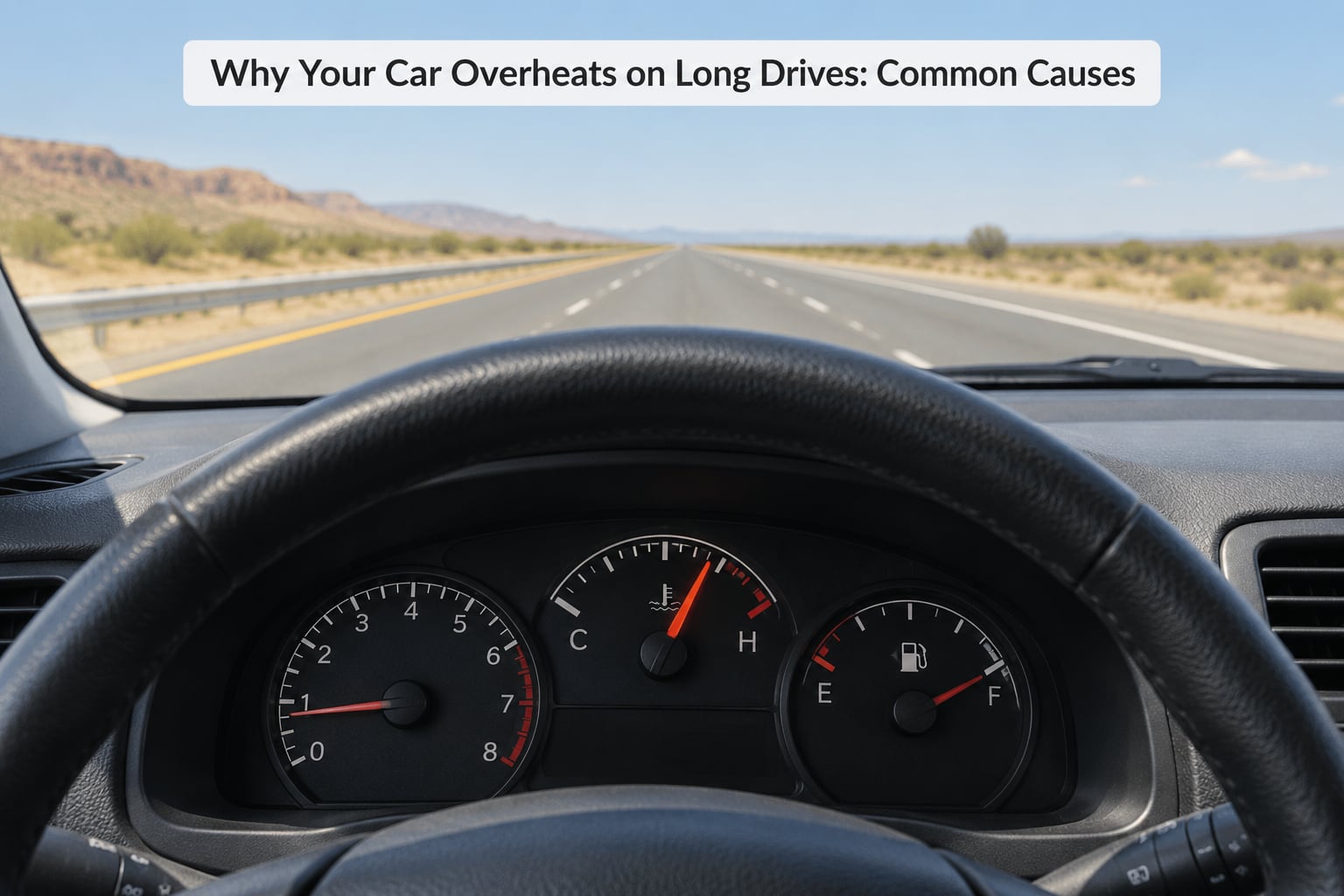
Overheating starts when the needle keeps climbing after the car is warm. Watch the gap between the needle and the red zone or the temperature warning light. On a healthy car, that gap stays the same all trip. When the needle creeps toward it, the system is losing.
Ambient heat and towing matter here. A car that sits comfortably at 195 degrees in May can touch 210 in July with the same load, and towing up a grade at 70 mph can add enough heat to push a marginal system over its limit. That is normal heat going wrong, not a broken car.
The clearest difference is timing. Heat that arrives after 20 minutes of cruising, that only appears on long grades, or that appears with passengers and luggage is almost always a cooling capacity problem rather than an immediate mechanical failure.
Warning Signs That Your Engine Is Overheating
Most drivers notice the gauge late. These are the earlier tells, and they show up in a specific order as coolant loses its margin.
- The needle sits higher than usual and drifts upward while cruising
- The temperature warning light comes on, even briefly
- A sweet, sharp coolant smell inside the cabin
- Steam curling up from under the hood
- The air conditioning blows warm, then cold, then warm again
- White vapor from the exhaust pipe
- Bubbling coolant in the reservoir or radiator
- A colored puddle or drip stain under the car when parked
- Loss of power, a rough idle, or the engine running rough at highway speed
- The check engine light alongside a temperature rise
Some of these deserve different reactions, so here is how to sort them.
| Warning sign | What it usually means | How urgent |
|---|---|---|
| Needle climbing, no warning light yet | Cooling system losing capacity, no immediate damage | Find a safe place to pull over within minutes |
| Temperature warning light on | Engine at or near its limit | Pull over and shut the engine off |
| Steam under the hood | Boiling coolant or a large leak | Stop immediately, step away, do not open the hood fully |
| Loss of power or rough running | Severe heat, possible head gasket failure | Stop, switch off, tow it in |
| Sweet smell with a puddle | External coolant leak | Do not keep driving to destination |
One signal deserves special mention. Forum owners report the heater blowing cold, then suddenly hot, mid-drive as a sign of combustion gases trapped in the coolant, which points to a head gasket problem rather than a simple level issue.
What to Do If Your Car Overheats on a Long Drive
Follow these in order. The sequence matters more than the speed you do them at.
- Turn the air conditioning off and ease off the gas. The compressor is one of the biggest loads on a hot engine.
- Drop your speed. Lower engine speed reduces heat output and increases airflow across the radiator at the same time.
- Get off the fast lane. You need time to reach a safe place, not maximum speed.
- Pull completely off the road. Turn on hazard lights, park on level ground if possible, and set the parking brake.
- Switch off the engine and leave the key out. Do not sit with the engine idling. Expect to wait 30 to 45 minutes, longer in desert heat, before touching anything.
- Do not open the radiator cap. The system is pressurized and hot coolant will spray out and burn you. This is the single most common serious mistake drivers make.
- Do not pour cold water on a hot engine. Sudden cooling warps the cylinder head, which turns a coolant problem into a head gasket repair.
- Once fully cool, look under the car for a puddle or drip, and check the reservoir level before you decide anything.
- Call roadside assistance rather than restarting. Repeated restarts cycle heat into the same components and hide the symptom.
Stop driving now, no exceptions, if any of these are true: the temperature light is on, the needle has entered the red, you see steam, the engine is losing power, or the gauge returns to normal only after you stop. A gauge that resets when the car is parked is not a gauge that is fixed.
Engineers have a blunt phrase for what happens next. Sustained excess heat bakes the cylinder head gasket, distorts the head surface and pushes coolant into the cylinders. A coolant top-up job is simple; a head gasket job on a road trip is not.
Long-Drive Overheating Problems and Fixes
Here is the same list again, with the fix attached to each fault so you know what you are dealing with.
1. Low or leaking coolant. The most common cause by a wide margin, and often the easiest to find. Look for a colored stain on the driveway, crusty residue on hoses, or a puddle that appears within a day of parking. Leaks that only show up under load, such as a hose clamp that opens at high temperature, will not drip when the car is cold.
2. Radiator cap or coolant hoses. The cap is a pressure valve, and a worn cap can release coolant slowly with no visible leak. Owners on mechanic forums routinely rank the cap second only to the thermostat on cars that overheat only on long trips. A replacement hose costs little and stops the coolant escaping into the block.
3. Blocked radiator core. Airflow is the radiator’s only job, and bug bodies, dust and bent fins reduce it. The tell is that the car runs cooler in cool air and struggles in summer, on grades, or after being driven fast. A core that has been repaired once with a plastic tank is often the culprit.
4. Thermostat stuck open. The engine never reaches full operating temperature. Look for a temperature needle that sits lower than normal, a heater core that stays lukewarm, and fuel economy that is worse than it should be. This one is a straightforward part replacement.
5. Cooling fan, relay or belt. Fans that do not run mean no airflow in traffic and no help after a stop. Turn the key on and let the engine idle, then stand behind the bumper and feel for air. Many fans are quiet enough that drivers never notice they have stopped. Fan noise, rattle or a fan that only runs on high setting all point here.
6. Water pump failure. The impeller is a plastic or metal piece inside a housing, and it can shed its blades without leaking a drop. The blades then circulate air instead of coolant. Listen for a grinding or buzzing noise from the front of the engine, and note whether the belt is worn or the pulley rattles.
7. An air pocket in the system. This one shows up on cars that were recently serviced and then start overheating with a full reservoir. An airlock blocks circulation at the top of the system and mimics a bad water pump. Proper bleeding of the cooling system clears it.
8. Head gasket or internal leak. Combustion gases entering the coolant show up as white exhaust smoke, a sweet smell with no puddle, a reservoir that froths or boils, and a heater core that cuts out mid-drive. Several owners of cars that overheat only at highway speed eventually traced it to a head gasket, and this is a shop job, not a roadside one.
Why Your Car Overheats on Long Drives Even With Full Coolant
A full reservoir rules out the simplest cause and leaves the harder ones. A radiator that cannot release heat, a pump that has lost its blades and a thermostat stuck open all leave the tank looking perfectly normal, which is exactly why these faults get misdiagnosed for months.
The single most useful question you can give a shop is timing. Tell them it runs cool at idle, climbs after 25 minutes at highway speed, and holds steady once stopped. An intermittent fault that only reproduces under load can be tested that way, whereas a car that is already warm on the driveway tells a mechanic very little.
The other telling clue is the coolant itself. Dark, oily coolant with a sweet smell and no puddle underneath points to an internal leak. White exhaust vapor on a warm engine after a drive is another one. Neither leaves evidence outside the car, so the absence of a puddle means nothing.
Why Checking Coolant Before a Road Trip Matters
Ten minutes before you leave saves a roadside tow. Do this on a cold engine.
- Open the hood on level ground with the engine cold and check the reservoir against the COLD or MIN and MAX lines.
- Look under the car where it usually parks for a colored stain, and run a finger along the radiator hoses, the water pump housing and the radiator cap for dampness.
- Confirm the radiator cap is seated and tightened, and that the cap is the correct pressure rating for the vehicle.
- Check the coolant in the reservoir is clean and the correct type for your engine. Use the specification in your owner’s manual.
- Confirm the accessory belt is tight and free of cracking or glazing.
- Start the engine, let it idle, and stand behind the bumper to confirm air is moving through the radiator and both fans engage.
Carry a spare bottle of the correct coolant with you on a long trip. Topping up is a legitimate temporary measure to get you to help, not a fix, because it treats the symptom and hides the level drop that told you something is leaking.
How to Prevent Overheating on Long Drives
Prevention here is mostly about condition and load, not about driving differently.
- Keep the cooling system on its service schedule, including coolant changes at the interval in your manual, which is commonly in the region of every 40,000 to 60,000 miles for many vehicles.
- Use the specified coolant and never mix incompatible types. Pre-mix is easier to get right; concentrate must be mixed with distilled water, not tap water.
- Do not overload the car for a trip. Luggage and roof boxes add weight, raise the center of gravity and increase the load the engine works against on grades.
- Run the air conditioning normally. Cutting it does very little for engine heat compared with reducing speed, and driving with the windows down and the HVAC off simply trades cabin comfort for nothing.
- Watch the gauge more often on long drives, especially in desert heat, on mountain grades and while towing.
- Take a break every two hours in extreme heat. It helps you and it gives the engine a moment at lower load.
- Keep an emergency kit in the car with a gallon of the correct coolant, a basic tool set, a warning triangle and roadside assistance details.
One habit worth keeping: if the car is older or you have no idea when the cooling system was last serviced, get it inspected before a multi-hour drive rather than during one.
When a Mechanic Should Inspect the Cooling System
Get a shop involved whenever the fault repeats, whenever it happens with no external leak, and whenever you already know the engine is losing pressure.
Some jobs are firmly shop work: a pressure test of the cooling system, a combustion gas test in the coolant, a head gasket or head resurfacing, an internal block or water pump repair, and an airlock that needs proper bleeding. Ask for the diagnostic steps rather than a parts list, because owners on mechanic forums describe the same pattern repeatedly: thermostat, cap and water pump replaced in one go, and the problem still there.
Document before you go. Note the drive time and outside temperature when it first happened, whether the air conditioning was running, whether it was flat road or grades, and what the gauge did. A recurring fault that only appears after 30 minutes at highway speed is one a technician may never reproduce during a five-minute test drive, so your notes are the actual evidence.
You can make a fair call yourself about severity. A low level with a visible leak and clean oil is usually a straightforward hose, cap or coolant job. A full reservoir, white exhaust smoke and a head that loses power points to internal damage, and that is worth a proper diagnosis before you spend anything on more parts.
Frequently Asked Questions
Can my car overheat just from driving on the highway for several hours?
Yes, and it is one of the most common complaints drivers bring to shops. After 30 minutes or so of steady driving, every metal surface around the engine is fully heat-soaked and the cooling system is working at its limit. A marginal fault such as a weak radiator cap or a partially blocked core can keep up for twenty minutes and fail on hour two. The timing is the clue: a fault that only appears after sustained driving is a capacity problem, not an immediate breakdown.
Does using the air conditioner make a car more likely to overheat?
Slightly, but far less than most people assume. The compressor adds mechanical load to the engine, which produces more heat, and it shares a condenser with the radiator’s airflow path. On a healthy car the system handles it easily. On a car already losing cooling capacity, running the air conditioning can be the extra load that tips it over. Turning it off is a sensible first step when the gauge climbs, but reducing speed does more than switching off the compressor.
Is it safe to drive a short distance after the temperature warning light comes on?
Only if the car has already cooled fully and you have no other warning signs, and even then it is a short distance to a safe place rather than to your destination. If the temperature light came on, the needle entered the red, you saw steam or the engine lost power, the correct call is to stop and tow it. A gauge that returns to normal once the car is parked only tells you the system recovered, not that the fault is gone.
Why does my car overheat but the radiator still looks full?
Because a full radiator only rules out one problem. A blocked radiator core cannot release heat even with plenty of coolant in it, a water pump whose impeller has lost its blades circulates air instead of coolant, and a thermostat stuck open means the engine never reaches operating temperature. Internal leaks and combustion gases in the coolant also leave the level intact while causing overheating. Check for airflow, white exhaust smoke and a bubbling reservoir.
What should I do if steam starts coming from under the hood?
Pull over safely, switch off the engine, set the parking brake and get everyone out of the vehicle. Do not open the radiator cap and do not pour cold water on the engine. If you need to look, raise the hood from the front edge and prop it with the hood prop or a stick rather than holding it with your hands, because escaping steam can burn. Call roadside assistance and treat it as a tow, not a top-up.
How often should I check or change my engine coolant?
Check the reservoir level monthly and before every long trip, always on a cold engine, against the COLD or MIN and MAX lines. Coolant service intervals vary widely by vehicle and coolant type, with many manufacturers specifying a change somewhere in the region of 40,000 to 60,000 miles, and some newer long-life formulas going much further. Your owner’s manual gives the figure for your engine, and that number is the one to follow.
Conclusion
Why your car overheats on long drives comes down to a cooling system that runs out of margin, usually because of low or leaking coolant, a radiator cap or blocked core, a thermostat, a fan, a water pump or an internal leak. Watch the gauge rather than the destination.
If the needle starts climbing, turn off the air conditioning, ease off the gas and pull over somewhere safe. Switch off the engine, wait for it to cool completely and never open a hot radiator cap or pour cold water on a hot engine. If the car cools down and stays cool, book an inspection before the next long trip, and treat any sign of a white exhaust, a sweet smell or a puddle as a reason to tow rather than drive.