Flight prices change so often because airlines reprice the same seat continuously, adjusting fares to demand, how many cheap tickets are left, how close departure is, and what competitors charge. Nothing about the flight has to change for the price to move. What you see is one moment in an ongoing calculation, not a fixed price with an expiration date.
That distinction matters more than any booking trick, because most of the advice circulating about airfare is folklore. The genuine levers are fewer and more boring than most travelers expect.
Table of Contents
- Why Flight Prices Change So Often: Demand, Capacity, and Timing
- What Actually Determines an Airline’s Price?
- How Demand and Remaining Seats Change Prices
- How Airline Pricing Algorithms Make Frequent Changes
- What Causes Prices to Drop as Well as Rise
- When Do Flight Prices Usually Change?
- Which Fare Changes Are Normal and Which Are Misleading?
- How Travelers Can Respond to Changing Airfare
- Frequently Asked Questions
- What to Do First When Flight Prices Keep Changing
Why Flight Prices Change So Often: Demand, Capacity, and Timing
Airlines sell a fixed number of seats on each flight, and those seats are released in price tiers rather than at one price. When the cheapest tier sells out, the floor price rises without anyone changing the flight. On top of that, pricing systems adjust fares continuously based on how fast the flight is filling, how close it is to departure, and how rivals are pricing the same route.
It helps to separate the ticket into two layers. The airline sets a base fare plus taxes, fees and any carrier-imposed surcharges. Then the layer you chose, from a carry-on that costs extra to a fully refundable ticket, gets added on top. A change in the second layer is a product decision, not a repricing event.
So when a fare moves, it is worth asking which layer moved. The Bureau of Transportation Statistics publishes average US domestic itinerary fares each quarter, and those market-level swings trace back mostly to seasonality and capacity rather than to any one airline making a decision.
What Actually Determines an Airline’s Price?
Airline pricing starts from a fare ladder. Every flight is loaded with the same seat count spread across dozens of booking classes, and each class has its own rules about changes, refunds and advance purchase. The fare you are quoted is simply the lowest class that still has inventory.
The fare ladder behind a single seat price
Consider a domestic route with two daily flights. The airline fills each departure with a few dozen inventory buckets: the cheapest and most restricted fare first, then progressively more expensive and more flexible ones, until the last buckets sit near the top of the range for that route. When the bottom buckets sell, the quoted price climbs one rung.
That is why the seat next to you on the same aircraft can cost several times more. Both of you are on the same flight, but one of you holds a seat in a different class, and the two classes were not priced alike to begin with.
The seven drivers behind almost every fare change
- Demand. How quickly the flight is selling, measured against the airline’s forecast for that route and date.
- Remaining inventory. How many seats remain in the cheapest classes, which is often the single largest mover.
- Time to departure. Fares climb as the flight approaches, though the shape of that climb varies enormously by route and season.
- Seasonality. Holiday weeks, school breaks and weather seasons carry built-in demand the airline priced months earlier.
- Capacity. Adding or cutting a flight changes the seat supply on a route, which reprices every other flight on it.
- Fuel and operating costs. Jet fuel and labor moves shift the cost baseline, which feeds into later repricing cycles rather than the next minute.
- Competition. When a rival changes fares, pricing systems on the same route typically follow within hours.
Route competition deserves emphasis. On a city pair with three or more carriers, fares behave very differently from a thin route where one airline has most of the demand. Where a new entrant appears, the incumbent frequently has to answer, and the response shows up as a fare drop on routes that had looked expensive.
How Demand and Remaining Seats Change Prices
Load factor is the share of a flight’s seats already sold, and it is the number most closely tied to a price move. Early in a booking cycle an airline sells its cheapest classes into a slow market to get moving, then closes off that pricing once the flight is tracking above forecast. Later, if sales stall, those classes can reopen at a lower price.
Holidays, major events and severe weather all compress demand into a narrow window. When a storm cancels flights across a region, stranded travelers rebook on whatever seats remain, and those remaining seats are almost always the expensive ones. Prices on a disrupted network can move sharply within a day, and not because anyone repriced a route on purpose.
| Demand condition | What is happening | Typical fare behavior | What to do |
|---|---|---|---|
| Low demand | Flight is well behind forecast; cheap classes still open | Fares at or below the route’s usual range; sales more likely | Book a fare that looks at or below the historical baseline |
| Moderate demand | Selling roughly as forecast; middle classes active | Fares near typical; base fare is a fair read | Use the price graph and the 24-hour cancellation rule to decide |
| High demand | Flight is ahead of forecast; cheap classes closed | Lower fare is gone; price rises in steps as each class empties | Shift dates, a nearby airport or a different time of day |
Booking pace matters as much as final demand. A flight can be 80% full two months out and a poor bet, or 80% full the week before departure and a good one. Airlines weight the rate of sale, not just the total, which is why a flight that suddenly starts selling fast gets repriced even when seats remain.
How Airline Pricing Algorithms Make Frequent Changes
Each fare on sale is attached to conditions: a purchase deadline, a minimum stay, a change fee, an eligibility flag. A resident of the fare’s country, a member of the airline’s program, a passenger in an eligible corporate account or someone booking far enough ahead can be shown a different set of fares from someone who meets none of those conditions on the identical flight and departure time.
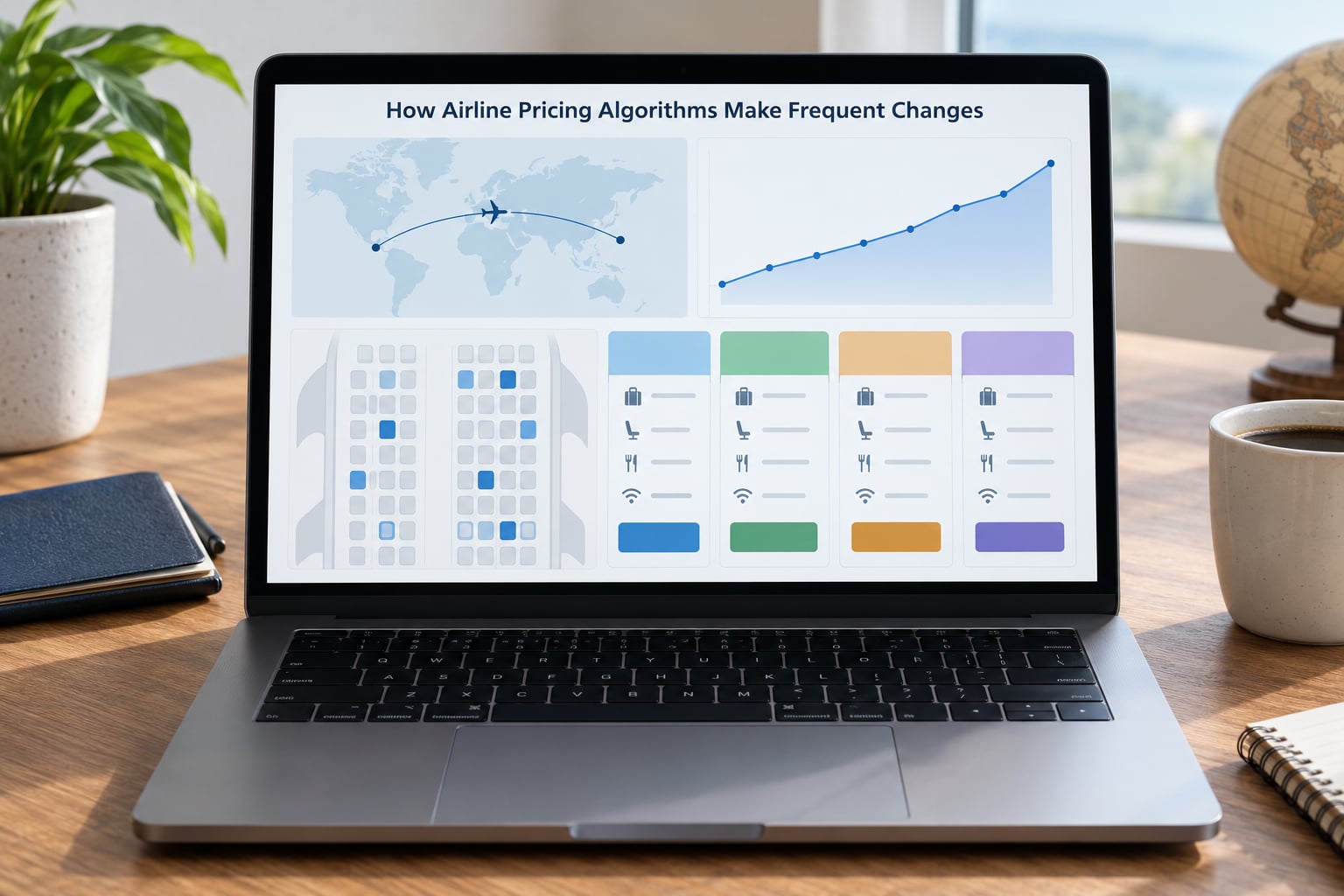
Imagine a single flight in a simplified fare ladder. At 60 days out, the lowest class is open to everyone. At 40 days, it is limited to members. At 21 days, it is closed, and the lowest bookable fare steps up. At 10 days, only the highest classes remain, and at 72 hours out the calendar is full, so the system reprices the last remaining seats against demand for the remaining capacity.
Nothing about the airplane changed across those steps. The inventory did, and the fare follows the inventory.
Why two websites show two different prices
The airline’s own checkout reflects live inventory. Meta-search sites such as Google Flights, Kayak and Skyscanner display cached data that Google states it updates roughly once every 24 hours. An online travel agency sits in between, sometimes passing the airline fare through and sometimes adding its own markup or payment fee.
Users on TripAdvisor and Reddit have reported booking through a meta-search result and reaching a higher fare at the airline or agency checkout than the number the search page displayed. That is the caching gap, and it is not a targeted penalty.
One of the most reported experiences, and the least well explained, is a fare rising during a single checkout session. The cause is usually that the class held at the first step of checkout was released or sold while the traveler was entering payment details, and the re-quote fell into a higher class. The seat hold that protects a price is short-lived, and it is not a guarantee.
What Causes Prices to Drop as Well as Rise
Fares fall for the same reason they rise: the numbers changed. Common causes include a new flight being added to a route, which adds seats and creates fresh cheap inventory; a schedule reduction, which does the opposite; a competitor matching or undercutting a fare; a promotion ending and being replaced; unsold seats approaching their departure deadline; and a cancellation that returns inventory to the general pool rather than holding it.
Not all of these drops reach every traveler. A fare that requires a seven-day advance purchase, a specific fare class, or a carrier’s own sales channel is not the same price as a fare that requires nothing. When people say the flight got cheaper, they are often comparing two products that differ in more than price.
Schedule changes are the most useful drop to understand. A route that gains a departure, or an airline that restores a cancelled frequency, sells the new capacity into a market that was previously supply-constrained, and the constrained fares ease.
When Do Flight Prices Usually Change?
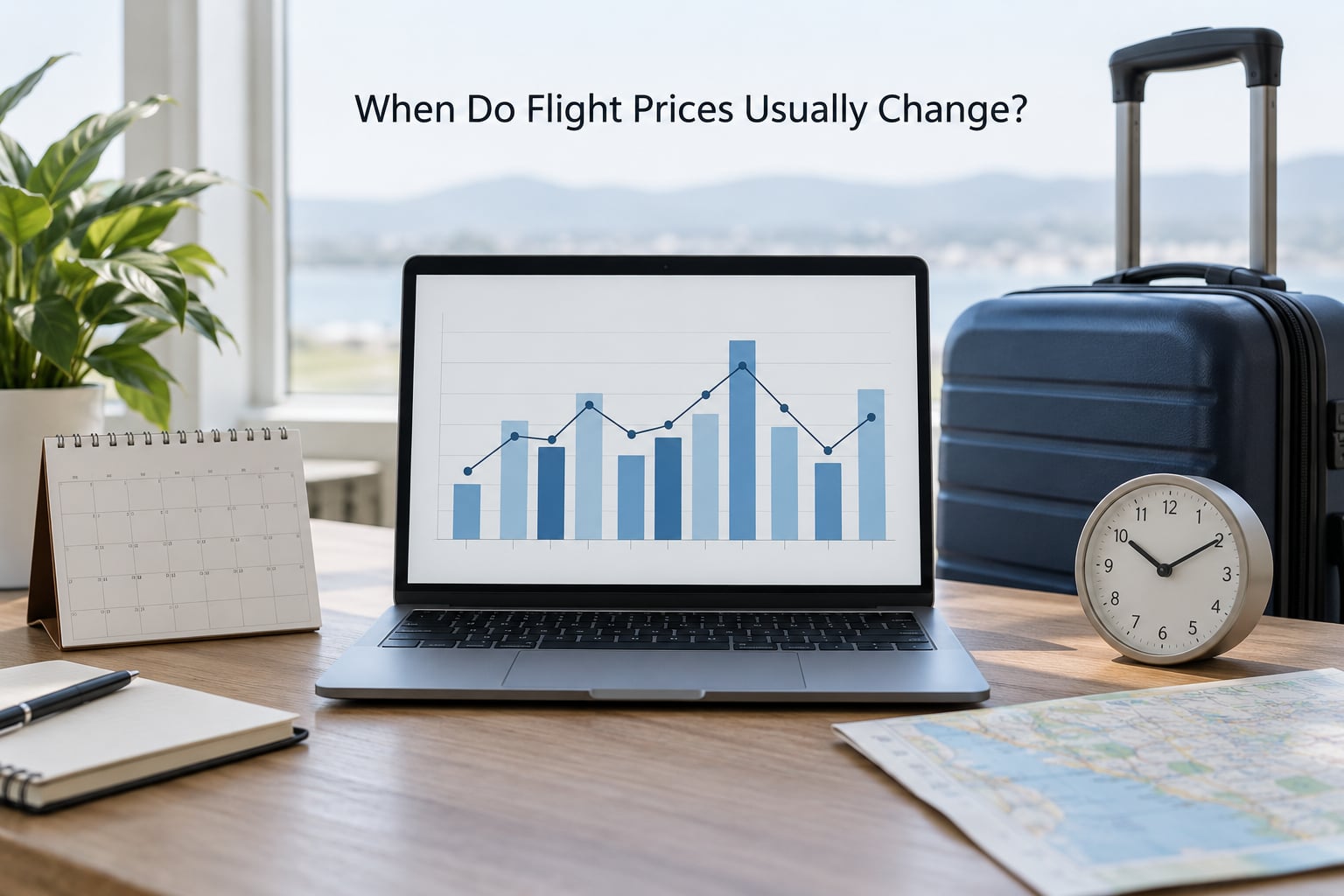
Fares move continuously rather than on a schedule, so there is no single best booking window that applies to every route. What changes across the booking cycle is the balance between inventory released for sale, demand forecasts, and the cost of leaving a seat empty closer to departure. Early on, cheap classes are open and a bad forecast is cheap to fix. Late, an empty seat is expensive to fix, and the last classes stay open deliberately.
| Booking period | Common pricing behavior | Traveler priority |
|---|---|---|
| Several months out | Cheapest classes open; wide spread between fares; schedules may still shift | Route choice and flexibility, not speed |
| Two to three months out | Cheap classes begin closing on high-demand flights; low-demand flights still cheap | Know your route’s normal range before reacting |
| A few weeks out | Fares step up in blocks as each class empties; little cheap inventory left on peak flights | Accept the fare or change the plan, not the search method |
| Final days | Only the highest classes remain; unsold inventory is released late and can create brief dips | Expect the highest prices and the least flexibility |
Booking advice that promises a magic window is oversimplified. Short-haul domestic routes and long-haul international routes behave differently, and peak weeks are already priced for the crowd when the calendar opens. The useful question is not when to book, but whether the fare in front of you sits inside the range that route usually commands.
Which Fare Changes Are Normal and Which Are Misleading?
Plenty of widely repeated airfare advice does not hold up. The airline or the meta-search site, not your browsing habits, decides what a seat costs. Repeat searching does not raise a fare, and Skyscanner has publicly stated the same. Clearing cookies, switching to incognito or routing through a VPN changes how a site identifies your browser, not the fare class available on a flight.
| Common claim | What actually happens |
|---|---|
| Searching more often raises the price | Repeat searches do not raise fares. Inventory and demand move, not your search count. |
| Incognito or cleared cookies unlock cheaper fares | Cookies and browser fingerprints have no effect on the fare classes an airline offers. |
| Prices systematically drop on Tuesdays | There is no reliable pattern of consumer fares dropping on a particular weekday. Sales are announced, not timed to a day. |
| Late-night searches find secret fares | No consistent evidence supports lower fares for consumer bookings at a given hour. |
| The airline raises prices after you search | Fares can move during a session because inventory was sold or released, not because you were tracked. |
| Every site shows the same price | Meta-search results are cached and may include markup; airline checkout is live and authoritative. |
Some influences on what you see are real but modest. Country of residence affects which fares an airline publishes, membership can unlock a private fare class, the device and market can change which inventory is surfaced first, and payment method sometimes changes the price at checkout. Treat those as variables worth comparing, not as levers to game.
How Travelers Can Respond to Changing Airfare
You cannot control repricing, but you can control how much of it you are exposed to. Most of the useful steps are comparison habits rather than tricks.
- Check the total, not the base. The fare in the headline is the airline’s base plus taxes and fees. Compare the final number on the airline’s own checkout, since that is the amount you actually pay.
- Move the date before moving the site. A one-day shift on either side often opens a different flight with a different fare class entirely. The date grid on a metasearch page makes this a single glance.
- Check nearby airports. A secondary airport a short drive or train ride away can have a different airline mix and therefore different fares.
- Read the fare rules. Change fees, advance purchase requirements and refund restrictions determine whether a fare is worth its headline price. Basic economy is usually the least flexible class and carries the biggest penalty for a mistake.
- Use a price baseline. The price graph in Google Flights shows whether a fare is high, typical or low for that route over the past year, and a price history from the Bureau of Transportation Statistics gives a longer view of a market.
- Set an alert and stop searching. Alerts on Google Flights or an airline app watch a route while you do something else. Refreshing manually is the least productive response to a price move.
- Use the 24-hour cancellation rule. For flights to, from or within the United States booked at least seven days before departure, you can cancel within 24 hours of booking for a full refund. It gives a repriced fare one day to settle.
- Know your recourse after that. Most tickets can be cancelled for a travel credit rather than a refund, and a fare bought in the cheapest class usually carries no credit at all. That asymmetry is why basic economy decisions are worth slowing down on.
When a fare drops after you buy, a refund is unlikely, but a credit is usually available under most fare classes. A price alert that keeps running after purchase is worth more than the hours spent refreshing a checkout page.
Frequently Asked Questions
Why do airline prices change between two identical searches?
Because the two searches happen at different moments against changing inventory. Between them, seats in the cheapest fare class on a given flight may have been sold, a competitor may have repriced the same route, or the departure date may have crossed a booking deadline. Two searches made seconds apart can match, and two made days apart often will not. Neither result is a personal assessment of you.
Are flight prices cheaper on a particular day or time?
For most routes, no consistent weekday or hour is reliably cheaper for ordinary bookings. What does vary is season: holiday periods, school breaks and large events carry more demand and are priced that way well before you start shopping. Midweek flights are often cheaper than weekend ones on the same route, but that is a difference in the flight itself, not a difference in when you search for it.
Does airline pricing change every time you search?
The fare shown to you can change between searches because the underlying inventory and demand forecasts are moving in real time, not because your searches are being recorded and used against you. Pricing systems act on aggregate demand for a flight. You have no way to prevent a fare from moving while you shop, so deciding early on a fare you consider fair is usually more productive than re-searching.
Why can another passenger see a different fare for the same flight?
Fares are published to different groups of travelers. A cheap class might be limited to a booking window, an eligible carrier sales channel, an advance purchase requirement, or travelers in a specific country. A member of an airline’s program, a resident of the fare’s country and an eligible corporate booker can all be shown a different lowest fare on the identical flight. Basic economy is also sold more narrowly than a standard economy fare.
Is a cheaper basic fare always the best-value ticket?
A basic economy fare is the least flexible class a US airline sells, and its restrictions are stricter than most travelers expect at booking. Changes usually require cancelling and rebooking, the fare may be nonrefundable, and adding a carry-on or choosing a seat can bring the total above a standard economy fare. If your plans could shift even slightly, a more flexible fare often costs less once the change fees are counted.
What to Do First When Flight Prices Keep Changing
Confirm whether the base fare actually moved or whether only the taxes, fees and your fare class changed, since those two situations call for different responses. Then compare the total on the airline’s own checkout across two or three nearby dates and any practical alternate airport, because the live checkout number is the one that counts against a meta-search estimate.
Once you have those totals, set a price alert for the route and stop refreshing. If the current fare sits inside the range that route usually commands, book it and use the 24-hour cancellation rule to buy yourself a day. If it sits well above that range and your dates are flexible, wait for the alert rather than searching again.