To plan a road trip around small towns, pick a region, shortlist the stops that are genuinely worth a night, cap your driving at roughly five to seven hours a day, and book the scarce thing first: a room. Small towns run lean — the diner shuts at eight, the gas station at nine, and the one inn on Main Street sells out for a county fair months early. Plan for that and a small-town route is the easiest, cheapest, most relaxing drive you will take all year.
I have planned these routes the slow way and the fast way. The fast way is a spreadsheet of towns copied off a listicle, and it falls apart around day four when everyone is tired, dinner options are three, and the museum you built the day around closed on the fourth of the month. The slow way takes about three hours of front-end work and then gets out of your way.
Below is the method I use. It covers what to gather first, then seven steps that turn a region into a route you can actually drive, then the mistakes that kill small-town itineraries.
Table of Contents
- What You Need to Plan a Road Trip Around Small Towns
- Step-by-Step
- Common Mistakes to Avoid on Small-Town Road Trips
- Frequently Asked Questions
- How many hours should I drive each day on a small-town road trip?
- Do I need to book small-town hotels and restaurants in advance?
- How can I find interesting small towns without spending hours researching?
- Is a road trip around small towns suitable for a solo traveler?
- What should I pack for driving through rural areas?
- What is the 3-3-3 rule for road trips?
- Conclusion
What You Need to Plan a Road Trip Around Small Towns
You need less than a guidebook and more than a map. Gather these five things before you pick a single town, because each one changes what your route is allowed to be.
Route planning tools
Google Maps is free and genuinely enough for a first pass — save your destinations to a list, add them one at a time, and read the leg times before you commit to an overnight. Roadtrippers layers in fuel stops, waypoints, and campground or hotel waypoints along the way. Waze is the one to have running on the passenger seat for road closures and construction that the other two lag on. Wanderlog is worth it when several people are sharing the trip and you want one place for hotels, food, and timings instead of four apps.
The tool does not make the plan. It just shows you the shape of it, which is the part that is hard to hold in your head.
Documents, insurance, and offline maps
Carry your license, proof of insurance for the vehicle, and your insurance card in the same folder. Download the full route area for offline use before you leave — rural two-lane highways are exactly where signal drops out, and map apps fail open into a blank grey screen at the worst possible moment.
Vehicle supplies
A tire inflator, a small first-aid kit, jumper cables, a reflective triangle, a flashlight, and a spare charger cable. Check oil, coolant, brake fluid, tires, lights, and wipers a week before departure, not the morning of.
Budget inputs
Get a per-day ceiling before you choose towns, not after. Split it into fuel, lodging, food, and activities, and decide in advance which line you will absorb surprise costs with. Fuel is your most predictable expense; lodging in a small town is your least available.
Route preferences
Write down three preferences before searching: how slow you want to go, what you want out of a stop (food, history, outdoors, photography), and how long you have. Small-town routes fall apart when people pick towns first and pace second.
Step-by-Step
Seven steps, roughly three hours of work for a week-long trip. You will know each step worked when the next one is easy.
Define Your Road Trip Style and Time
Decide which of four trip types you are actually running: a weekend getaway, a regional loop, a food-focused run, or a longer slow trip. A weekend is one base town plus three day trips. A regional loop closes back on itself so you never repeat a road. A food trip needs towns with somewhere to eat at 8pm. An outdoor trip needs trailheads and state parks, not historic districts.
Then write down your non-negotiables — the two or three things you would be genuinely disappointed to miss. Those become fixed points. Everything else on the route is negotiable, and marking which is which is the single thing that keeps an itinerary from becoming a prison.
It worked when you can say out loud, in one sentence, what this trip is about. If you cannot, you are going to spend three hours choosing towns instead of driving.
Choose a Region and Build a Loose Route
Pick the region before the towns. Look at how far you can drive in a comfortable day, then choose a region whose width fits your trip rather than the other way around. A week out and back covers a lot of ground; a week loop does not, because you are driving the same roads twice.
Decide loop or one-way. A loop is calmer — no luggage in the car, no rental one-way fee, and you are never more than a couple of hours from where you started. A one-way gets you further for the same number of days, which matters if your fixed points sit in different states.
Build the route loosely. In Google Maps, save candidate towns to a list and add them in order, checking the drive time between each pair. Look for scenic byway designations, which are roads chosen for scenery rather than speed and usually run through exactly the towns you want. Aim to leave 20 to 30 percent slack between towns — that slack is what turns a bad weather day or a closed attraction into an inconvenience instead of a rewrite.
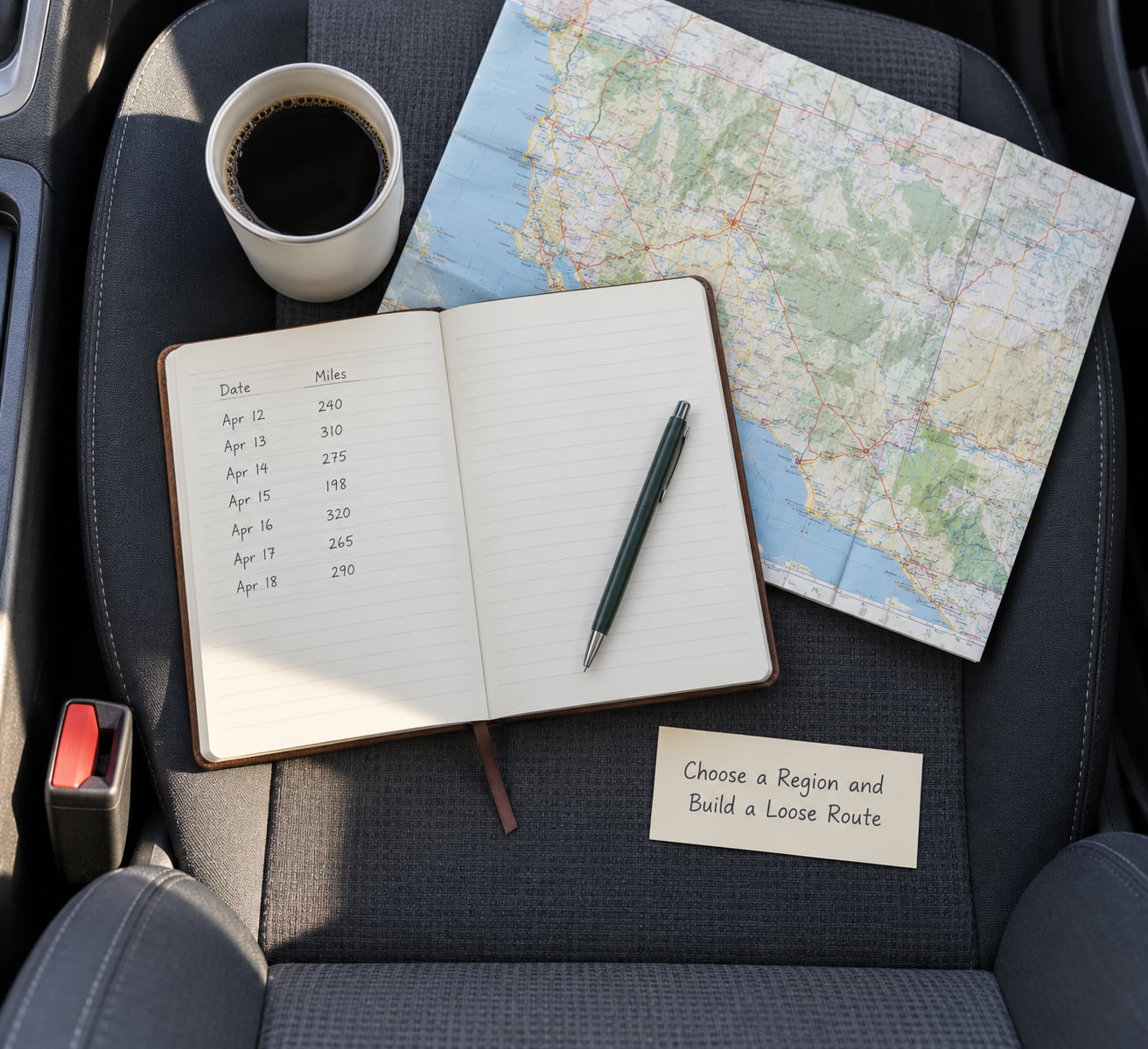
It worked when the route lives in one app and every leg shows a drive time you would be happy to sit through.
Match Towns to Experiences and Driving Times
Spacing is the practical rule most people miss: target 60 to 80 miles between small-town stops. Closer and you are changing hotels for scenery you could have seen from the road. Farther and you are gambling on a town whose diner, gas station, and inn all shut early.
Then judge each town on what it actually offers. A good small town has at least two of these: a historic main street with real 19th-century buildings, a landmark diner or bakery, a covered bridge or one genuinely unusual roadside attraction, a state or county park within a short drive, a working farm stand or a farmers market on weekends, or a local festival on a date you could route around.
Where do you find that list quickly? State tourism sites and regional visitors bureaus are the most reliable, since they list seasonal hours and closures. RoadsideAmerica and Atlas Obscura cover the weird stuff, which is often what makes a town memorable. Local news and chamber of commerce pages tell you what is actually open now. People planning these routes on Reddit tend to recommend staying with a host through Harvest Host, which is a good way to find towns where someone will point you at the thing worth seeing.
| Drive time between towns | What it usually means |
|---|---|
| Under 60 miles | Good day trip from an anchor town, poor overnight stop — you will change hotels for nothing |
| 60 to 80 miles | The sweet spot for an overnight, roughly 1.5 hours of driving |
| 80 to 150 miles | Fine for a two-night stop, poor for a single night unless the town has a lot going on |
| Over 150 miles | A full driving day; do not plan an activity on either end |
Set a Daily Driving Limit
Five to seven hours of driving per day is the working limit for most adults, and it includes the stops, not just the wheels turning. Beyond that, attention degrades and the last hour of an eight-hour day is where mistakes happen. A community rule of thumb that circulates on travel forums is the 3-3-3 rule: three days, three states, about three hundred miles a day. Treat it as a starting point, not gospel — it is a heuristic people pass around, not official guidance.
Adjust down for your party and up carefully for your own tolerance:
| Traveller type | Comfortable driving per day | Notes |
|---|---|---|
| Solo traveller | 6 to 7 hours | Fatigue builds quietly; stop every two hours regardless |
| Couple | 5 to 7 hours | Plan a scenic-byway leg rather than an interstate to break it up |
| Family with kids | 3 to 4 hours | Cut legs in half and stop before anyone asks, not after |
| RV or camper van | 4 to 5 hours | Add time for hookups, height and weight restrictions, longer braking |
| Travelling with pets | 4 to 5 hours | Pair every leg with a planned stop, not an emergency one |
Split your total route miles by your daily limit, then subtract one hour from one day for a buffer you will probably use. Shorten a day when the terrain is hilly, when the forecast is bad, or when the people driving are tired — none of those are failures of the plan.
It worked when every day on the sheet has the same shape: drive, one anchor activity, arrive before things close, stop driving.
Check Lodging, Fuel, Food, and Seasonal Conditions
Book the room before you lock the route. A town of two thousand might have six rooms above a diner and one historic inn, and they go first. Start with places that offer free cancellation, book the tight nights, then fill the flexible ones as the route firms up.
Check what you cannot book in advance. Diner hours, gas station hours, and grocery store hours are not bookable and not usually posted anywhere you’d think to look — check the town’s own website or Facebook page, or just call the one number you can find. In general, assume a diner’s last seating is around 7pm and a fuel stop has to happen before 9pm.
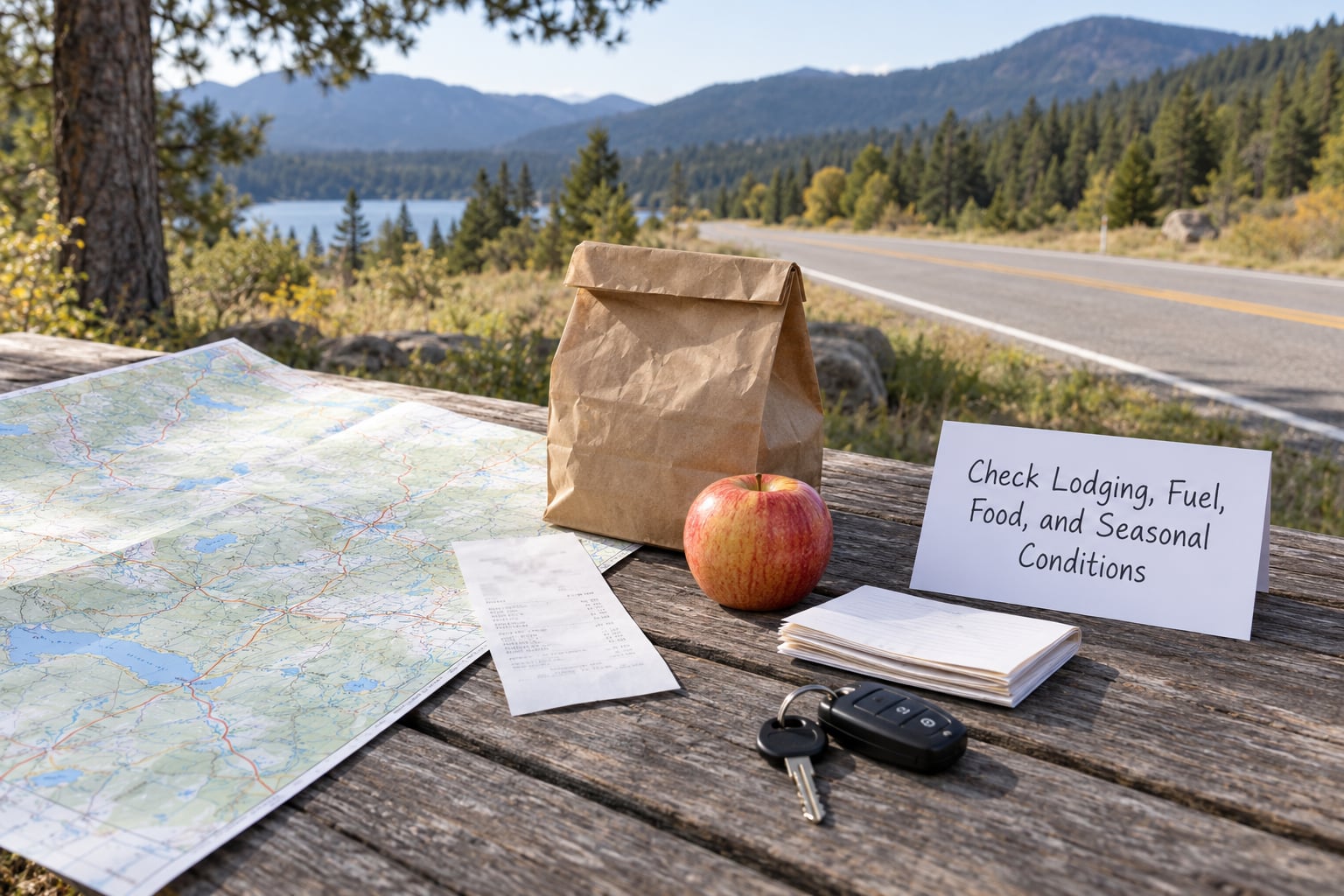
Fill the tank before the town limit, not inside it. Carry a snack kit and a cooler, because a town with one gas station may have zero places open late. Check seasonal closures for anything you care about — parks, ferries, and small museums often shut for part of the year — and re-check the weather and road conditions the morning of each drive.
It worked when you can name where you are sleeping tonight and where you are eating, without needing to look anything up.
Add One Memorable Activity to Each Town
One anchor activity per stop, not five. A historic downtown walk, the landmark diner, the covered bridge, the overlook at the state park — pick one, budget two hours, and let the rest be unplanned. Small towns are two blocks wide; you will walk it end to end before your coffee is gone.
The best recommendations come from a person, not an app. Ask whoever is behind the counter what people come into town for, and ask two people. Then build the rest of the day around whatever they said.
Confirm the Plan and Build a Backup Route
A week out, save every confirmation, screenshot the addresses, and re-read the whole route once in the map app. Then write down the backup: an alternate lodging option in the same town, an alternate road if the main one is closed, and the nearest larger town with more services in case you need fuel, food, or a mechanic.
Put together a one-page next-day list — addresses, drive time, what is booked, what you want to see, where you are sleeping. This sounds fussy and it is the thing that turns a wrong turn at dusk into a normal evening.
| Day | Drive | Town type | Overnight plan |
|---|---|---|---|
| 1 | 3 hrs | Anchor town | Three nights, day trips out |
| 2 | 0 | Same town | Park or trail day |
| 3 | 2 hrs | Historic small town | One night |
| 4 | 3 hrs | Food town | Two nights, anchor night mid-week |
| 5 | 3 hrs | Riverside town | One night |
| 6 | 2 hrs | Market or farm town | One night |
| 7 | 3 hrs | Home | — |
Two or three night anchor stays in a week are what keep a small-town route from wearing people down. Most of the fatigue people blame on driving is actually the packing, unpacking, checking out, and checking in every single evening.
Common Mistakes to Avoid on Small-Town Road Trips
- Arriving after everything shut. Plan to reach each town by 5pm rather than at dinner. If you cannot make the timing, drive past it and come back tomorrow.
- Assuming cell service. Signal dies in exactly the valleys and canyons where you need directions. Download the route offline and carry a paper map as the backup.
- Booking nothing because the town looks empty. Small-town rooms sell out for festivals, harvest season, and fall foliage long before they look booked online.
- Driving eight hours between towns. You will arrive tired, eat late, and remember nothing. Cut the leg in two and stay somewhere in the middle.
- Over-scheduling the day. Three stops in four hours is a bad day. One anchor activity plus walking a town is a good one.
- Treating the whole trip as driving. If nobody spends two hours anywhere, nobody remembers any of it.
- Trusting a listing that was written in March. Hours, ownership, and seasonal openings change. Call the business, or check its current social page, the week you go.
- Making every attraction mandatory. Keep one or two fixed points and let the rest of the week stay open. Plans that cannot bend usually get abandoned.
Most of these come from trying to plan too much. The fix in most cases is subtracting something.
Frequently Asked Questions
How many hours should I drive each day on a small-town road trip?
Most adults are comfortable with five to seven hours of driving per day, stops included. Families with young children usually want three to four, and solo or RV travellers land somewhere in between. The limit matters more than the distance, because small-town stops are close together and you want to arrive before dinner service ends. If a day has to run long, make it the one day with nothing planned on either end.
Do I need to book small-town hotels and restaurants in advance?
Lodging, yes, because a town of a few thousand might have only a handful of rooms and they disappear first. Book the tight nights with free cancellation, then fill flexible ones later. Restaurants rarely take reservations in small towns and rarely need them, but check that the kitchen is still serving at the hour you plan to arrive, since a diner seating at 7pm is normal.
How can I find interesting small towns without spending hours researching?
Use state tourism sites and regional visitors bureaus first, since they list seasonal hours and closures accurately. Add RoadsideAmerica or Atlas Obscura for the unusual roadside stops that make a town memorable. Then check the local news site or chamber of commerce page for what is currently open. A town only needs two good things — a historic main street and somewhere worth eating — to justify an overnight.
Is a road trip around small towns suitable for a solo traveler?
It suits solo travel well, mainly because rural towns are safer and quieter than big cities and a lot of the social risk drops away. The trade-offs are real: you cannot split driving, dinner options shrink after eight, and roadside breakdown help takes longer. Stay within comfortable solo driving range of six to seven hours, book the room in advance, and let someone have a copy of your route.
What should I pack for driving through rural areas?
Pack for the gap rather than the destination. A tire inflator, jumper cables, a first-aid kit, a reflective triangle, a flashlight, warm layers, water, and snacks cover most breakdowns and most long stretches without services. Download your maps for offline use before you leave, since cell service drops out on rural highways, and keep a paper map in the glove box as a last resort.
What is the 3-3-3 rule for road trips?
The 3-3-3 rule is a community rule of thumb that circulates on travel forums: travel about three hundred miles a day, across roughly three states, for about three days at a time. It is a shortcut for sizing a trip and pacing the first stretch, not official guidance. Many travellers find it fine for adults and too fast for a family with young children, so treat it as a starting point and adjust.
Conclusion
Start with three things: pick a region that fits the days you have, set a daily driving limit you would actually enjoy, and shortlist towns with at least two clear reasons to stop. Book the room before you book the route, plan to arrive by five, and leave the middle of each day open.
The rest of a good small-town itinerary is mostly the decision to stop planning so much. Once the logistics are handled, let the town do the work.