Planning a desert road trip in summer comes down to three things: pick the elevation, build the route around fuel and water, and keep the hot hours empty. In the American Southwest, daytime highs between June and September regularly run past 105F, shade is measured in miles rather than minutes, and the nearest gas station can be 100 miles down a straight road. Get those three right and the trip is the best driving you’ll do all year.
The rest is logistics, and the good news is that none of it is complicated once it’s written down. A weekend of planning buys you a week of driving that feels spontaneous rather than frantic.
I plan these routes the same way every time: pick the dates, pick the region, then build backward from the last fuel stop. Everything in between gets scheduled around heat. What follows is the sequence I use, in the order I use it, with the numbers I actually plan by.
Table of Contents
- What You Need
- Step-by-Step
- How do you choose the right desert route for a summer road trip?
- How do you plan driving times around desert heat?
- How should you prepare your vehicle for a desert road trip in summer?
- How do you pack water, food, and shade for a desert road trip?
- How do you handle campsites, permits, and restricted areas in the desert?
- How do you prepare for emergencies and changing desert conditions?
- Common Mistakes
- Frequently Asked Questions
- What is the best month for a summer desert road trip?
- How much water should I bring for a desert road trip?
- Is there reliable cell service in the desert during summer?
- How many days should I allow for a summer desert road trip?
- Can I take a rental car on a desert road trip?
- Are desert thunderstorms dangerous for road-trippers?
- Conclusion
What You Need
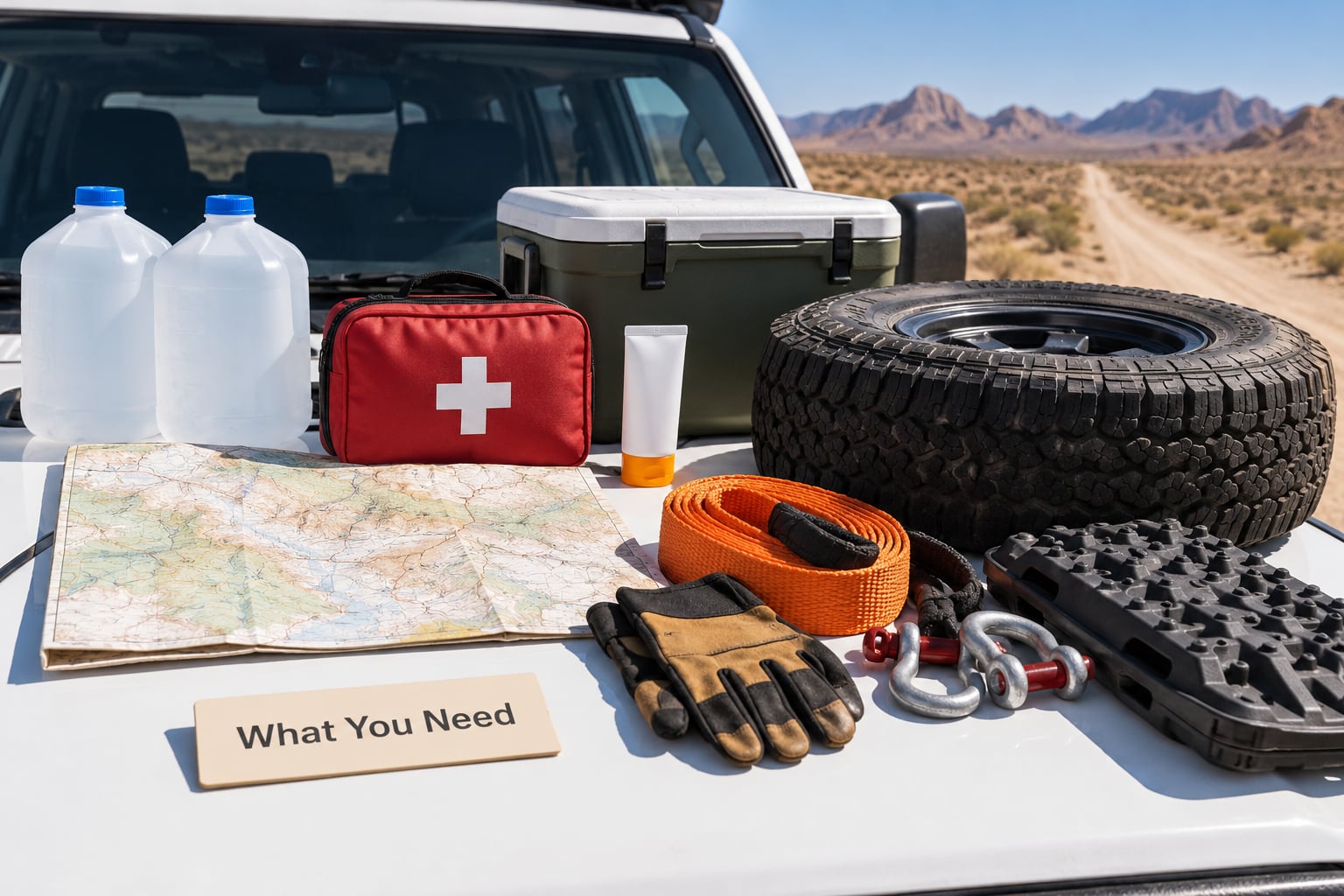
Most of what a summer desert road trip needs is not gear. It’s documents and decisions, made before the cooler is packed.
Paper and confirmation. Permits and campground reservations, printed or saved offline. A confirmation number on your phone is useless at a trailhead with no signal.
Water containers. Enough capacity to hold a full day’s supply for everyone, not just what fits in the bottle holders.
Navigation. Downloaded offline maps for the whole route, plus a paper map of the state as backup. Assume a 90-minute stretch of your day will have no bars.
First aid and recovery gear. A kit that includes more than band-aids, a tire inflator or spare, a jump pack, a shovel, a tow strap, and a headlamp that works at 3am when something goes wrong.
Sun and skin protection. Wide-brim hat, UPF long sleeves, SPF 50+ sunscreen, lip balm with SPF, and sunglasses. Desert UV bounces off sand and asphalt straight back at you.
Shade. A canopy or a small tarp earns its space. So does a heavy-duty tarp you can throw over the vehicle if the car dies in the sun.
Communication. A satellite messenger for the truly remote segments, plus a charged power bank. Cellular coverage is a cell dead zone across most of this terrain.
Here are the numbers I plan by, written down so you can check the plan against them later.
| Rule | Number | Why |
|---|---|---|
| Water carried | 1 gallon per person per day, plus half again for remote segments | Desert heat drives fluid loss faster than thirst registers it |
| Fuel | Never below half a tank; fill up at every town with more than one pump | Station gaps on desert routes regularly exceed 80 miles |
| Driving hours | Road before 10am and after 4pm; park in between | Avoids the peak heat window entirely |
| Tire pressure | Cold reading taken before departure, re-checked morning of | Asphalt heat raises pressure and blowout risk |
| Check-in | Evening message with location, plus a missed-check-in trigger time | Help is measured in hours on these routes |
Step-by-Step
How do you choose the right desert route for a summer road trip?
Choose by elevation first, destination second. The low desert parks are the ones people plan around in summer and the ones most people regret. Death Valley, Saguaro, Joshua Tree and the lower stretches around Phoenix and Las Vegas are effectively closed to hiking in July and August because there is no safe window of shade.
So route the trip north and higher. Flagstaff, Cedar City, Bishop and the Utah side above 6,000 feet give you evenings and nights you can actually sleep through, with a two-hour drive to red rock in the morning. One r/roadtrip user put it plainly: skip Phoenix, spend the time in Sedona, and take Monument Valley because it is a better drive anyway. That instinct is right. Elevation is the cheapest heat protection there is.
On the dry heat versus wet heat question that comes up in almost every forum thread: dry heat is not safer. Low humidity in Phoenix or Las Vegas does not stop heat exhaustion, and anyone who has been caught out in it knows how fast the transition happens. Treat both the same way and drink before you are thirsty.
Month by month, the Southwest looks like this:
| Window | Typical daytime high | Crowds | Recommendation |
|---|---|---|---|
| June | 95-110F | Low to moderate | The best summer window; early mornings are workable |
| July | 105-120F | Moderate | Drive only, stay high, no long hikes at low elevation |
| August | 105-120F | Moderate | Same as July plus monsoon storms in the afternoon |
| September | 95-110F | Low | Best value and best light of the summer season |
Allow seven to ten days for a loop that includes three parks. Users planning these trips repeatedly warn against cramming more in. The desert does not care about your schedule, and the version of this trip where you are behind the wheel at 3pm in peak heat is the version that goes wrong.
How do you plan driving times around desert heat?
Build the day around the sun, not the map. Start driving before sunrise, cover your long miles by 10am, then stop for four hours in the middle of the day at a place with shade or a pool. Pick the driving back up after 4pm.
That midday block feels like wasted time on paper and it is the reason the trip works. Two three-hour drives beat one six-hour drive every time in summer.
Add buffer to your estimates rather than to your schedule. Slow grades, construction zones around canyon country, and the twenty minutes you lose photographing something you have never seen before are all normal. If your plan has zero slack, it will fail on day one.
How should you prepare your vehicle for a desert road trip in summer?
A sedan is fine for paved desert roads. You do not need a 4×4 to drive from Flagstaff to Moab, and buying one for a vacation is money better spent on a spare tire and a full tank. Off-road territory is a different trip with different rules.
The checks that actually matter:
- Tires. All four checked cold the morning you leave, spare inflated and confirmed. Ambient heat on desert asphalt pushes pressure up, and underinflation on a hot road is how you get a blowout at 105F. Follow the pressure listed on the driver’s door jamb, not the number molded into the sidewall.
- Coolant and brakes. Both fluid levels verified, and the cooling system serviced if it has not been in a year or two. Extra coolant in the trunk is cheap insurance.
- Air conditioning. Tested at idle before departure, because it loads hardest in stopped traffic. Leave it running. The fuel it costs is not worth trading cabin heat for, and the idea that switching it off saves meaningful fuel is a myth that keeps circulating in the forums.
- Air filter and cabin filter. Dust is the other desert problem, and a clogged filter makes the engine work harder in exactly the heat it can least afford.
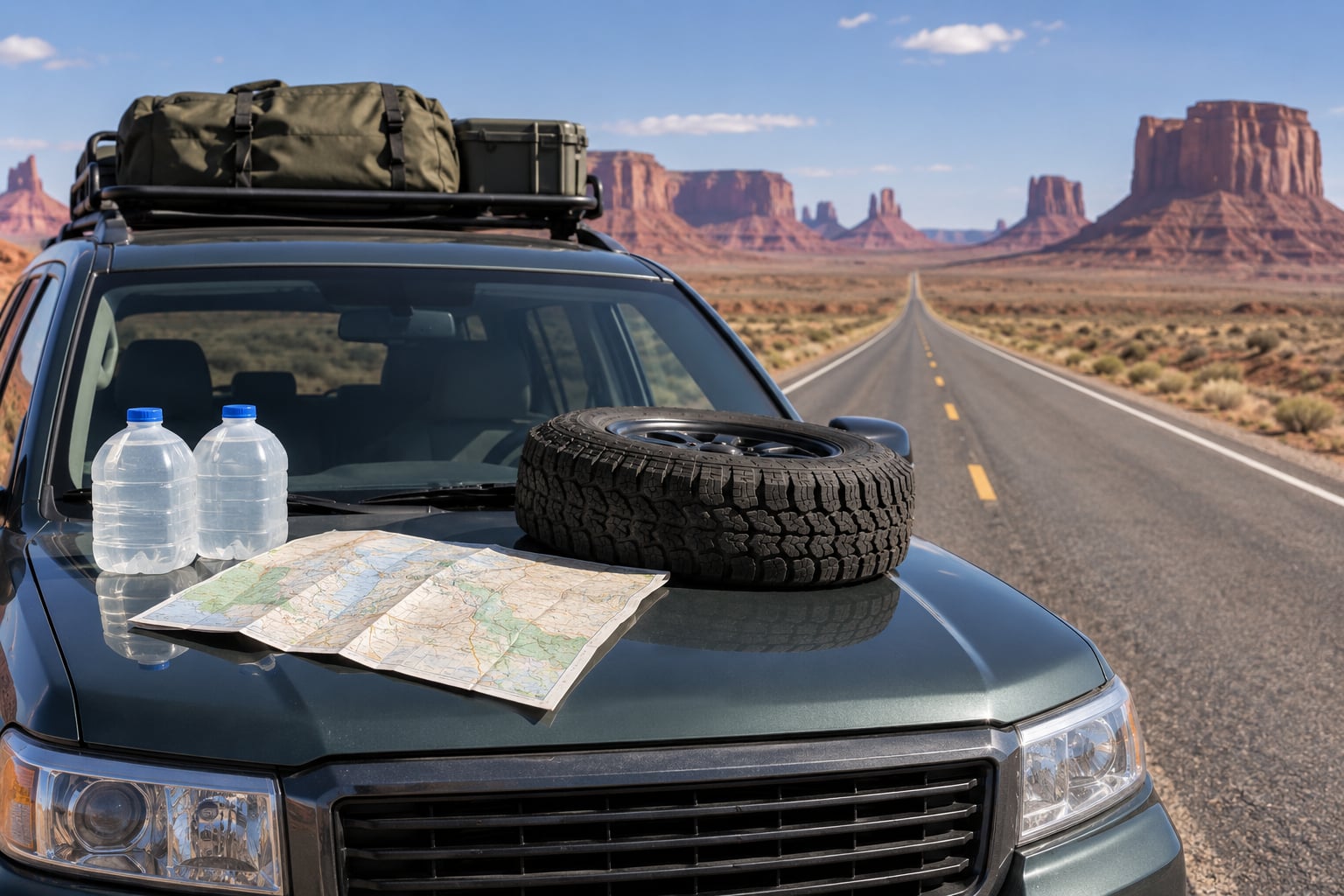
- Spare equipment. Inflator, tire iron, jack, jump pack, tow strap, shovel, a multitool, duct tape, and a half gallon of water that belongs to the car rather than to you.
- Fuel range. Know your real range at highway speeds with the AC running, and plan on using less than the dashboard promises.
Follow your owner’s manual for service intervals and specs, and let a qualified shop do anything beyond a check and a fill.
How do you pack water, food, and shade for a desert road trip?
One gallon of water per person per day is the floor, not the goal. Add half again for any segment where the next town is more than 100 miles away, and carry it in multiple containers so one puncture does not end the trip.
Freeze some of it. Overlanding forums pass along a trick that works better than it has any right to: keep a cooler packed with frozen water bottles, and the cooler becomes drinking water, cold storage and a shade source as the bottles thaw. Add electrolyte tablets or powder, because you lose salt as well as water and plain water alone stops helping after the first few hours.
For food, plan on things that do not need a stove and do not spoil in a hot car. Trail mix, nut butter, tortillas, dried fruit, jerky, electrolyte drinks, and a few things that are simply a pleasure, because you will be eating them in a parking lot at sunset.
Keep dust off everything with dry bags or plastic bins, and keep one complete change of clothes sealed. Nothing ruins a trip faster than sweat-soaked clothing that never dries.
How do you handle campsites, permits, and restricted areas in the desert?
Land ownership is the part people get wrong. Most desert land in the West is federal Bureau of Land Management or Forest Service land, not a national park, and the rules are different. Dispersed camping is generally allowed for up to 14 days, then you move. Some roads and areas near towns are closed to camping outright.
National parks are the opposite: designated campgrounds or backcountry permits, stricter rules, and in the busiest parks a timed entry reservation that you need before you arrive. Check whether the park you want issues one that month, because it changes your whole arrival plan.
Fire restrictions are posted and enforced, and they flip on and off through the season. Confirm camping, permit, fire and road status with the current official source for each area right before you leave, and again the morning you drive in. Land status changes with weather and with a single administrative decision.
Leave No Trace in a place where one dropped bottle ruins the view for everyone behind you: pack out everything, stay on durable surfaces, and never camp or drive on vegetation.
How do you prepare for emergencies and changing desert conditions?
Cell service is the first thing to plan around. Assume no signal across long stretches and that your phone will not help you when it matters. Download offline maps before departure, and know which segments have coverage and which do not. Free options handle offline routing well; if you pay for anything, pay for a subscription service with downloadable regional maps rather than a nicer display. A paper map in the glovebox is still worth carrying.
For the genuinely remote segments, a satellite messenger beats a satellite phone. It sends short texts and works without cell towers, which is the entire problem you are solving.
If the car breaks down, the order matters. Get everyone and every animal out of the vehicle and into whatever shade exists. Call for help or send a satellite message immediately rather than attempting a repair first. Stay with the vehicle, because searchers start from the last known location and a vehicle is a landmark. Conserve what you have, and do not walk away from it unless you are certain of the direction and the distance.
Know the difference before it happens. Heat exhaustion shows up as heavy sweating, headache, nausea, dizziness and weakness, and it responds to shade, water and cooling. Heatstroke can strike with little or no sweating, confusion, and loss of coordination, and it is a medical emergency. When in doubt, call it in and get cool.
Monsoon season runs roughly July through September in Arizona and New Mexico. Afternoon thunderstorms can drop flash-flood water into dry washes and across roads within minutes, sometimes far from where the rain fell. Never camp or park in a wash, check forecasts before committing to a drive, and if water crosses the road, turn around. Also check road conditions and wildfire closures before each day’s drive.
Finally, leave a trip plan with someone who is not on the trip. Route, campsites, dates, vehicle description, and a specific time when they should expect your evening check-in, plus what they should do if it does not arrive. Silence is the only signal that something is wrong out there.
Common Mistakes
Every one of these shows up in the same forum threads, year after year.
Believing dry heat is harmless. A r/roadtrip user warned against the dry-heat-is-better line by name, and they were right. Low humidity does not protect you from heat exhaustion.
The fix: drink on a schedule rather than on thirst, and put a bottle in reach of every passenger.
Running the tank low. The most repeated advice in road trip forums is to keep an eye on the gas gauge, and it is the least followed. Station gaps run 80 miles or more in places.
The fix: fill at every town with more than one pump, and treat half a tank as the warning line rather than the goal.
Overbooking the route. The instinct to add one more park is the most expensive mistake on the list, because you pay for it in hours of driving through the heat you were trying to avoid.
The fix: three parks in ten days, and a written day plan with a midday stop in it.
Planning for cell service. A route built around bars that are not there turns a wrong turn into an emergency.
The fix: offline maps downloaded, paper map in the car, satellite messenger on the truly empty segments.
Hiking at low elevation in July and August. There is no safe window in these parks. One camper writing about southwestern Utah said the desert does not care, which is the correct mental model.
The fix: hike at dawn from a high base, or hike somewhere else in summer and save the desert for the evening.
Skipping the vehicle check. Tires, coolant, spare, AC. It is an afternoon of work before a week of driving.
The fix: cold tire pressures the morning you leave, fluids verified, spare confirmed inflated, AC tested at idle.
Camping without checking the rules. Camping 29 nights in one spot, camping in a closed area, or missing a timed entry reservation will end a trip in a parking lot.
The fix: verify ownership, camping limits, fire restrictions, seasonal closures and reservations with the official source before you drive in.
Telling nobody where you are going. The one mistake that turns a flat tire into a search.
The fix: itinerary, overnight stops, check-in time and a named person, handed over before departure.
On the budget question that comes up constantly, a summer desert road trip is driven almost entirely by fuel, food, camping or lodging and park fees. Lodging in the gateway towns is where a trip either fits or does not, so price the nights first and choose the route second. A per-day estimate built before booking is more useful than any generic figure, because the price of a room in Phoenix and the price of a room in Cedar City are not the same decision.
Frequently Asked Questions
What is the best month for a summer desert road trip?
June and September are the best summer months in the Southwest. June gives you workable early mornings before the heat builds, and September brings lower highs, thinner crowds and the best light of the season. July and August are fine for driving and high-elevation towns, but low-elevation parks are effectively closed to hiking. If heat is the deciding factor, the shoulder seasons of late spring and October are cooler and calmer.
How much water should I bring for a desert road trip?
Plan on one gallon per person per day as the minimum, and add half again for any segment where the nearest town is more than 100 miles away. Carry it in several containers so a single leak does not end the trip. Add electrolytes, not just plain water, because you lose salt as well as fluid. Freeze some bottles as part of your load; they become cold drinking water and extra shade as they thaw.
Is there reliable cell service in the desert during summer?
No. Coverage disappears across long stretches of I-40 in New Mexico, Arizona highway 89 and 163, and the roads between Death Valley, Las Vegas and the Mojave. Download offline maps for the entire route before you leave and carry a paper map as backup. For the emptiest segments, a satellite messenger that sends short texts is worth the money, since it needs no cell tower to work.
How many days should I allow for a summer desert road trip?
Seven to ten days for a loop covering three parks is the realistic number. Fewer days forces long drives between stops, and more than three parks in ten days puts you behind the wheel during peak heat. Build each day around two three-hour driving blocks with a shaded midday stop between them, and plan to sleep in higher-elevation gateway towns such as Flagstaff, Cedar City or Bishop rather than in the low desert.
Can I take a rental car on a desert road trip?
Yes, for paved routes. Check the rental company’s restrictions on unpaved roads and off-road driving before you go, since many contracts exclude them. A sedan handles paved desert highways fine and you do not need four-wheel drive. Confirm that roadside assistance covers the states on your route, and pay for a coverage plan if the gaps between towns worry you. Inspect and photograph the vehicle and tires before leaving the lot.
Are desert thunderstorms dangerous for road-trippers?
Yes, mainly through flash flooding. Monsoon storms from July through September can send water into dry washes and across roads within minutes, sometimes far from where the rain actually fell. Never camp or park in a wash, even a dry-looking one, and check the forecast before each afternoon drive. If water covers the roadway, turn around rather than trying to cross it.
Conclusion
Start with the three decisions that constrain everything else: which months, which elevation, and where the fuel is. Then write the day plan around heat, carry a full gallon of water per person per day plus a reserve, and give someone at home your route and a check-in time.
Confirm camping rules, permits, fire restrictions and seasonal closures with the official land agency before you drive in, check your tire pressures cold the morning you leave, and spend the middle of every day somewhere with shade. Get those right and the Southwest in midsummer is the trip you will still be talking about in winter.