Plan on 2 to 4 hours of actual driving per day for a road trip that still feels like a holiday, with 6 hours as a workable upper end for short stretches and 8 hours as a ceiling you cross at most once. Most of what people call driving time is not driving time at all, and the road you’re on matters more than the mileage on the map.
This guide was updated for 2026. I drive multi-day routes most summers and the number people get wrong is rarely the driving. It’s the stops, the darkness and the fourth hour in a row that nobody scheduled.
Table of Contents
- How Many Hours Should You Drive Per Day on a Road Trip?
- What Counts as Driving Time on a Road Trip?
- How Many Hours Per Day Is Safe?
- Daily Driving Limits by Trip Type
- How Often Should You Stop While Driving?
- How Many Hours of Night Driving Are Safe?
- How to Plan a Safer Daily Driving Schedule
- How to Know When You Should End the Driving Day
- Frequently Asked Questions
How Many Hours Should You Drive Per Day on a Road Trip?
The short answer: 2 to 4 hours behind the wheel per day for a comfortable trip, 6 hours if you want a real push, and no more than 8 hours on any single day. Experienced drivers handling a straight interstate transfer can stretch that ceiling once in a while. Everyone else should treat it as a wall.
Here’s why the number feels lower than what you read online. A mapping app will happily tell you a trip is a nine-hour drive. That’s nine hours of wheel time in ideal conditions, and your actual day will be eleven or twelve hours of elapsed time once you add fuel, food, traffic on the back half of the route, and the construction nobody warned you about.
Two to four hours of real driving usually fills a good day once you factor in a proper lunch, two or three genuine stops and arriving somewhere worth stopping at. That’s the range that leaves you still wanting to look out the window on day six.
What Counts as Driving Time on a Road Trip?
Driving time is the hours your hands are on the wheel and you’re actually moving. Total travel time is everything else, and on a real trip the gap between the two is enormous.
On a typical interstate leg, expect roughly one hour of non-driving inside every four hours at the wheel. That covers a fuel stop, a bathroom, a 30-minute meal, and a stretch of legs. Add traffic and it gets worse fast. Road trip forum regulars keep reporting the same thing: the northern half of a Boston route regularly adds several hours the app did not show, because the app assumes average traffic.
A six-hour route is not six hours of continuous driving. It’s closer to five at the wheel spread across seven and a half hours of daylight, with a good chunk of that spread bought with coffee and a roadside stop every two hours.
How Many Hours Per Day Is Safe?
There is no single universal number, and anyone who gives you one without asking about the road, the weather and who’s in the car is guessing. What safety research does agree on is that attention degrades with time behind the wheel, and that the degradation shows up in the third and fourth uninterrupted hour.
That pattern drives the practical targets:
- Weekend trip: 2 to 3 hours per day. There’s time for the detour you didn’t plan.
- Weeklong road trip: 3 to 4 hours per day, so you arrive rested enough to actually do something.
- Cross-country run: 5 to 6 hours per day, with one long anchor stop in the middle.
- One-way transfer day: Up to 7 or 8 hours, once, ideally not followed by another long day.
- Solo driver: Treat 6 hours as firm. There’s no one to hand the wheel to when it stops being fun.
How many hours per day is safe for a one-way transfer?
Seven to eight hours, once, on a good road, with a break every two hours and two drivers who swap at each stop. That’s the version that works. The same day with one driver, kids in the back, or a mountain pass in the dark is a different question entirely.
One more piece of legal housekeeping, because it comes up constantly on road trip forums: the federal 11-hour rule has nothing to do with you. FMCSA hours-of-service rules — 11 hours driving inside a 14-hour window, a 30-minute break after 8 hours of driving, and limits across 7 or 8 consecutive days — govern commercial motor carriers. It’s a useful yardstick to measure a day against, but it is not a legal limit on a private driver.
Daily Driving Limits by Trip Type
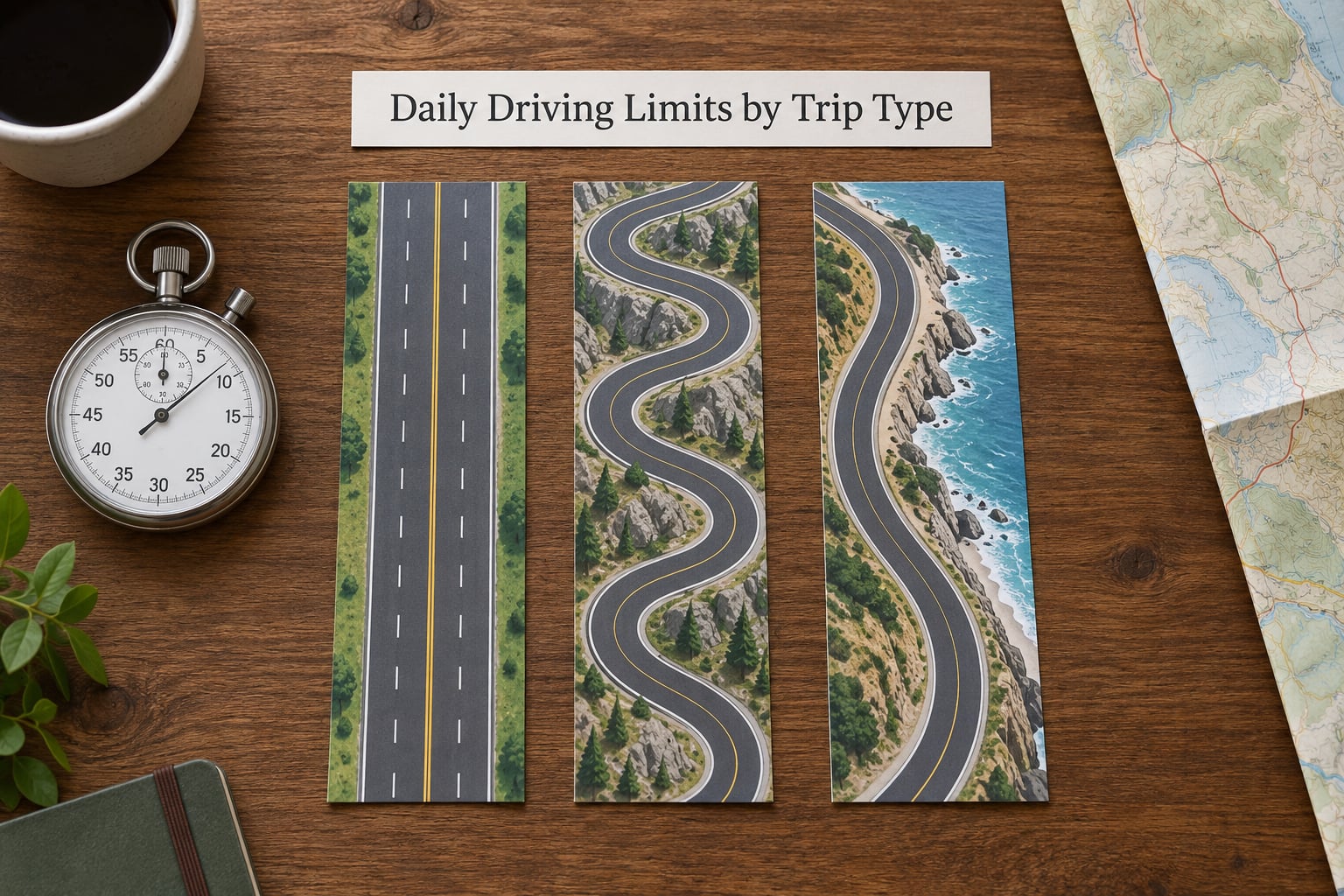
| Trip type | Hours at the wheel | Typical daily miles (km) | Adjustments |
|---|---|---|---|
| Interstate transfer | 6 to 8 hrs | 300 to 500 mi (480 to 800 km) | Break every 2 hrs, swap drivers, arrive before dark |
| Scenic highway | 3 to 5 hrs | 100 to 200 mi (160 to 320 km) | Add 50% to the app estimate for stops and viewpoints |
| Coastal or parkway | 3 to 4 hrs | 75 to 120 mi (120 to 195 km) | Pull-offs are further apart than they look |
| Mountain or switchbacks | 2 to 4 hrs | 50 to 95 mi (80 to 150 km) | Concentration cost is far higher than the clock suggests |
| Short marquee drive | 1 to 3 hrs | 25 to 60 mi (40 to 95 km) | The point is the road, so stop often and walk |
The Pacific Coast Highway and the Blue Ridge Parkway both fall in the middle rows for a reason. Miles per day drop hard once the road stops being straight, and a route with a dozen designated pull-offs will eat your daylight even though the app says you arrive by dinnertime.
How Often Should You Stop While Driving?
Every two hours, for 15 to 30 minutes, is the interval that keeps a day sustainable. Stop on the clock rather than on how you feel, because feeling fine is exactly what tired looks like before it becomes something else.
At each stop, do three things: get out and walk for 10 or 15 minutes, drink water rather than another coffee, and switch drivers if you have a second one. Long-haul drivers who rotate in two-hour shifts routinely report 500 to 600 mile days that still felt like moving forward rather than grinding through.
Anchor the whole day around one real stop. A proper lunch with a walk, a trailhead, a swim at a wayside — 45 to 90 minutes that you planned in advance beats six two-minute bathroom breaks.
Stop sooner than scheduled if you start drifting between lanes, miss an exit you were watching for, or find yourself blinking harder than the windshield requires. None of those mean the schedule is wrong. They mean the schedule is no longer matching the driver.
How Many Hours of Night Driving Are Safe?
Fewer, and by more than most itineraries assume. NHTSA research shows fatal crashes are more likely after dark than during the day, and the reasons are practical: narrower field of view, unlit animals and slower obstacles, oncoming headlights, and drivers who are more tired than they were eight hours earlier.
The rule most experienced road trippers use is the simplest one on this page: leave at sun up, stop at sun down. It costs you miles, and it buys back the thing people actually remember the trip for.
If you do have to drive at night, shorten the day overall, aim to finish by 10 pm, and give the first hour of darkness to flat, well-lit highway rather than rural two-lane roads. On those roads, dusk to dawn is when deer and other large animals are moving, and there’s no warning and no reaction time.
How to Plan a Safer Daily Driving Schedule
1. Estimate the route in hours, not miles. Take the app’s drive time and add 50% for a scenic route, or double it for coastal and mountain roads with heavy pull-off traffic.
2. Separate driving from everything else. Add one hour for a real meal and 15 minutes for every two hours of driving. That converted total is your real day length.
3. Build in a buffer. Add 10 to 15% for traffic, weather or construction. On a route heading north in the afternoon, the delay usually lands in the second half.
4. Set a hard stop time before you leave home. Decide the hour you’ll stop driving regardless of distance covered, and write it down. A time is a decision; a mile goal is a negotiation you’ll lose.
5. Plan to arrive in daylight. If your destination is four hours out and you’d arrive at 11 pm, add an hour of buffer and take the loss in the schedule instead of the trip.
6. Adjust for passengers and road type. With kids, four hours plus a real playground stop is usually the ceiling. On switchbacks, subtract an hour from whatever the app said. If one leg of the trip is a genuine long transfer, make it the first or last day so the damage lands outside the middle of the vacation.
Never stack two long days back to back. Fatigue accumulates quietly across a multi-day trip, and the tenth day is not the same driver as the first one even when the hours look identical.
How to Know When You Should End the Driving Day
Drowsy driving rarely arrives as a decision. It shows up as small errors you would normally catch and start correcting without noticing. Watch for:
- Drifting within your lane or drifting toward the shoulder
- Repeatedly missing exits or signs you were reading clearly
- Heavy blinking, eyelid trouble, or blurred vision that clears after a blink
- Slower reactions to traffic or difficulty judging distance
- Restlessness, irritability, or trouble focusing on a conversation
- Yawning you can’t remember deciding to do
Micro-sleeps — lapses lasting a few seconds — can happen without the driver knowing they occurred. That’s why a window crack and loud music are not a substitute for stopping.
When you notice these signs, pull over at the next safe place, nap for 20 to 30 minutes if you can, and get out of the car and move around. Resume only when you’re actually alert, not merely when the caffeine has landed. If it keeps happening, stop for the night. The distance you don’t make up today isn’t lost, it’s just deferred.
One last piece of health advice that’s worth taking seriously: sitting still for six hours at a stretch raises your risk of a blood clot. Walk at every fuel stop, and if you’re on a long coach or in a car for hours, flex your ankles and knees while you’re stationary at lights. Persistent swelling in one leg or calf is worth a doctor’s attention, not another day’s drive.
Frequently Asked Questions
What is the 3-3-3 rule for a road trip?
The 3-3-3 rule is a community planning heuristic, not a law: no more than 3 hours driving in one stretch, 3 breaks per day, and no driving after 3 pm, or no driving in the last 3 hours of daylight. It is stricter than most itineraries and is popular with travelers who want the trip to still feel relaxed by day four.
How many hours a day is it safe to drive?
For most road trips, 2 to 4 hours of driving per day is safe and still enjoyable, and 6 hours is a realistic upper end for short stretches. Treat 8 hours as the ceiling for a single day, not a routine. A break every two hours, a shared wheel where possible and finishing before dark are what make a long day hold up.
Is 7 hours of driving too long for one day?
Seven hours sits at the top of comfortable. It works well on an interstate transfer with two drivers who swap at each stop and a solid mid-day break. With kids in the car, on mountain roads, or with a single driver, the same seven hours usually feels like ten. Plan it as a one-off rather than a daily average.
Is 10 hours of driving in a day too much?
Ten hours is too much as a routine target, and it is occasionally survivable with two drivers, a break every two hours, and daylight for most of it. Never schedule it two days in a row. Many travelers who have done it describe the following days as harder than the driving itself, which is cumulative fatigue showing up late.
Is 12 hours too much to drive in one day?
Yes, as a habit. A 12-hour day behind the wheel on unfamiliar roads, often at night, is where drowsy driving risk climbs sharply and where most road trip forum veterans say the trip stops being fun. If a route genuinely requires it, add stops every two hours, share the wheel, and put it on the outbound leg rather than the return.
Is driving 3 hours a day too much?
Three hours a day is comfortably safe and leaves plenty of room for the trip to still be a trip. That’s the number most experienced travelers aim for on a weeklong road trip because it fits a morning start, a proper midday stop and an early evening arrival without anyone counting hours. On a longer trip, it’s the pace that keeps day six enjoyable.
Start with this: pick 3 to 4 hours of driving per day as your default, decide your hard stop time before you leave, and build the route around arriving before dark rather than covering miles. If you’re answering the question “how many hours should you drive per day on a road trip” for your own itinerary, the road type and who’s in the car will move that number within about an hour either way.