A historic route road trip is a drive that follows the original alignment of a former named highway or trail — Route 66, the Lincoln Highway, the Natchez Trace, the Pony Express route — with stops chosen for the history rather than the shortest drive. Planning one takes seven steps: pick a theme, compare viable routes, research the stops, pace the legs, set a budget, check conditions, then book. Set aside two or three evenings for the planning itself.
That last part matters more than it sounds. A historic route is rarely one continuous road anymore. US 66 was decommissioned in 1985 and much of it was bypassed, absorbed into the Interstate System, or paved over by towns that grew along it. A standard navigation app will happily route you straight onto I-40 and skip the road you crossed a continent to see.
So this guide treats a historic route road trip as its own kind of trip. You are not going from point A to point B. You are retracing something that exists in fragments, and the plan has to work with those fragments.
Here is what makes a road count as historic, and what you need on hand before the wheels turn.
Table of Contents
- What You Need to Plan a Historic Route Road Trip
- Step-by-Step: Build a Historic Route Road Trip
- Common Mistakes and Tips for a Better Historic Road Trip
- Frequently Asked Questions
- How long should a historic route road trip be?
- What is the best season for a historic route road trip?
- How do I choose which historic sites are worth visiting?
- How much should I budget for a historic route road trip?
- Do I need to make reservations for historic battlefields and museums?
- How do I add flexibility without making the itinerary confusing?
- Start With the Route and the Story You Want to Tell
What You Need to Plan a Historic Route Road Trip
Three terms come up constantly and they are not interchangeable. A historic route is a road that still runs, in whole or in part, on its original alignment — Route 66 and the Lincoln Highway are the best-known examples. A heritage highway is a modern road that keeps the old road’s route but was rebuilt to modern standards, which is what most of US 66 is today. A scenic byway is a designation for a road that is pretty, not necessarily old. Confusing the three is how people end up on a freeway with a historic route sign at the rest stop.
Beyond the route itself, you need four things lined up.
- Historical research sources. The National Park Service maintains a historic routes subject page covering wagon roads, trails and alignments no longer in use. The Federal Highway Administration’s highway history material and the National Register of Historic Places listing database tell you what a site is and why it matters before you drive to it.
- A route-specific guide. A general road atlas will get you between cities. It will not show you which stretch of pavement is the 1926 alignment.
- Offline maps. Rural historic alignments lose cell signal constantly, and a route that looks like a dead end on paper is usually a county road to somewhere.
- A weather habit. Not an app — a habit. Desert routes wash out, mountain routes close, and wildfire season closes roads for weeks with little warning.
| Tool type | What it does well | Free or paid | Use it for |
|---|---|---|---|
| General route planner | Multi-stop routing, distance and time between towns | Free tier available | Building the skeleton of each leg |
| Offline map download | Turn-by-turn when signal disappears | Free | Every rural segment, downloaded before you leave |
| Paper road atlas | Shows the old alignment and small towns a screen hides | Paid | Finding Business Loops and original pavement |
| Route-specific guide | Turn-by-turn notes on where the old road survives | Paid or free, varies by route | The actual historic road, not just the towns |
| National Park Service pages | Authoritative site history and current access notes | Free | Verifying what a stop really is |
| Site and museum sites | Hours, closures, timed entry | Free | Building a realistic stop list |
One note on the vehicle. Old alignments are narrow, cambered and sometimes unpaved, and pre-1940 bridges have weight limits that a modern car never notices but a camper or a rented SUV with a roof box might. If you are driving something tall, check bridge and lane limits segment by segment rather than assuming the whole route is open to it.
Step-by-Step: Build a Historic Route Road Trip
1. Choose the historical theme and region
Decide what the trip is actually about before you decide where it goes. A Civil War battlefields trip through Virginia and Tennessee, a Route 66 run from Chicago to Santa Monica, and a Pony Express retrace across Missouri and Kansas are three different trips that share nothing but the word “historic.”
Then pick a region small enough to hold together. A single state or a two-state corridor lets you stop at sites without driving a full day to reach the next one. Cross-country routes work if you accept that you will be in the car more and seeing less.
2. Compare viable historic routes
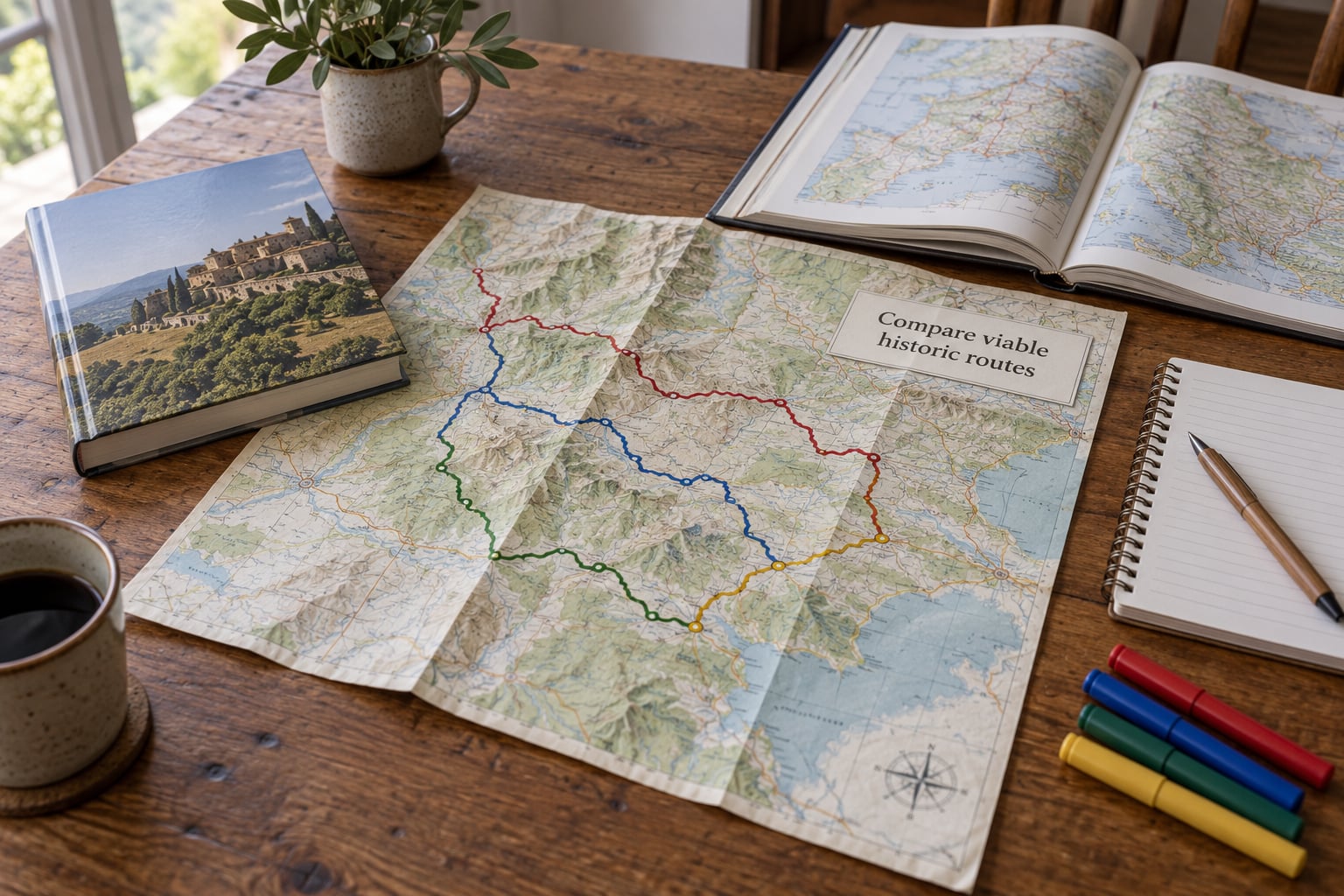
Once you have a region, put two or three candidate routes side by side and compare them on distance, road condition, seasonal exposure and how hard they are to follow in their original form. The last column is the one people skip and the one that decides whether the trip is fun or frustrating.
| Route | Approx. length | States | Minimum days | Following the original road |
|---|---|---|---|---|
| Route 66 (Chicago to Santa Monica) | About 2,450 miles | 8 | 12 to 14 | Hard. Decommissioned in 1985; Business Loops and remnant alignments are scattered |
| Lincoln Highway (New York to San Francisco) | About 3,400 miles | 14 | 14 to 18 | Hard. Much was widened and rerouted; original pavement survives in patches |
| U.S. Route 20 (Boston to Newport, Oregon) | About 3,365 miles | 10 | 14 to 18 | Moderate. Still a numbered US highway in most places, with old segments nearby |
| Natchez Trace | About 444 miles | 3 | 3 to 4 | Easy. A park route with a defined, protected alignment |
| Pony Express and Santa Fe Trail | About 1,800 miles combined | 5 to 6 | 7 to 10 | Hard in places. Much of the trail is a graded route on unpaved roads, some sections on private land with limited access |
| Pacific Highway | About 1,800 miles | 3 | 8 to 10 | Moderate. Its US 99 alignment survives under a different number in places |
Treat those lengths as planning approximations and confirm details with official route organizations before you commit. The day figures assume two to four hours of actual driving per day, not six.
3. Research the stops worth making
Research segment by segment rather than for the whole route. Open one leg at a time, list what is genuinely on the road you will be driving, and rank the list. Battlefields, historic homes, museums, landmarks, interpretive centers and the small communities that grew around all of these are the raw material.
Then sort the list into two columns: essential and optional. A site earns essential status if it only appears once on the whole route, if it needs a timed entry, or if skipping it means doubling back later. Everything else is optional, and optional means you drop it when the day runs long without regret.
Keep a running note on each stop’s opening days, typical visit length and whether it closes seasonally. Small-town museums and county historical societies are the most likely to be closed on Sundays or for a few weeks in winter, and that is exactly the sort of thing that quietly ruins a day.
4. Build a route that does not feel rushed
Set a daily driving cap first, then work backwards from the number of days you actually have. Two to four hours of driving is the range most travelers can hold for a week or more without resentment. Seven hours in the driver’s seat is a one-day sprint, not a daily rhythm, and on a historic route with slow roadside stops it turns into nine.
Once the cap is set, time-box each leg. Give every leg a realistic driving total, add one anchor stop, and add buffer time on top — about an hour of slack on a typical day and a full free day somewhere in the middle of the trip.
The anchor rule does most of the work. One anchor stop per day means you always have exactly one thing that matters that day, and everything else is a bonus if the timing works out. People who schedule four stops a day burn out by the fourth day and end up doing none of them properly.
Watch the shape of the route on the map. Historic routes are famously not straight lines, and doubling back to catch something you missed is the single most common way a trip loses time.
5. Create a realistic budget
Build the budget in categories rather than one lump number, then price each category against current rates for the months you are actually traveling. Peak season in a popular tourist state can run materially higher than the shoulder weeks on either side of it, so the dates change the answer more than the route does.

| Category | How to estimate it | Common surprise |
|---|---|---|
| Fuel | Total planned miles divided by the vehicle’s real highway mileage, times current fuel prices along the route | Historic alignments are slower than the posted route mileage suggests |
| Lodging | Number of nights, priced by season and town rather than by national average | The famous historic motels are small, and small means they sell out |
| Admission fees | Add per site for the essential stops only | Battlefield and museum passes often cover several sites and beat paying one by one |
| Food | Per person per day, budgeted higher in tourist towns and at genuine destination dinners | Some small towns close their only diner early |
| Parking and tolls | Check whether your route crosses tolled segments at all; many western historic routes do not | Tolls on the approach legs, not the historic stretch |
| Incidentals | A flat reserve for breakdowns, replacement tires, and the one roadside attraction you cannot walk away from | Old roads find tires and radiators more efficiently than interstates do |
Then decide what the money is buying. Travelers who value the route itself — the pavement, the small towns, the roadside architecture — can cut hard on nights and admissions and still have a good trip. Travelers who want guided tours and a specific museum at a specific time need a different budget, and mixing the two is how trips get overspent.
6. Check the season, road, and weather conditions
Season is the variable that quietly changes everything. Desert segments are pleasant in spring and autumn and punishing in summer. Mountain passes close in winter. Battlefields and historic sites in the South are often best in the milder months, and a long stretch of the route runs through areas where summer brings thunderstorms, flash flooding and wildfire closures.
Daylight hours decide how much you can pack into a leg. Short winter days mean your usable driving window shrinks, and a two-hour stop at an interpretive center in December costs you an hour of light you needed for the next two hours of road.
Check three things before departure and again a few days out: current road closures on the specific segment, event calendars at the sites you care about, and the weather for the middle of the trip rather than the endpoints. Mid-trip is where the problem always is.
7. Book and prepare the final itinerary
Turn the research into a dated document with confirmed bookings, contact details and confirmation numbers in one place. If you print one copy, that is the copy. Hotels, car rental, campgrounds and any timed-entry reservations go in first because they are the items with limited availability.
Then build the navigation. Download offline maps for every state on the route, save a pin for each essential stop, and download a paper atlas or printed route notes for the segments where the old road diverges from what your phone will suggest. Assume that on a rural segment your phone will route you around the thing you came for.
Keep a one-page facts sheet in the car: hotel addresses and confirmation numbers, the emergency number for the states you cross, your vehicle’s roadside assistance number, and a paper copy of any documents that matter. Keep it where a passenger can reach it, not buried in a bag under the rear seats.
Finally, write day one realistically. Most people lose the first morning to a full day of driving, and then start the trip tired. A short first day, an easy dinner, and an early night buys you a trip that still feels like a holiday on day nine.
Common Mistakes and Tips for a Better Historic Road Trip
These are the errors that come up again and again, almost always from people whose first attempt went sideways.
Treating it like a normal A-to-B trip. This is the big one. If you build the plan the way you would for a flight, you will end up on an interstate. Plan the legs around the historic alignment, then add the highway time as a cost on top.
Over-scheduling stops. The urge to see everything is what turns day four into a nine-hour day of museums you half-remember. One anchor stop per day, everything else optional, solves most of this.
Leaving the anchor nights unbooked. Famous historic motels are small properties, often a dozen rooms, and they are the first thing booked in peak season. Book those first, then fill the rest around them.
Trusting the app on the old road. Download offline maps and carry a paper backup. The single most common bad moment on these routes is a phone that has decided the alignment is not worth the trip.
Ignoring weekly closures. Sunday closures at small museums, weekday-closed historic houses and seasonal shutdowns will quietly remove a third of your stop list if you never check. Verify days, not just hours.
Underestimating rural services. Gas stations, mechanics and late-opening diners thin out fast once you leave the main towns. A full tank and a downloaded list of the next three fuel stops is not paranoia.
The flexible version of all of this is a skeleton rather than a schedule. Fix the dates, fix the anchor nights, fix the long legs, and leave the middle of each day open. You can always add, and you cannot add your way out of a day that started too early.
Frequently Asked Questions
How long should a historic route road trip be?
For a full cross-country historic route, fourteen days is the practical floor and three weeks lets you stop without rushing. A single-state or short corridor route needs three to four days. The real constraint is not miles but how many hours a day you are willing to drive, so set that first and let it determine the length.
What is the best season for a historic route road trip?
Late spring and early autumn suit most routes. Temperatures are moderate, desert and mountain segments are open and daylight is long enough for a decent stop plus real driving. Summer brings heat in desert states and wildfire closures in the West. Winter is quiet and atmospheric but shortens your driving window and closes some sites seasonally.
How do I choose which historic sites are worth visiting?
Research one leg at a time and rank what you find. Make a site essential if it appears only once on the whole route, needs a timed entry, or means doubling back later. Everything else is optional. Many travelers find that a route with three carefully chosen sites beats one with twelve rushed ones, and they still remember the three.
How much should I budget for a historic route road trip?
Work it out category by category instead of using a national average: fuel based on your planned miles and the vehicle’s real highway mileage, lodging priced by season and town, admissions for essential stops only, food per person per day, plus any tolls and a flat reserve for breakdowns. Peak-season pricing in tourist states changes the total more than the route does.
Do I need to make reservations for historic battlefields and museums?
For major battlefields, national park sites and anything with timed entry, yes, book ahead. Small county historical societies and independent museums rarely need a reservation, but many close on Sundays or for part of the season, so check their calendar before you build a day around them. The lodging is the part that actually sells out.
How do I add flexibility without making the itinerary confusing?
Use a skeleton instead of a schedule. Fix the dates, the anchor nights and the long legs, then leave the middle of each day open with a short list of optional stops. Write the flexible parts on a separate card from the fixed parts. You can always add a stop, and nothing ruins a trip faster than a day that was never going to fit.
Start With the Route and the Story You Want to Tell
Pick one region and one historical theme this week. Compare two or three viable routes on distance, days needed and how hard each is to follow in its original form, and save a driving-distance map for the two you like best. Nothing else should be booked until you know which road you are actually driving.
Then set your daily driving cap, because that single number decides whether the trip is relaxing or a grind. If you do nothing else from this guide, do that one. Updated for October 2026.