Driving coast to coast across the contiguous United States covers roughly 2,800 to 3,000 miles and takes about 40 to 45 hours of actual time behind the wheel, non-stop. Once you add fuel, food, rest breaks and overnight sleep, most people need 7 to 10 days to finish. Here is how that number breaks down by pace, route and number of drivers.
The gap between 45 hours and ten days is the whole story of this trip. Distance is the easy part. The real constraint is how many focused hours a day you can drive before you stop being a safe driver, and how much of the country you want to look at while you are awake for it.
Table of Contents
- How Long Does It Take to Drive Across the United States?
- What Is the Shortest Coast-to-Coast Drive?
- How Many Days Should You Allow for the Trip?
- Which Route Is Fastest?
- What Determines the Total Driving Time?
- How Many Hours of Driving per Day Are Safe?
- How to Plan a Coast-to-Coast Road Trip
- When Is the Best Time to Drive Across the Country?
- Frequently Asked Questions
- Conclusion
How Long Does It Take to Drive Across the United States?
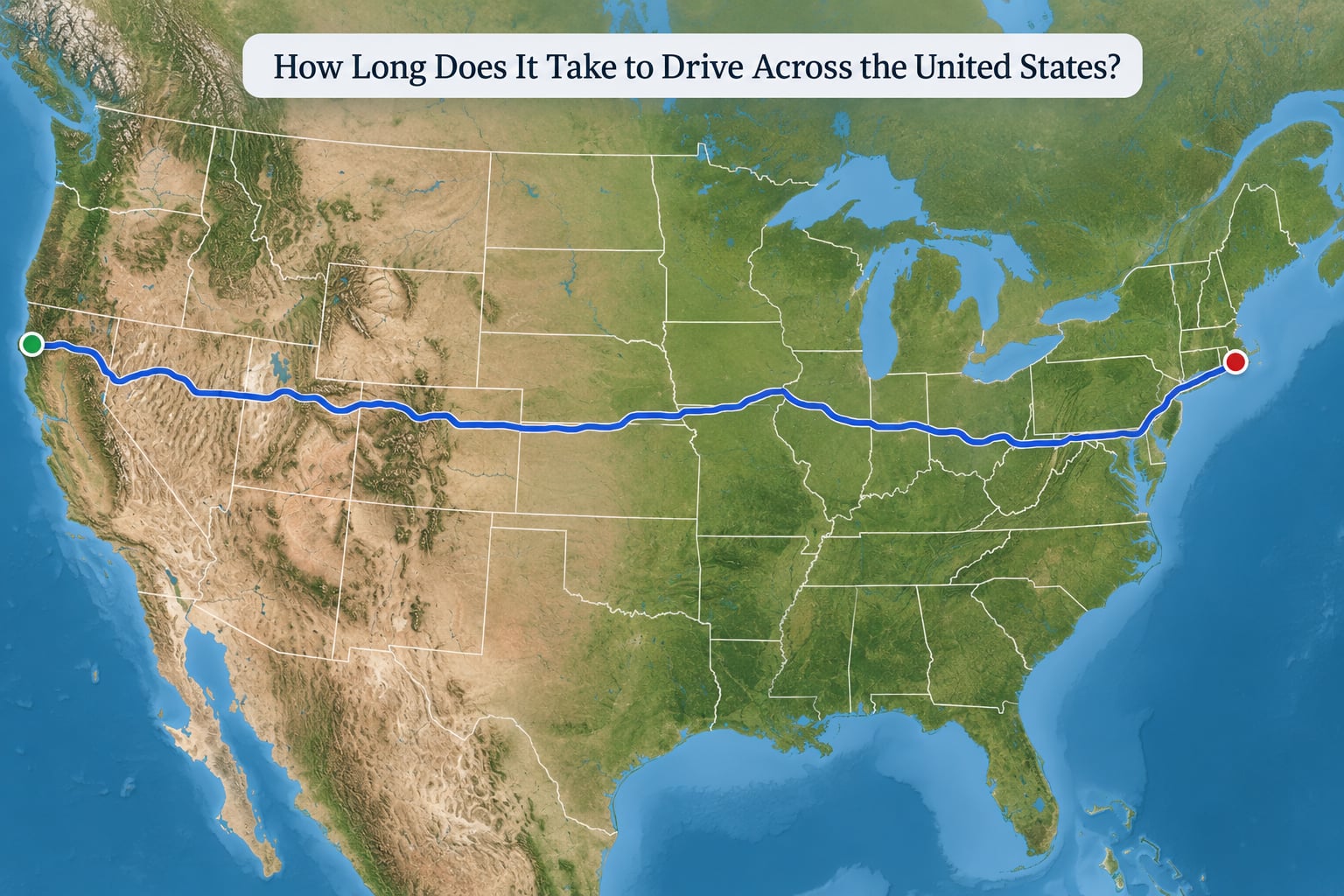
A coast-to-coast drive is about 2,800 to 3,000 miles and roughly 40 to 45 hours of non-stop driving. With realistic breaks, meals, fuel and overnight stops, expect 7 to 10 days. Most first-timers underestimate the driving and overestimate how much they will want to stop.
- Typical distance: 2,800 to 3,000 miles coast to coast, depending on your starting and ending cities
- Non-stop wheel time: about 40 to 45 hours at a realistic average speed
- Realistic trip length: 7 to 10 days for most drivers
- Fastest sane schedule: 5 to 6 days at 10 focused hours a day, which is a lot
- Comfortable pace: 5 to 7 days at 6 to 8 hours of driving per day
Start and end points move the number more than anything else. These are approximate distances for common pairs:
| Route | Approximate distance | Non-stop hours |
|---|---|---|
| San Diego to Newark | 2,450 miles | 38 hours |
| Los Angeles to New York | 2,800 miles | 42 hours |
| San Francisco to New York | 2,900 miles | 43 hours |
| Boston to San Francisco | 3,000 miles | 45 hours |
| Seattle to Miami | 3,300 miles | 49 hours |
Seattle to Miami adds roughly 400 miles and six hours of wheel time compared with San Diego to Newark, and it crosses four time zones instead of three. Same country, very different week.
What Is the Shortest Coast-to-Coast Drive?
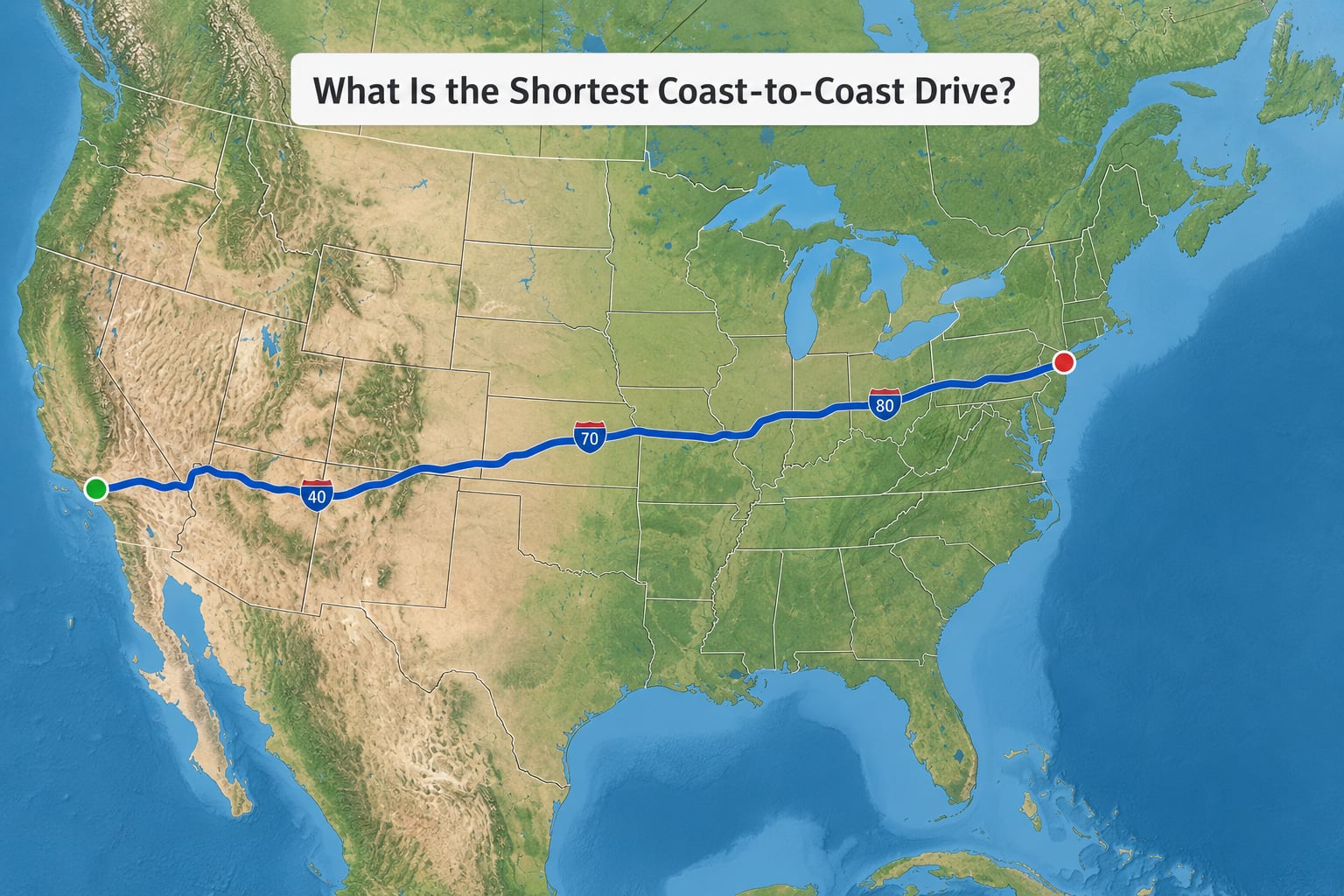
The shortest practical transcontinental crossing runs between Southern California and the New Jersey/New York area, roughly 2,450 miles from San Diego to Newark. At an honest average speed of about 64 mph that is around 38 hours of driving, and nobody should attempt it in fewer than five days.
Mileage and drive time are different numbers and readers mix them up constantly. Mileage is fixed by geography. Drive time is mileage multiplied by the average speed you actually hold, which is lower than the posted speed limit nearly everywhere.
End one leg farther north and you pay for it in hours. San Francisco to Boston is close to 3,000 miles. Seattle to Miami is over 3,300. Both are perfectly doable crossings; they just need one more day and a lot more patience.
How Many Days Should You Allow for the Trip?
Match the pace to the trip you want, not the trip you think you should want. A compressed crossing gets you to the other side faster and gives you nothing to remember except the passenger seat.
| Pace | Hours driving per day | Typical miles per day | Total days | Suits |
|---|---|---|---|---|
| Hard sprint | 10 hours | 550 to 650 miles | 5 to 6 days | Two or more rotating drivers with a deadline |
| Balanced | 7 to 8 hours | 400 to 500 miles | 6 to 7 days | Couples and families who still want stops |
| Relaxed | 5 to 6 hours | 300 to 400 miles | 8 to 10 days | Solo drivers, anyone with young kids, most first-timers |
| Slow road trip | 3 to 4 hours | 180 to 260 miles | 12 to 16 days | RV travelers, national parks, scenic byways |
A Reddit user moving from Los Angeles to upstate New York logged 2,894 miles in five days with a second driver and two cats in the car. That is real, and it is close to the ceiling rather than a comfortable target.
Tripadvisor road trip regulars put it differently: 2,500 to 3,000 miles at 500 miles a day is a five or six day trip. Push to a flat 60 mph the whole way and 3,000 miles becomes about 50 hours of pure wheel time with no stops at all.
Which Route Is Fastest?
There is no universally fastest route. The shortest distance is usually the I-10 and I-40 southern tier, but scenery, weather and tolls can add hours back. Compare these four common approaches.
Southern Tier: I-40 and I-10, about 2,400 to 2,700 miles
The southern crossing follows I-10 from Los Angeles through Arizona, New Mexico and Texas, then I-40 across Oklahoma and Arkansas to Memphis and on to North Carolina. It is the shortest and flattest option, and it changes time zones only three times. The trade-off is scenery that repeats for hundreds of miles and summer heat in Arizona and west Texas.
Some drivers detour north to the Grand Canyon or down to Big Bend, which adds a half day each way.
I-80, about 2,900 miles
I-80 runs from San Francisco through Reno, Salt Lake City, Cheyenne, Omaha and Chicago to Cleveland or Newark. It is a straight shot with the Rocky Mountains and Sierra Nevada as the only real obstacles. Expect winter closures over Donner Pass and slow grades through the Sierra. Toll roads are common on the eastern half, particularly in Illinois, Indiana and Ohio.
How long does it take to drive across the United States on I-90?
I-90 is the long northern line from Seattle through Spokane, Billings, Rapid City, Sioux Falls and Minneapolis to Boston, about 3,200 miles and roughly 46 hours of driving. It avoids the Rockies entirely but crosses long, empty stretches of Montana, Wyoming and the Dakotas where services are hours apart. In Montana, Badwater Pass on US-2 closes for snow each winter, which can force a detour south.
The Great Northern and US-50
US-2 across the top is the scenic version, over 3,500 miles and more than 50 hours of driving if you follow it end to end. Plan it as a two-week trip or longer. One practical warning: routes that detour north into Manitoba or Saskatchewan leave the country and require a passport and permission to re-enter the United States.
US-50, the Loneliest Road in America, runs about 3,000 miles from Nevada to Utah to Colorado to Kansas to Missouri to Illinois. There are stretches where the nearest gas station is 100 miles behind you. Fuel up at every stop.
Route 66
Route 66 is history, not a through route. It has been decommissioned since 1985, and the remaining pieces run from Chicago to Santa Monica, roughly 1,800 miles. Driving it end to end takes 25 to 30 hours of wheel time, realistically four to six days with stops.
What Determines the Total Driving Time?
The variables stack, and they are worth ranking before you book anything. In rough order of impact:
- Starting and ending cities. Southern California to New Jersey versus Seattle to Miami is roughly 850 miles and 11 hours of difference.
- Route chosen. The southern tier beats the northern line by several hundred miles.
- Your actual average speed. Divide miles by your real average, not by the speed limit.
- Number of drivers. Two alternating drivers push a real average much higher than one tired driver at hour nine.
- Time of year. Winter mountain closures, summer construction and severe weather all cost hours.
- Stop schedule. Every national park detour, every roadside diner, every missed fuel exit adds up.
- Vehicle type. An RV or a truck towing a camper averages 10 to 14 mph below a sedan in practice.
The simple formula is total hours = miles divided by your realistic average speed. If you plan 450 driving miles a day and your honest average on that route is 60 mph, that day is 7.5 hours of wheel time before any stop.
Posted speed limits are not averages. Interstates that say 75 mph often run 65 in practice because of construction, weather, trucks and traffic around cities. Most coast-to-coast average speeds land somewhere between 58 and 68 mph.
How Many Hours of Driving per Day Are Safe?
Six to eight focused hours of driving is a normal, sustainable day for most people. More than ten in one stretch buys you a shorter calendar and a worse experience.
| Hours driving per day | Solo driver | Two alternating drivers |
|---|---|---|
| 4 to 5 hours | Comfortable | Too easy, add stops |
| 6 to 7 hours | Manageable | Good daily target |
| 8 to 9 hours | Long day | Fine with planned breaks |
| 10 hours or more | Not recommended | Only with a real deadline |
Experienced trippers on the Tripadvisor road trip forum plan four to five hours of actual driving when they are the only driver, specifically because there is nobody to hand the wheel to when they get foggy. Forum advice that comes up constantly: pull over every three to four hours, get seven or more hours of sleep before departure, and take a 30 to 60 minute power nap if the day goes long.
The 3-3-3 rule is a loose convention, not a regulation. The idea is three hours of driving, a genuine break, and then enough hours left in the day to actually look at where you are. It works well as a sanity check and poorly as a hard target, because it ignores how far you still have to go.
For context on the limits that professional drivers operate under: the Federal Motor Carrier Safety Commission rules cap commercial driving at 11 hours behind the wheel inside a 14-hour window, followed by 10 hours off duty. Tourist drivers are not subject to those rules, but they are subject to the same physics. Two days of 15-hour drives to save four days of vacation is a bad trade.
How to Plan a Coast-to-Coast Road Trip
- Pick your endpoints and one primary route. Changing routes mid-trip is what turns eight days into twelve. Use a paper map as a backup to whatever you are navigating with.
- Divide the total miles by your real daily limit, not your hopeful one. Add one full spare day to the total. You will want it.
- Book lodging for the first three nights before you leave. Peak summer weeks and holiday weekends fill the cheap motels along the southern tier first.
- Mark your fuel stops. On a 25 to 30 mpg sedan, 2,800 miles is roughly 95 to 110 gallons, about three tanks. That stops every 350 to 450 miles if you refill at a quarter tank.
- Check weather and road conditions the morning of each leg. Official state DOT sites and the national road weather service cover closures, wildfire restrictions and snow.
- Share your itinerary with someone who is not in the car. A daily text with your fuel level and next stop costs nothing.
- Build recovery time into the schedule. Put the longest driving day after a short one, never before.
Budget for what a nine-day trip actually consumes: fuel, nine nights of lodging, food, tolls and national park entry fees. On a sedan, national parks are the single biggest line item most people do not expect. Reserve timed entry for Arches, Yosemite and Rocky Mountain ahead of the trip.
When Is the Best Time to Drive Across the Country?
Late spring through early fall suits most drivers. Spring and fall bring the most comfortable temperatures and daylight, and fewer people in the national parks than in July.
- Spring (April to May): Comfortable in the south, still cold in the Rockies and the Dakotas. Wildflowers in Utah and Arizona, low crowds, occasional spring storm systems.
- Summer (June to August): Longest daylight and the most crowded. Expect slowdowns at Yellowstone, Yosemite, the Blue Ridge Parkway and around Las Vegas. Also peak wildfire season in the West, with smoke and occasional road closures.
- Fall (September to October) Best all-round window: fewer crowds after Labor Day, good light, and generally stable weather in the central states.
- Winter (December to February): Highest risk. Donner Pass on I-80, mountain passes in Wyoming and Colorado, and storm systems across the southern plains all add days. If you take it, check DOT closure reports daily and carry chains.
Whichever season you pick, verify forecasts, closures and any state-level restrictions shortly before you leave. Road conditions in this country change faster than any printed guide.
Frequently Asked Questions
What is the fastest time to drive across the United States?
The shortest crossing is roughly 2,450 miles from San Diego to Newark, about 38 hours of non-stop driving. A five-day schedule at 10 driving hours a day is the fastest most drivers should attempt. Anyone trying to finish in two days would need to drive roughly 19 hours a day straight, which is unsafe and rarely worth saving three days.
Is driving coast to coast in one week realistic?
Yes, and it is the sweet spot for most travelers. Seven days gives you roughly 400 to 450 driving miles per day, which is 6 to 7 hours behind the wheel plus a real stop. Pick one route and stick to it, book your first three nights ahead, and drop the parks you cannot fit. Eight days is better; seven is workable.
How many hours a day can you safely drive on a road trip?
Six to eight focused hours is the usual target for most drivers, with a break every two to three hours. Solo drivers are better served by four to five hours, since there is nobody to take over. Professional drivers operate under federal rules capping them at 11 hours of driving in a 14-hour window, and no leisure trip is worth pushing past that.
What route is fastest from California to New York?
The I-40 and I-10 southern tier is the shortest, running about 2,800 miles from Los Angeles to New York through Arizona, New Mexico, Texas and Arkansas. I-80 is only slightly longer and far more scenic but crosses the Rockies and collects more tolls east of Illinois. Pick by season: I-80 in summer, I-40 in winter.
How much fuel does it take to drive across the United States?
A sedan getting 25 to 30 mpg burns roughly 95 to 110 gallons over a 2,800 mile crossing, about three full tanks. An RV at 10 to 12 mpg uses closer to 250 gallons. On US-50 across Nevada or I-80 west of Reno, services can be 100 miles apart, so fill up at every stop rather than running the tank down.
Conclusion
How long does it take to drive across the United States? About 40 to 45 hours of driving over 2,800 to 3,000 miles, which turns into 7 to 10 days once you are sleeping, eating and stopping. Five to six days works if you have two drivers and a deadline. Two days does not work for anyone.
Choose one route before you leave, divide your total miles by an honest daily limit of 400 to 500, then book your first three nights. Everything else on this trip is easier once those three decisions are made.