If you want to know how to budget for a cross country road trip, start with two numbers: your total miles and your car’s real-world MPG. Everything else — gas, lodging, food, park passes, tolls — hangs off those two. A realistic cross country road trip runs about 120 to 200 dollars per person per day, and a two-week trip lands somewhere around 3,000 to 3,900 dollars for two people sharing a hotel room and a car.
This guide walks through a working budget you can plug your own numbers into, plus the choices that move the total up or down. All figures are typical US ranges for 2026; gas prices, park fees and hotel rates change constantly, so treat them as planning assumptions rather than quotes.
Table of Contents
Cross-Country Road Trip Costs at a Glance
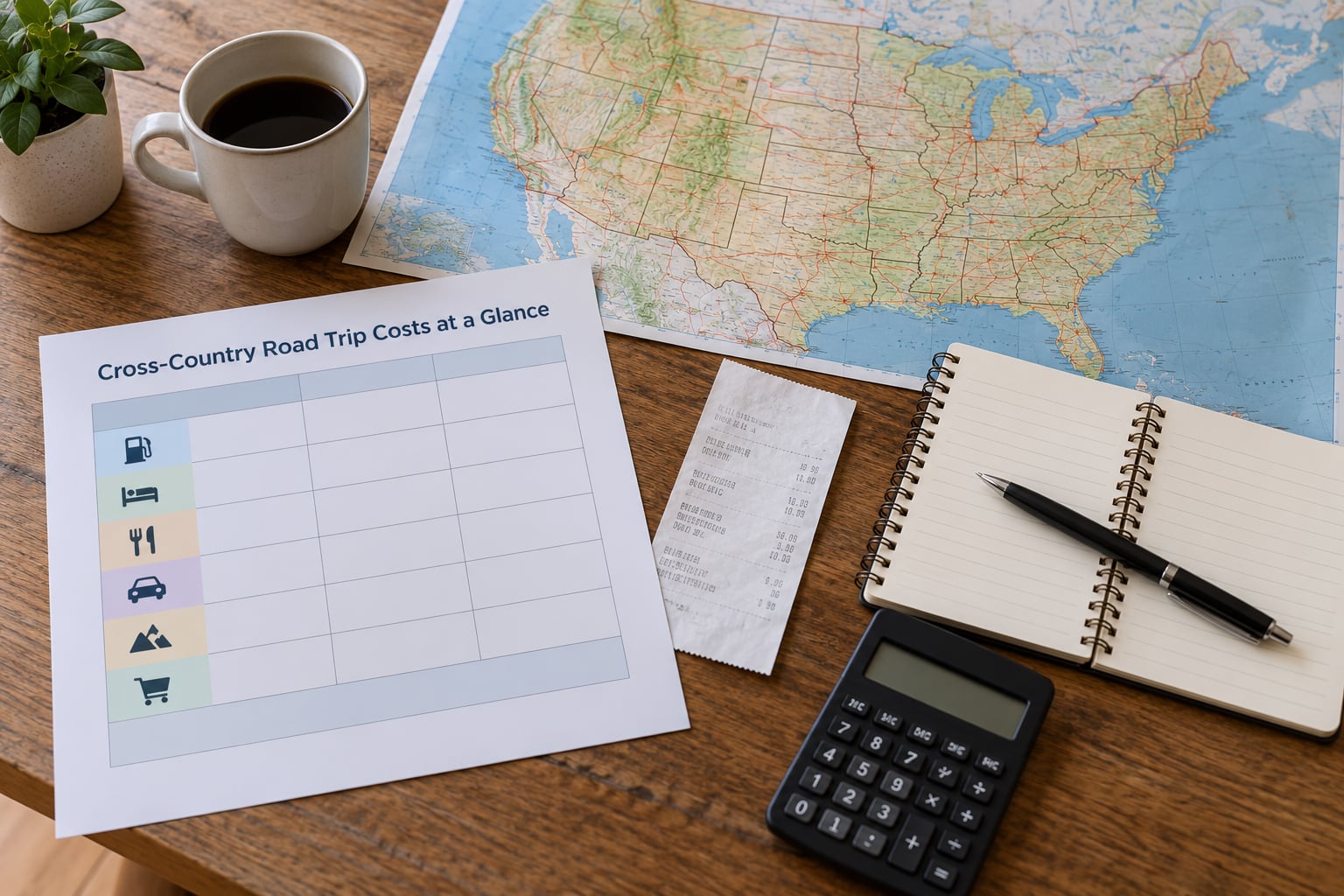
Here is the whole budget in one table. Per-person, per-day figures assume two travelers sharing one vehicle and one room, camping or hotel-split as noted.
| Category | Shoestring | Comfortable | Premium |
|---|---|---|---|
| Fuel | 10 to 15 dollars | 20 to 30 dollars | 35 to 45 dollars |
| Lodging | 0 to 15 dollars | 45 to 70 dollars | 110 to 160 dollars |
| Food | 20 to 25 dollars | 40 to 50 dollars | 70 to 90 dollars |
| Parks and attractions | 0 to 5 dollars | 15 to 25 dollars | 40 to 60 dollars |
| Tolls, parking, fees | 5 to 10 dollars | 15 to 25 dollars | 25 to 40 dollars |
| Total per person, per day | 40 to 70 dollars | 135 to 200 dollars | 280 to 400 dollars |
Fuel, lodging and food usually swallow 70 to 85% of the budget. That is good news, because those are the three categories you actually control.
To size the trip itself, use these typical totals. Mileage ranges assume a one-way cross plus detours for sightseeing.
| Trip length | Typical miles | Shoestring, solo camping | Two travelers, hotels |
|---|---|---|---|
| 7 days | 1,500 to 2,000 | 500 to 750 dollars | 1,700 to 2,200 dollars |
| 14 days | 2,800 to 3,400 | 900 to 1,300 dollars | 3,100 to 3,900 dollars |
| 30 days | 4,500 to 5,500 | 1,500 to 2,000 dollars | 6,000 to 7,400 dollars |
Notice how the per-day cost drops as the trip gets longer. The 30-day solo figure works out to roughly 55 dollars a day because the same fuel and food spread over more miles. Long slow trips are simply cheaper per day.
How to Budget for a Cross Country Road Trip Step by Step
Build the budget in this order. Each step depends on the one before it, so skipping ahead is how people end up short on day nine.
1. Pick the route and count the miles
Map the trip before you price anything. A Boston-to-Portland run and a Seattle-to-Miami run are both “cross country,” but one is about 3,000 miles and the other closer to 3,400, and the fuel lines reflect that difference. Add 10% to whatever the map gives you, because detours happen.
2. Run the fuel formula
The formula is simple enough to write on a napkin: total miles divided by MPG, multiplied by the average price per gallon. For a 3,000-mile trip in a car doing 30 MPG at 3.25 dollars a gallon, that is 100 gallons, or about 325 dollars. Swap in your real highway MPG, not the number on the window sticker — city and mountain driving usually cost you two or three MPG.
3. Set a lodging line
Multiply nights by your nightly rate. National park gateway towns, coastal California and the Mountain West run far higher than the Midwest, so price the towns you actually plan to sleep in rather than a national average. Free camping on BLM and national forest land exists but carries rules about how far you must camp from a road or a developed site; check them before you rely on it.
4. Set a food line
Decide how many meals you will buy. Eating out three times a day at 15 dollars a meal is 45 dollars a day before snacks, coffee or gas-station water. One cooked meal and a grocery run a day usually lands nearer 20 to 25 dollars.
5. Add fees and passes
Tolls, parking, entrance fees and the odd ferry ride. The America the Beautiful annual pass runs about 80 dollars and covers national parks and federal recreation areas for a year; it pays for itself at roughly five or more park visits, which most cross-country park routes clear easily.
6. Reserve a 10 to 15% buffer
This is money you do not plan to spend. It covers the blown tire, the emergency tow 200 miles from the nearest town, or the hotel you need because the campground is full. Treat it as untouchable, and keep it somewhere you will not see it when you are buying lunch.
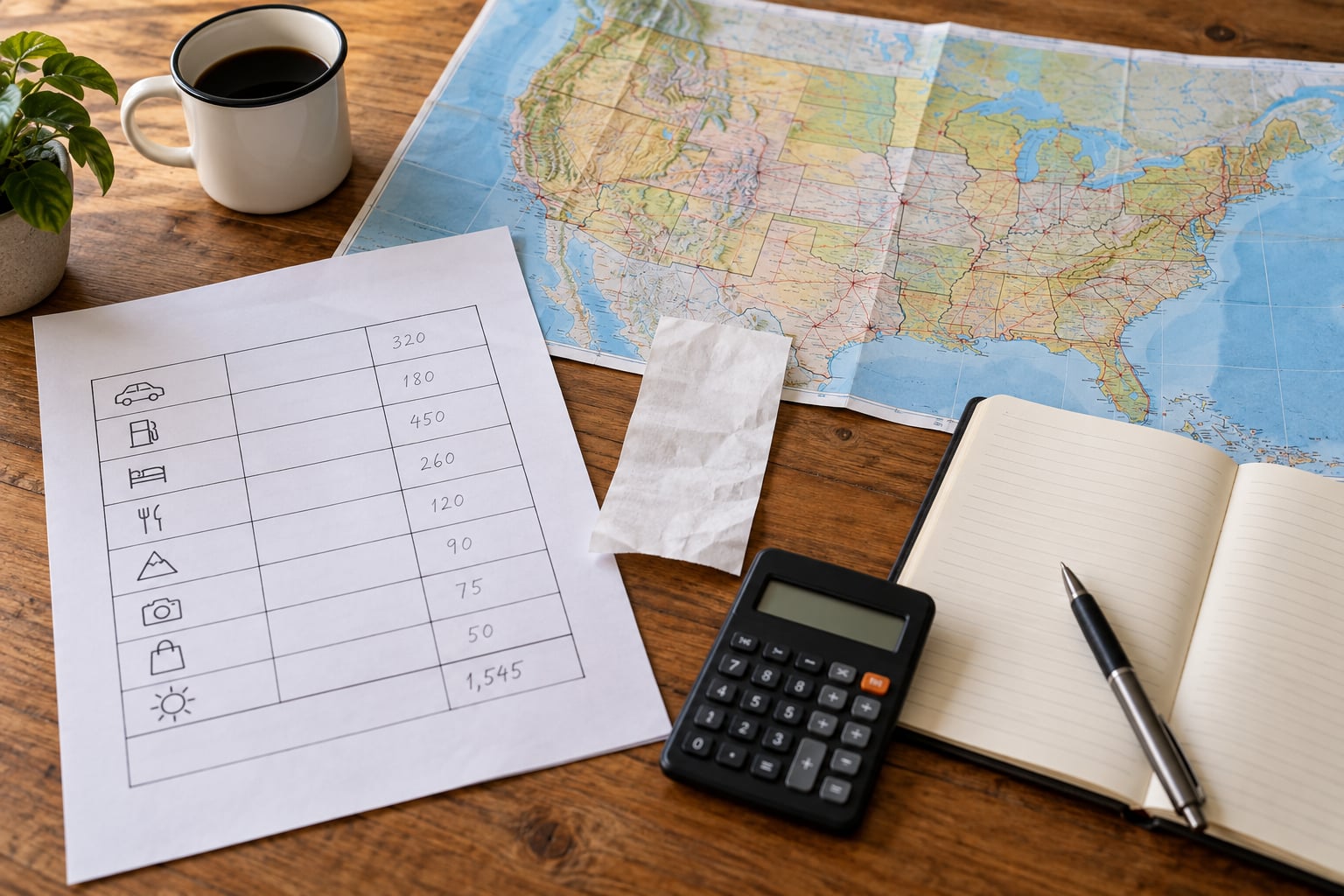
7. Track it as you go
One row per category, one column per day. Every night, write down what you actually spent. Budgets do not fail on the math — they fail because nobody noticed the drift until it was too late to route around it.
What Affects the Price
Distance. Fuel scales almost linearly with miles, and on a solo trip it is frequently the largest line in the budget. Nothing else moves the total as predictably.
Route. I-80 across Nebraska is cheap and dull; going up through the Rockies to Yellowstone is expensive in gas, tolls and mountain gas prices, and worth it for many people. Coastal routes add parking. Decide which extras are worth their cost per mile.
Season. Shoulder season — the weeks on either side of summer — cuts hotel rates meaningfully and thins out park crowds. Gas runs higher in some regions during summer driving season, and ski-country towns peak in winter.
Vehicle efficiency. A car getting 25 MPG versus 38 MPG on a 4,000-mile trip is the difference of roughly 165 dollars in fuel alone. It also changes how often you stop, which is where a lot of unplanned spending happens.
Lodging type. This is usually the biggest lever after fuel. Camping or a host network can take lodging from 70 dollars a night down to near zero; hotels in gateway towns can run double that.
Group size. A car costs the same whether one person or four is in it, so fuel and tolls per person fall sharply as the group grows. Lodging is different: a two-person room usually costs less per head than four separate rooms, but a two-bedroom suite or cottage is often the cheaper move for a family of four.
Sightseeing stops. Every extra stop adds fuel, a night somewhere and often an entrance fee. Two or three anchor destinations with a long drive between them is usually cheaper and less exhausting than twelve short stops.
Vehicle prep. Nobody budgets the car, and then the oil change, four tires, a spare, roadside assistance and insurance ride out of the same pot. Forum threads about cross-country budgets surface this as the most common surprise cost.
Ways to Save
Buy the annual park pass if you will visit five or more parks. At about 80 dollars it beats per-park entrance fees on almost any multi-week park route, and it removes a decision from the days you want to be making better ones.
Cook more than you think. Eating out every meal is the single line item travelers regret most often. A 12-volt fridge, a 20-dollar camp stove and one grocery stop per two or three days can cut the food line by a third or more.
Refuel on the way in, not the way out. Gas prices often sit a little higher in resort towns and thinner markets. Use GasBuddy before you pick a stop, and fill the tank at a tenth of a tank or less so you are never choosing a station on fumes.
Stay with people where you can. Host networks, friends and family, and swap arrangements for the expensive gateway-town nights. Staying two nights in one cheap town instead of two expensive towns on the same leg is an easy win.
Do the mileage math before you pick the car. On a 4,000-mile trip, fuel is about 12% of the budget at 35 MPG and about 18% at 25 MPG. A rental that costs more per day but delivers better MPG is sometimes the cheaper car for the whole trip.
Avoid peak-season park traffic. Shoulder season cuts hotel rates, campsite fees and the sheer number of people competing for the same parking spots.
Take free things. Public lands, free walking tours in downtowns, city tourism cards when they stack with hotel stays, junior ranger programs for kids, national park days when entry is waived, and just driving the scenic byway because it is already on the way.
Know what you cut first. When the budget slips — and it will — trim in this order: paid attractions, then a hotel night upgraded to a campsite, then one drive day by taking a shorter route. Never cut fuel or the buffer. Deciding this in advance takes the panic out of it.
Frequently Asked Questions
How much should I budget for a cross country road trip?
For a two-week trip across the US, budget roughly 3,100 to 3,900 dollars for two people sharing a car and hotel rooms, or about 150 to 200 dollars per person per day. Solo travelers camping and cooking can do a 3,000-mile trip for under 1,300 dollars. Add a 10 to 15% buffer on top of any figure here, and price gas for your actual route.
How much does a cross country road trip cost per day?
It depends on travel style more than distance. Camping, groceries and free sights run about 40 to 70 dollars per person per day. Hotels, a mix of restaurants and paid attractions put a comfortable trip at 135 to 200 dollars per person per day. Premium travel with upscale hotels and most meals out runs 280 to 400 dollars. Solo drivers should expect the fuel share to fall on them entirely.
Is 1000 dollars enough for a road trip?
For a one-way cross country drive, camping and cooking most meals, 1,000 dollars is tight but workable for a solo traveler in an efficient car. Fuel on 3,000 miles alone can eat 325 to 400 dollars of it. The same amount disappears in a week once hotels and three-meals-a-day restaurants are included. For two people or a week-plus trip, aim for double.
How much should I budget for food per day on a road trip?
Plan 20 to 25 dollars a day if you buy groceries, cook at least one meal and keep coffee cheap, and 40 to 50 dollars if you eat out once a day and assemble the rest from a cooler. Eating out three times runs 45 dollars before snacks and drinks. Cooking equipment and a small fridge are one-time costs that pay for themselves within the first week.
How do you split gas money with people you are traveling with?
Split fuel by miles driven rather than by head count, since that is what actually burns the money. Settle the tab weekly with a shared expense app so nobody keeps a mental tally for three weeks. Agree in advance that the person booking the hotel or rental puts it on one card and gets reimbursed by the group, then put the rule in writing before the first fill-up.
Start With the Route and the Fuel Line
Pick the route, count the miles, and run them through your car’s real highway MPG at the current average price per gallon. That one line tells you whether the trip fits your money before you have spent anything, and every other category is a smaller decision underneath it.
Then write down your nightly lodging rate and daily food rate, add park passes, tolls and vehicle prep, and reserve a buffer you will not touch. The numbers on this page are reasonable for 2026; check the current weekly gas average and park fees before you leave, because those two move the most between seasons.