How to keep kids entertained on a long car ride comes down to rotation, not one perfect activity. Mix no-supply games that use the passing scenery, one or two quiet hands-on things in a lap kit, and audio, then swap them out before boredom sets in. Total prep is about 20 minutes, and it works for the whole drive.
I’ve done six-hour stretches with a two-year-old and a nine-year-old in the back seat, and the trips that go well are the ones where nobody is waiting for a parent to perform. Kids self-serve from a bag, the scenery does some of the work, and the driver stays calm.
Table of Contents
- What You Need for a Long Car Ride With Kids
- Step-by-Step: How to Keep Kids Entertained on a Long Car Ride
- Common Mistakes That Ruin a Long Car Ride
- Frequently Asked Questions
- What is the best way to keep kids entertained on a long car ride?
- How long should kids watch screens during a road trip?
- What are good car games for children of different ages?
- How often should a family stop on a long drive with kids?
- What can I do if my child gets bored or cranky in the car?
- Are audiobooks and podcasts appropriate for young children?
- Conclusion
What You Need for a Long Car Ride With Kids
Gather five things before you turn the key, and skip everything else.
- Two or three activity options per child. One observation game, one quiet solo activity, one audio option. More than three and they spend the first hour choosing instead of playing.
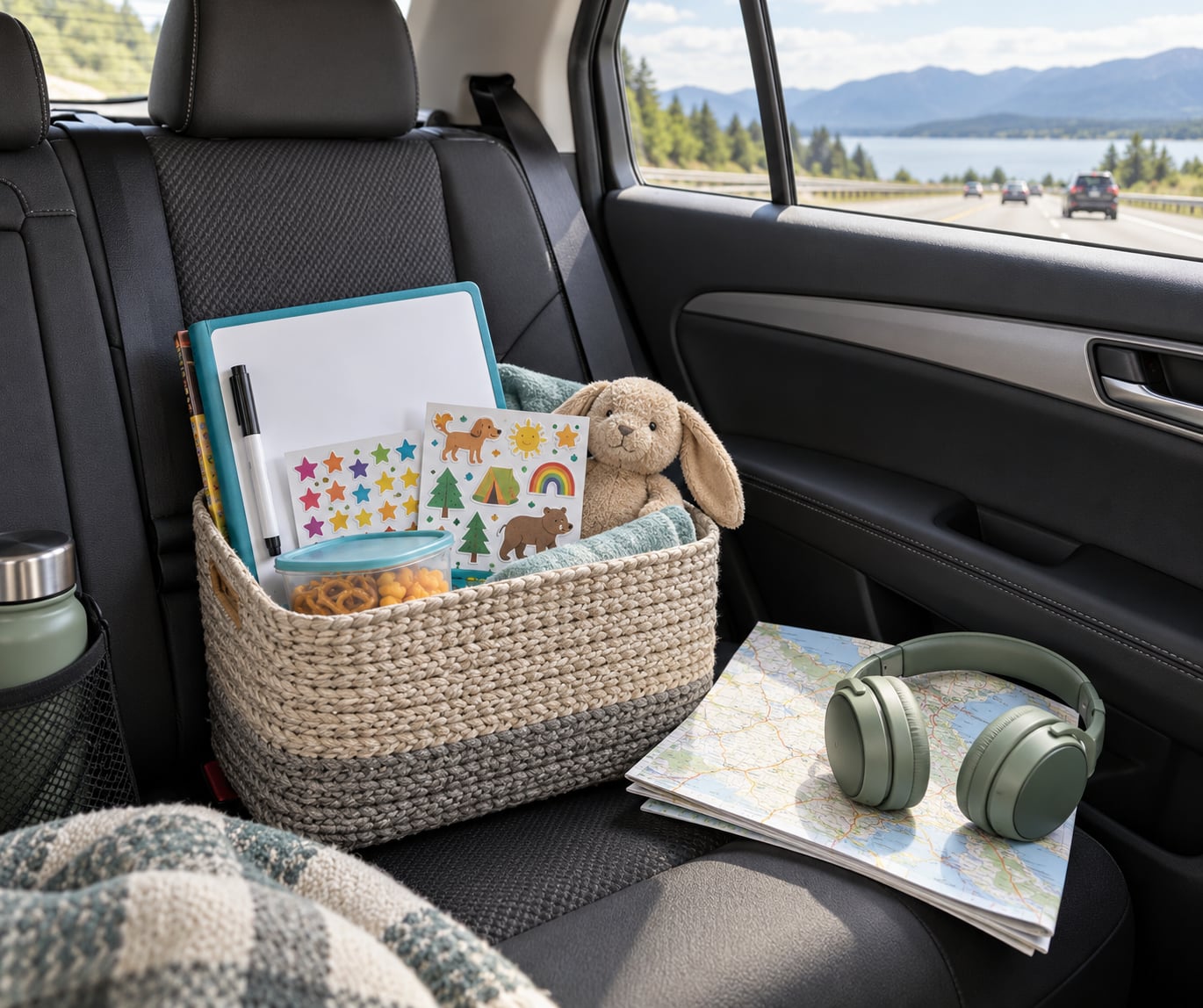
- A reachable bag per kid. A soft tote or a handled activity basket that sits in the footwell or beside them, not in the trunk. A front seat reaches kids best.
- Snacks staged in small portions. Crackers, dry cereal in a lidded cup, fruit pieces, a nut-butter packet. Hungry kids ask for entertainment constantly, and handing over food ends that request faster than any game.
- Downloads done at home. Audiobooks, a kid playlist, two episodes of a show. Reception drops constantly in rural stretches and nobody wants to explain buffering to a five-year-old.
- A break plan and a progress method. Put the first planned stop on the navigation before you leave, and mark out three or four milestones on a paper map. Seeing minutes remaining does more for the are-we-there-yet loop than any toy.
Add a trash bag for wrappers, a change of clothes for the child who will inevitably spill, and a blanket if anyone sleeps. That’s the kit.
Step-by-Step: How to Keep Kids Entertained on a Long Car Ride
Set Up a simple ride menu before you leave
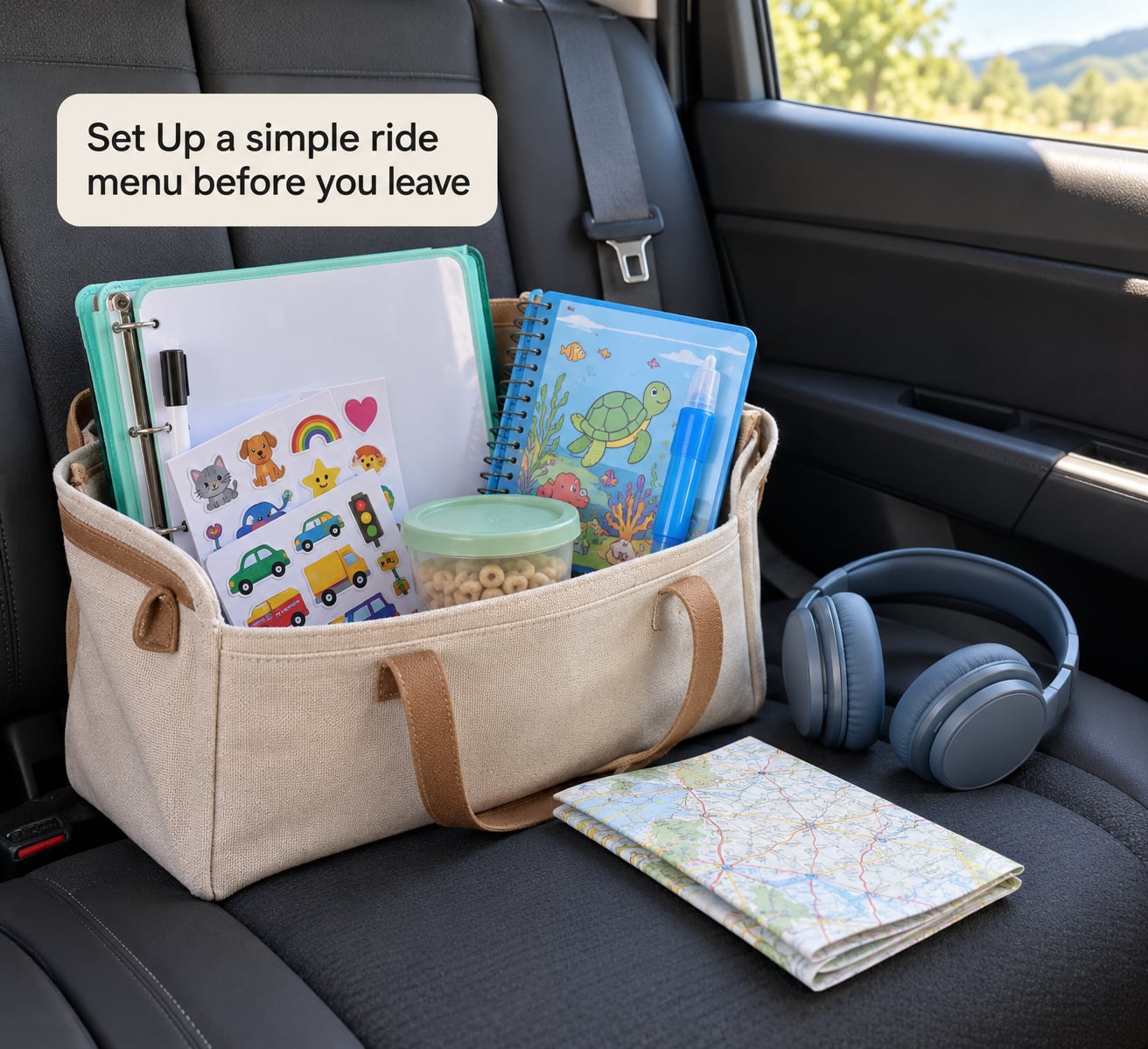
Offer three to five options and let kids pick the first one. Choice is what makes the activity work, because a kid who chose it argues with it far less.
For a preschooler, three choices is plenty: a game, a drawing thing, and a story. For a tween, add one adult-free option like a downloaded puzzle app or a photography scavenger hunt that uses their own phone camera. Write the menu on an index card so nobody has to remember the list out loud.
Here is the short version, with prep time and mess level worked out so you can build a menu in a few minutes:
- I Spy and scavenger hunt — ages 3 and up, screen-free, zero prep, zero mess.
- 20 Questions — ages 5 and up, screen-free, zero prep, zero mess.
- License plate game — ages 6 and up, screen-free, zero prep, zero mess.
- Audiobook or kid podcast — ages 4 and up, screen-free, about 10 minutes of downloading at home, no mess.
- Dry-erase binder pages — ages 3 and up, screen-free, 5 minutes of setup, no mess.
- Water pens and reusable books — ages 2 and up, screen-free, zero prep, no mess.
- Sticker books and simple puzzles — ages 2 to 6, screen-free, zero prep, no mess.
- Screen time — ages 4 and up, needs a device, about 10 minutes of downloading at home, no mess.
- Quiet time with a blanket — all ages, screen-free, zero prep, no mess.
Use short, rotating activity blocks
Block length should match attention span, roughly one to three minutes per year of age. That’s about 15 minutes for a five-year-old and 30 for a ten-year-old, which sounds short until you notice it means four to eight swaps across a six-hour drive.
Change things before the child asks. If someone is on the third I Spy round and starting to whine about the answers, hand over the next item yourself rather than waiting for the request. Parents on parenting forums describe the swap as the single biggest difference between a calm back seat and an argument.
Build in movement and snack breaks
Plan a real stop every two to three hours, and pick the location before departure. A town with a playground, a basketball court, or a fast-food place with a play area beats a rest area with a vending machine.
Advice that keeps coming up on parenting forums is splitting a four-hour drive in two rather than pushing through. Fifteen minutes of running around resets a kid far better than any activity, and it gives the driver a break too.
Watch the clock on the late afternoon. A drive that runs from 2 p.m. to 7 p.m. lands every child in their worst hour with nothing to burn energy on. Either start earlier or plan the longest audio stretch for that window.
Make audio time more interactive
Audio works best when kids are given a job alongside it. During an audiobook, have them draw a picture of what you just described. During a song, hand over the lookout duty: they call out bridges, tunnels, farm equipment, and semi trucks.
Guessing games fit straight into audio. Ask one odd question at a time, such as whether an elephant weighs more than a car or a fridge. The answers don’t matter. What matters is that the kid is talking instead of asking when you’ll arrive.
For young children, check whether your public library offers a card that works as an app. That’s the cheapest audio library available and the titles go well past what a streaming trial includes.
Use screens without letting them take over
Screens are a tool, not a verdict. Two hours of a tablet on a six-hour drive is a reasonable deal for most families, and the guilt is usually unnecessary.
Set the start, not just the limit. Say one show now and one after the first stop, so the ending is a milestone instead of a negotiation. Download everything at home, charge the device fully, and prop it somewhere out of reach at turn time rather than handing it over again.
Have a fallback ready for when it ends early. A scavenger hunt, a snack, or a change of driver works better than another screen.
How to keep kids entertained on a long car ride at every age
Toddlers under two need faces and motion more than toys. Songs with hand motions, peekaboo through the seat, and a small basket of sensory toys buy you twenty minutes at a stretch. Skip anything with loose small pieces and skip anything tiny enough to vanish into the seat crack.
Preschoolers from three to five do well with I Spy, sticker books, water pens, and a lap desk. They also do well with being asked to spot things, which turns a boring highway into a treasure hunt.
School-age kids from six to nine want games with rules and a winner: 20 Questions, the license plate game, road trip bingo, guessing games about states or animals. Many public libraries have road atlas books for kids, and coloring between towns works fine as long as they are not prone to motion sickness.
Tweens from ten to thirteen are the hardest group because anything that feels babyish gets rejected on sight. Give them responsibility instead: they choose the music, they navigate, they keep the snack list, they shoot their own scenery scavenger hunt with a phone. Responsibility reads as respect, and it lasts hours.
Adapt for temperament as much as age. Shy kids want quiet options they control. Sensory-sensitive kids need fewer surprises and a predictable rotation. Easily bored kids need novelty more than depth, so bring more pieces rather than better ones.
For motion-sensitive children, this matters more than anything else on the list. Skip reading, close-up puzzles, and drawing while the car is moving, since all three fix the eyes on a still object. Point them at the horizon, open a window, keep the vent aimed at the face, and offer crackers. The best car-sick activities are I Spy, license plates, and talking about scenery, all of which use distance vision.
Create a calm travel kit
One basket per child, filled at home, reachable from the seat. Fill it with sealed, mess-free, screen-free options: a dry-erase binder with page protectors, a water pen book, sticker pages, a couple of few-piece games that will not disappear into the upholstery, and a snack container.
Keep a second reserve bag in the front seat. That bag holds the novelty items and the special snacks, and handing something over from it buys you a genuinely good stretch of quiet. Parents who use this pacing trick report the back seat settles noticeably faster.
Two rules keep the kit working. Nothing small enough to lose and nothing wet. Crayons melt into upholstery in a hot car, marker caps come off and stain everything, and a lost puzzle piece turns into a forty-minute search at the worst possible moment.
Common Mistakes That Ruin a Long Car Ride
Packing twenty activities for a five-hour drive. Too much choice is its own problem, because kids browse instead of playing. Bring a small menu and hold the rest back.
Scheduling every minute of the drive. Routines break the moment traffic adds forty minutes. Plan the shape of the ride, not the exact minutes.
Saying no to food for hours. A bored child is often a hungry child. Stage snacks instead of banning them.
Relying on screens alone. A child who finishes the download has nowhere to go, and hour three is worse than hour one. Pair screen time with at least one screen-free option that lasts the same length.
Skipping the transition. Never end an activity cold. A five-minute warning before a swap prevents most back-seat fights.
Ignoring sibling dynamics. Two kids with identical kits fight over identical things. Give each child a different kit, set one rule about sharing, and give them a shared job like choosing the next song.
Use a flexible entertainment plan
Let the kids rotate between activities freely within the menu. Make the whole family part of it, with singalong stretches and shared guessing games that include the driver.
Use the scenery instead of ignoring it. Name landmarks, comment on weather, count trucks in different colors, and look for the biggest bridge of the trip. These cost nothing and they work because the entertainment is actually leaving the window.
Let kids record a voice memo or a short video at each stop for a trip journal, which gives them something to look forward to making. And accept quiet as a legitimate part of the ride. Calm silence at hour four is a win, not a failure.
Frequently Asked Questions
What is the best way to keep kids entertained on a long car ride?
Combine three things and rotate between them: no-supply games that use the scenery, quiet hands-on activities in a lap kit, and audio such as audiobooks or a kid playlist. Offer three to five options per child and let them pick the first one, then swap activities every 15 to 30 minutes. The rotation matters more than any single game, because attention span runs roughly one to three minutes per year of age.
How long should kids watch screens during a road trip?
For a six-hour drive, about two hours of screen time is a reasonable amount for most families, and there is no need to feel guilty about it. The smarter move is to name when it starts rather than only setting a limit, so one show now and one after the first stop makes the ending feel like a milestone. Download everything at home, because reception drops in rural stretches.
What are good car games for children of different ages?
Preschoolers do well with I Spy, a scavenger hunt, sticker books and water pens. Six to nine year olds like games with rules and a winner: 20 Questions, the license plate game and road trip bingo. Tweens usually reject anything that feels babyish, so hand them a job instead, such as choosing the music, navigating, or running a scenery scavenger hunt with their own phone.
How often should a family stop on a long drive with kids?
Plan a real stop every two to three hours, and choose the location before you leave. A town with a playground or a fast-food place with a play area works far better than a rest area. Fifteen minutes of movement resets a kid more effectively than any activity in the car, and splitting a four-hour drive in two is usually easier on everyone than pushing straight through.
What can I do if my child gets bored or cranky in the car?
Swap activities yourself before the request comes, hand over a staged snack, and change the scenery by pulling over somewhere new. Boredom often means hunger, a long unbroken stretch, or a transition that came without warning. Keep a small front seat reserve bag for exactly these moments, since handing over something special buys a genuinely long stretch of quiet.
Are audiobooks and podcasts appropriate for young children?
Audiobooks suit early readers especially well, since listening and reading the same story builds vocabulary. Picture books work as read-along audio for this age group. For podcasts, pick short episodes with a clear story arc and end on a cliffhanger, and avoid shows built for adults. Check whether your public library offers an app-based card, which often has the widest selection.
Conclusion
Start with the ride menu, not the toy box. Pick two or three activities per child, pack one quiet option and one audio option each, stage the snacks, and set the first break into your navigation before you leave.
Then rotate on a schedule rather than on requests. Fifteen minutes for a five-year-old, thirty for a ten-year-old, and one unplanned stop every two to three hours. That is the whole system, and it works on every drive.